
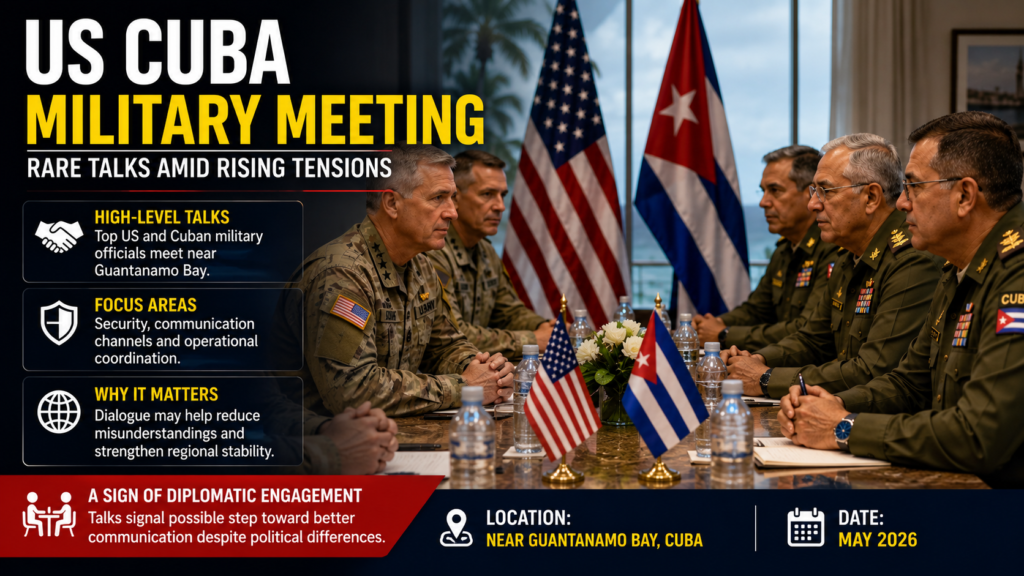
US Cuba Military Meeting has emerged as one of the most closely watched geopolitical developments in the Americas after senior military officials from the United States and Cuba held rare discussions near Guantanamo Bay. The unexpected engagement comes at a time when relations between the two countries remain complicated by political disagreements, security concerns, and broader regional tensions.
The meeting has sparked intense speculation among analysts who are asking a crucial question: Why are military leaders from two long-time rivals talking now?
While details of the discussions remain limited, experts believe the talks could have significant implications for regional stability, military communication, and future diplomatic engagement.
Advertisement

Also Read :- Chandrayaan 2 Moon Ice Discovery: New Evidence Suggests Water Ice Beneath Lunar South Pole
US Cuba Military Meeting Marks a Rare Diplomatic Moment
The US Cuba Military Meeting stands out because direct military interactions between the two countries are relatively uncommon.
According to reports, senior military officials met near the Guantanamo Bay region, a location that has long symbolized the complex relationship between Washington and Havana. The discussions reportedly focused on issues of mutual concern, including operational coordination, security matters, and communication channels.
Observers note that even limited military dialogue can play an important role in reducing misunderstandings and preventing unintended incidents.
The fact that the meeting took place despite ongoing political differences has attracted significant international attention.
Advertisement

Why the Timing of the Meeting Is Raising Questions
One reason the US Cuba Military Meeting is generating headlines is its timing.
The talks occurred amid increasing political tensions and renewed debates surrounding US-Cuba relations. Analysts believe both sides may recognize the importance of maintaining direct communication, particularly when regional security concerns continue to evolve.
Military-to-military engagement often serves as a practical mechanism for addressing operational issues even when broader diplomatic relations remain strained.
This has led many experts to view the meeting as a strategic effort to preserve stability during a period of uncertainty.
Guantanamo Bay Remains at the Center of Attention
The location of the US Cuba Military Meeting has added another layer of significance.
Guantanamo Bay has been a focal point in US-Cuba relations for decades. As a result, any high-level interaction in the region naturally attracts global interest.
Security experts suggest that maintaining communication around the area is important for operational safety and crisis management. Even limited cooperation can help ensure that activities conducted near the region remain transparent and predictable.
The meeting demonstrates that practical concerns can sometimes create opportunities for dialogue despite broader political disagreements.
US Cuba Military Meeting Could Reduce Security Risks
Another important aspect of the US Cuba Military Meeting is its potential role in reducing security risks.
Military officials often emphasize the importance of communication channels during periods of geopolitical tension. Direct engagement can help prevent misunderstandings, improve coordination, and establish procedures for handling unexpected situations.
Analysts point out that communication between military organizations is frequently used around the world as a confidence-building measure.
While the meeting does not necessarily indicate a major policy shift, it could contribute to greater predictability in future interactions between the two countries.
International Observers Closely Monitoring Developments
The US Cuba Military Meeting is being closely watched by governments, security analysts, and regional organizations.
Many observers are interested in whether the discussions represent a one-time engagement or the beginning of a broader effort to improve communication mechanisms.
The outcome could influence future conversations on regional security, migration concerns, maritime coordination, and emergency response cooperation.
Although no major agreements have been publicly announced, the mere fact that the talks occurred has already become a significant development in regional diplomacy.
What Happens Next?
Following the US Cuba Military Meeting, attention is now shifting toward possible follow-up engagements.
Experts caution that a single meeting does not automatically signal improved political relations. However, continued communication could help create a more stable environment for addressing shared concerns.
Future interactions will likely determine whether this rare military dialogue develops into a sustained channel for cooperation or remains an isolated event.
For now, policymakers and analysts around the world are carefully evaluating the broader implications of the discussions.