
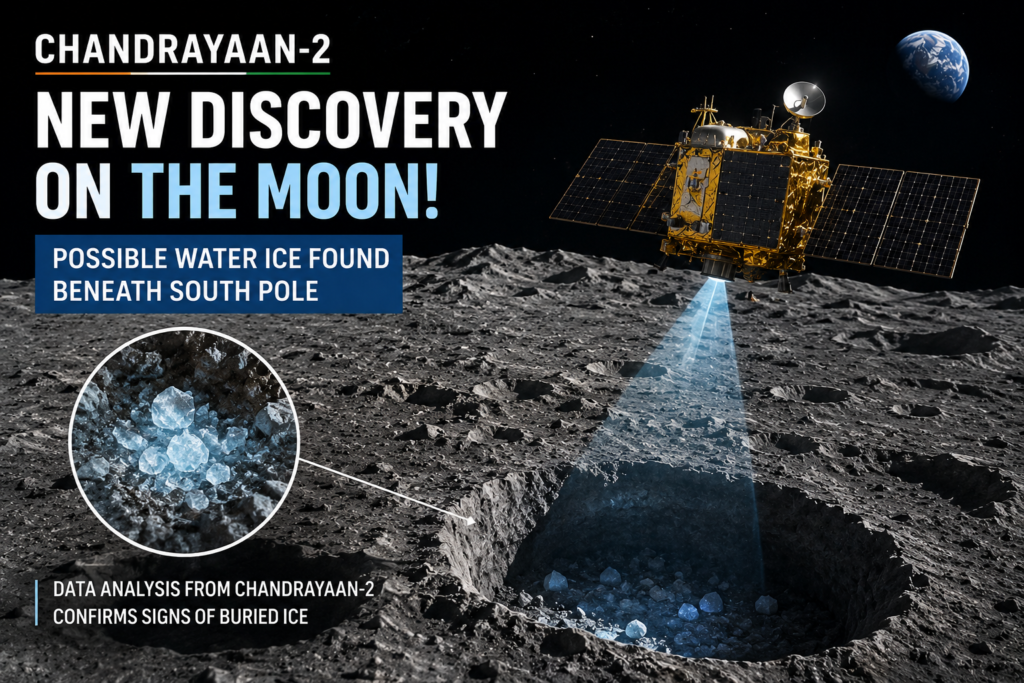
Chandrayaan 2 Moon Ice Discovery is generating excitement across the global scientific community after researchers identified strong indications of water ice buried beneath the Moon’s south polar region. The findings, based on data collected by India’s Chandrayaan-2 mission, could significantly influence future lunar exploration and long-term plans for human presence on the Moon.
Scientists have long suspected that water ice may exist in permanently shadowed regions near the lunar poles. However, the latest analysis is providing fresh clues that hidden reserves could be more widespread than previously believed.
The discovery is raising an intriguing question: Could the Moon possess enough accessible water resources to support future missions?
Advertisement

Also Read :- Norway Chess 2026: Praggnanandhaa Creates Sensation with Victory Over Magnus Carlsen
Chandrayaan 2 Moon Ice Discovery Reveals Hidden Potential Beneath the Surface
The Chandrayaan 2 Moon Ice Discovery focuses on the Moon’s south polar region, one of the most scientifically important locations in the solar system.
Researchers analyzed observations gathered by Chandrayaan-2’s instruments and identified conditions favorable for the accumulation and preservation of water ice beneath the lunar surface. The study suggests that cold and permanently shadowed craters may contain buried ice deposits that have survived for billions of years.
Unlike areas exposed to direct sunlight, these shadowed regions remain extremely cold, creating natural reservoirs where water molecules can remain trapped over long periods.
This finding is attracting attention because water is considered one of the most valuable resources for future space exploration.
Advertisement

Why Scientists Are Excited About the Discovery
The significance of the Chandrayaan 2 Moon Ice Discovery extends far beyond scientific curiosity.
Water on the Moon can potentially be used for drinking, oxygen production, and even rocket fuel generation through the separation of hydrogen and oxygen. This means future astronauts may not need to transport all essential resources from Earth.
Experts believe lunar water could help establish sustainable bases on the Moon while supporting deeper missions into space.
The possibility of locally available resources could dramatically reduce mission costs and improve the feasibility of long-duration exploration programs.
Chandrayaan 2 Moon Ice Discovery Strengthens India’s Space Achievements
The Chandrayaan 2 Moon Ice Discovery is another major milestone for India’s space program.
Although Chandrayaan-2’s lander did not achieve a successful soft landing in 2019, the mission’s orbiter has continued to deliver valuable scientific data. Over the years, the spacecraft has provided detailed information about the Moon’s surface, mineral composition, and environmental conditions.
The latest findings demonstrate the long-term scientific value of the mission and highlight the capabilities of Indian space research.
Scientists worldwide continue to utilize Chandrayaan-2 data for new lunar studies and discoveries.
How Water Ice Could Change Future Moon Missions
One reason the Chandrayaan 2 Moon Ice Discovery is attracting global interest is its potential impact on future exploration strategies.
Space agencies are increasingly focusing on the lunar south pole because of its unique environment and resource potential. NASA’s Artemis program and several international lunar initiatives are targeting this region for future missions.
If significant quantities of water ice are confirmed, mission planners could develop infrastructure designed around local resource utilization.
This would mark a major shift from traditional exploration models that depend heavily on supplies launched from Earth.
The South Pole Remains a Scientific Treasure
The Chandrayaan 2 Moon Ice Discovery further reinforces the importance of the Moon’s south pole as a prime destination for research.
Scientists believe the region may preserve valuable records of the Moon’s geological history and the evolution of the solar system. The presence of potential water ice adds another layer of scientific importance.
Future robotic and human missions are expected to investigate these areas more closely to determine the quantity, depth, and accessibility of the ice deposits.
Every new finding is helping researchers build a clearer understanding of Earth’s closest celestial neighbor.