
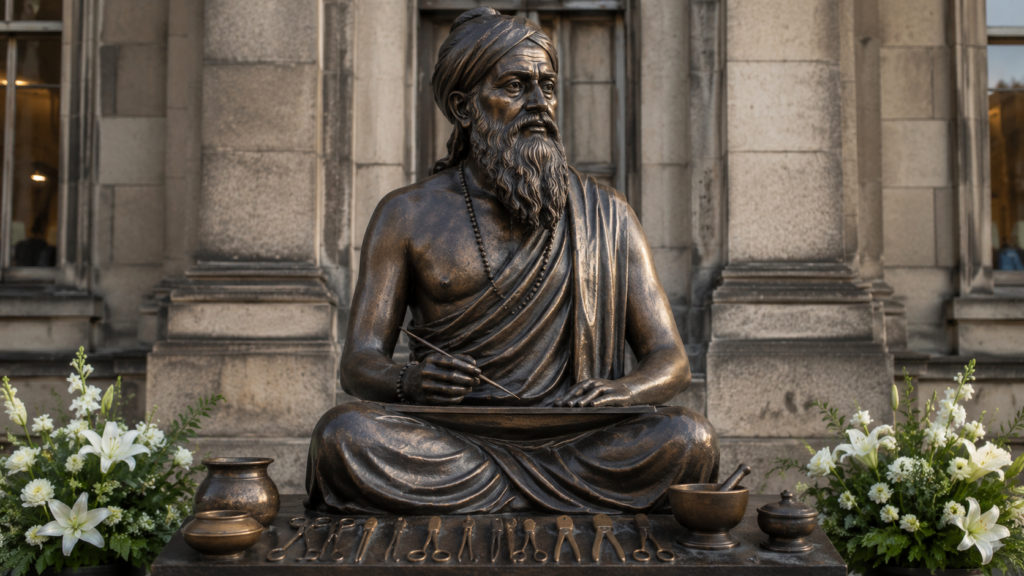
Sushruta Statue Unveiled in Edinburgh has become a landmark moment in the recognition of India’s contribution to global medicine. The Royal College of Surgeons of Edinburgh (RCSEd), one of the world’s oldest surgical institutions, unveiled a statue of the ancient Indian physician Sushruta, acknowledging his pioneering role in the history of surgery.
The event highlights the growing international appreciation of India’s ancient scientific achievements and places Sushruta among the most respected figures in global medical history.
Advertisement

Also Read :- Lucknow Coaching Centre Fire: 15 Students Dead After Blaze Engulfs Aliganj Coaching Building
Sushruta Statue Unveiled in Edinburgh Recognises the Father of Surgery
- The statue was unveiled at the Royal College of Surgeons of Edinburgh in Scotland.
- Sushruta is widely regarded as the Father of Surgery.
- He lived in ancient India and authored the Sushruta Samhita, one of the earliest known medical texts.
- The text documents surgical techniques, instruments, anatomy studies, and medical procedures.
- Medical historians consider his work foundational to the development of modern surgery.
The Sushruta Statue Unveiled in Edinburgh reflects the institution’s recognition of the lasting influence of ancient Indian medical knowledge.
Advertisement

Why Sushruta Continues to Influence Modern Medicine
- Sushruta described more than 300 surgical procedures.
- Historical records mention over 120 surgical instruments in his writings.
- His work included reconstructive surgery, fracture treatment, wound management, and anatomical observations.
- The Sushruta Samhita is regarded as one of the most comprehensive ancient medical documents.
Experts note that many principles outlined by Sushruta remain relevant to the evolution of surgical science.
Significance of the Edinburgh Recognition
- The Royal College of Surgeons of Edinburgh was established in 1505.
- It is among the most respected surgical institutions globally.
- The installation of the statue symbolizes international respect for India’s medical heritage.
- The honour highlights the contribution of non-Western civilizations to the advancement of healthcare and surgery.
The Sushruta Statue Unveiled in Edinburgh serves as a reminder that medical innovation has deep roots across different cultures and civilizations.
Why was Sushruta honoured in Edinburgh?
The Royal College of Surgeons of Edinburgh recognised Sushruta’s pioneering contributions to surgery and medical science, which continue to be studied by historians and healthcare professionals worldwide.
What is Sushruta best known for?
Sushruta is best known for authoring the Sushruta Samhita and for documenting advanced surgical techniques centuries before many similar developments appeared elsewhere.
Key Highlights of the Event
- Statue unveiled at the Royal College of Surgeons of Edinburgh.
- Recognition of Sushruta’s contribution to surgical science.
- Celebration of India’s ancient medical achievements.
- Global acknowledgement of the historical importance of the Sushruta Samhita.
- Strengthening awareness of medical knowledge developed in ancient India.
Important Facts About Sushruta
- Known as the Father of Surgery.
- Author of the Sushruta Samhita.
- Practiced medicine in ancient India.
- Documented surgical instruments and techniques.
- Recognised internationally for contributions to healthcare history.
The Sushruta Statue Unveiled in Edinburgh marks a significant milestone in the global recognition of India’s scientific and medical heritage. The honour not only celebrates an ancient physician but also acknowledges the enduring impact of Indian medical knowledge on the evolution of modern surgery.