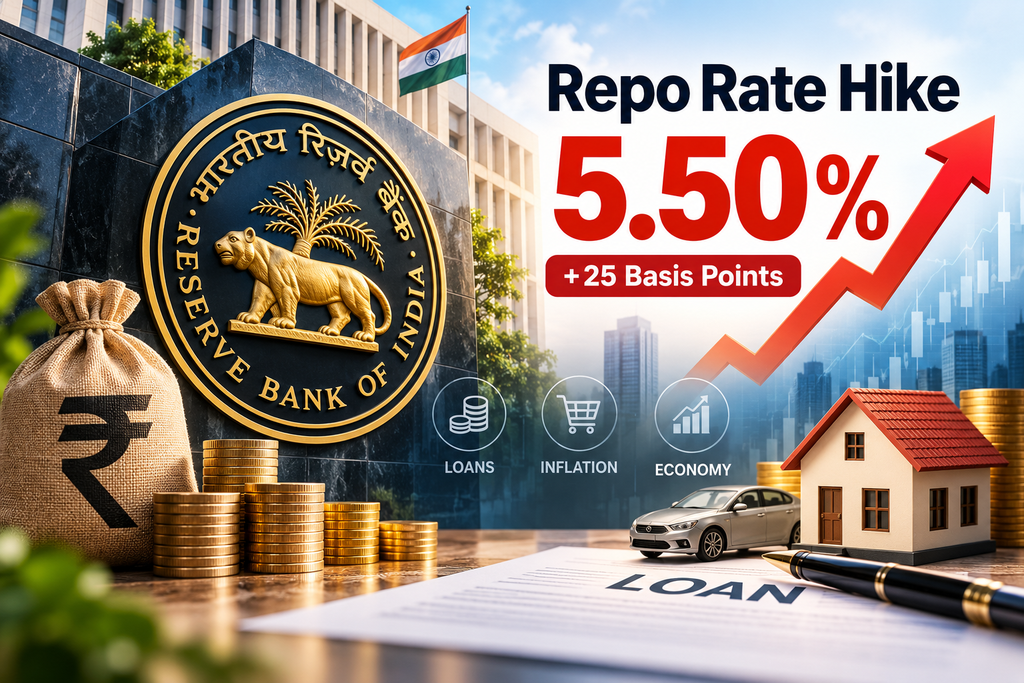
The Repo Rate has become an important topic after the Reserve Bank of India (RBI) announced a change in its key policy rate. On October 7, 2026, the RBI increased the repo rate by 25 basis points to 5.50%. This was the first increase in the benchmark rate in nearly four years.
The decision has attracted attention because changes in the repo rate can influence borrowing costs, bank lending rates, inflation and overall economic activity.
What Is the Repo Rate?
The Repo Rate is the rate at which the Reserve Bank of India lends short-term funds to commercial banks against eligible securities.
It is one of the major tools used by the central bank to manage liquidity and influence economic conditions. When the repo rate changes, banks can face changes in their own borrowing costs, which may eventually affect lending rates offered to customers.

Why Did RBI Increase the Repo Rate?
The latest rate decision comes at a time when inflationary pressures have been attracting attention. According to reports, India’s August consumer inflation reached 4.82%, remaining above the RBI’s 4% target for the third consecutive month. Rising oil prices and broader price pressures were among the factors influencing the policy environment.
The RBI also changed its policy stance from neutral to calibrated tightening, indicating a stronger focus on managing inflation while continuing to monitor economic growth.
Current Repo Rate in India
After the latest RBI decision, the Repo Rate stands at 5.50%.
The 25-basis-point increase represents a relatively measured move. However, its importance comes from the fact that it is the first repo rate hike in nearly four years.
How Can the Repo Rate Affect Loans?
Changes in the policy rate can influence the interest rates offered by banks and other financial institutions.
If lending rates increase, new borrowers may face higher interest costs. Existing borrowers with loans linked to floating or external benchmark rates may also see changes in their borrowing costs, depending on how their lender passes on the policy change.
The actual impact can vary between banks, loan products and individual lending arrangements.
Impact on Inflation
One of the key purposes of monetary tightening is to help control inflationary pressure.
Higher interest rates can make borrowing more expensive and may reduce demand for credit. Over time, this can help moderate demand in the economy. The RBI’s latest move comes as policymakers continue to focus on inflation while also considering the country’s growth outlook.
Also visit us: Triumph Bonneville T40: A New Classic Roadster With Modern Performance
Impact on Banks and Businesses
The repo rate can also influence the banking and business environment. Changes in borrowing costs may affect businesses that depend on loans for expansion, working capital or other financial requirements.
Banks, meanwhile, need to balance deposit rates, lending rates and overall liquidity conditions as monetary policy changes.
Rate-sensitive sectors can therefore pay close attention to RBI policy decisions because changes in borrowing costs can influence business expectations and financial conditions.
What Does the Latest Decision Mean for the Economy?
The latest Repo Rate decision highlights the RBI’s focus on maintaining price stability while keeping an eye on economic growth.
India’s economic growth remains relatively strong, but inflation, energy prices and global economic developments continue to create uncertainty. The RBI’s calibrated approach suggests that future policy decisions will depend heavily on incoming economic data and changing conditions.
Final Thoughts
The latest Repo Rate hike is an important development for India’s financial and economic environment. The RBI has raised the rate by 25 basis points to 5.50%, marking its first increase in nearly four years.
For consumers, businesses and financial markets, the key area to watch will be how banks respond to the policy change and how inflation and economic growth develop in the coming months.