
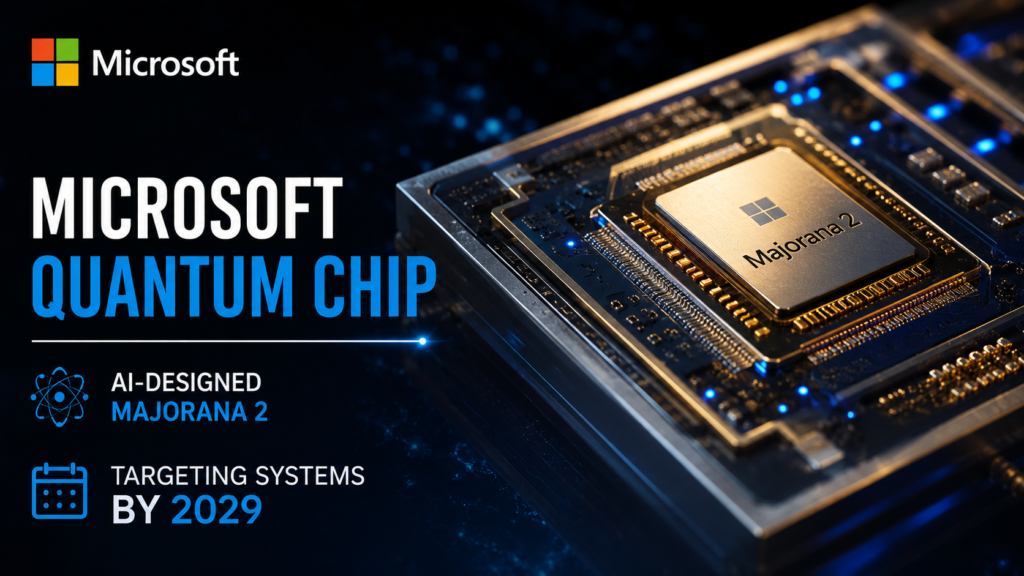
Microsoft Quantum Chip technology is once again capturing global attention after the tech giant unveiled significant progress in its quantum computing ambitions. The company has revealed new details about its AI-assisted quantum chip development, highlighting how advanced artificial intelligence is accelerating the path toward practical quantum systems.
The announcement has sparked excitement throughout the technology industry because quantum computing is widely considered one of the most transformative innovations of the modern era. While traditional computers continue to become faster, quantum machines promise to solve problems that today’s most powerful supercomputers would struggle to handle.
Microsoft believes its latest advancements could bring the world closer to commercially useful quantum systems, with the company targeting major milestones before the end of the decade.
As competition intensifies among global technology leaders, Microsoft’s latest breakthrough is positioning the company at the center of the next computing revolution.
Advertisement

Also Read :- Trump AI Executive Order Reshapes Federal AI Policy and Ignites National Debate
Microsoft Quantum Chip Development Accelerates With AI Assistance
The Microsoft Quantum Chip project represents years of research focused on creating a new foundation for quantum computing.
Unlike conventional computers that process information using binary bits, quantum computers rely on quantum bits, commonly known as qubits. These qubits can exist in multiple states simultaneously, enabling quantum machines to perform certain calculations at extraordinary speeds.
Microsoft has increasingly incorporated artificial intelligence into the design and development process. By using AI tools to analyze materials, optimize designs, and identify potential breakthroughs, researchers can accelerate discoveries that would otherwise take years.
Company executives believe the combination of quantum science and artificial intelligence could dramatically shorten development timelines.
This strategy reflects a broader industry trend in which AI is becoming a critical tool for scientific innovation.
Advertisement

Majorana 2 Chip Becomes the Centerpiece of Microsoft’s Quantum Vision
At the heart of the latest announcement is Microsoft’s Majorana 2 quantum chip.
The processor is based on years of research into topological quantum computing, a unique approach that aims to create more stable and reliable qubits. Stability remains one of the biggest challenges in quantum computing because quantum states are extremely sensitive to environmental disturbances.
Microsoft’s researchers have focused on developing topological qubits that could potentially reduce error rates and improve scalability.
The Majorana 2 architecture is designed to support future quantum systems capable of handling increasingly complex computational workloads.
Industry analysts view this development as an important step because error correction and scalability remain among the largest obstacles preventing widespread quantum adoption.
The company’s latest progress suggests it is moving closer to addressing these long-standing challenges.
Why Quantum Computing Could Change Entire Industries
The excitement surrounding the Microsoft Quantum Chip extends far beyond the technology sector.
Quantum computing has the potential to transform industries including healthcare, pharmaceuticals, manufacturing, cybersecurity, logistics, finance, and energy.
Researchers believe quantum systems could accelerate drug discovery by simulating molecular interactions with unprecedented precision.
Financial institutions may eventually use quantum algorithms to optimize investment strategies and manage complex risk calculations.
Manufacturers could improve supply chain operations, while energy companies might discover more efficient materials for batteries and renewable technologies.
These possibilities explain why governments and corporations worldwide are investing billions of dollars into quantum research.
The race to achieve practical quantum computing has become one of the most significant technological competitions of the 21st century.
Microsoft Targets Powerful Quantum Systems by 2029
One of the most closely watched aspects of the announcement is Microsoft’s timeline.
The company has indicated that it aims to achieve major quantum computing capabilities by 2029. This ambitious goal reflects growing confidence in the progress being made across multiple areas of quantum research.
Developing large-scale quantum systems requires advancements in hardware, software, error correction, materials science, and infrastructure.
Microsoft’s leadership believes that recent breakthroughs, combined with AI-assisted development methods, are helping overcome barriers that once appeared nearly impossible.
The company’s roadmap has attracted attention from investors, researchers, and enterprise customers eager to understand when practical quantum applications may become available.
While experts caution that significant challenges remain, Microsoft’s confidence is fueling renewed optimism throughout the industry.
Artificial Intelligence and Quantum Computing Form a Powerful Partnership
One of the most fascinating elements of the announcement is the growing relationship between AI and quantum computing.
Artificial intelligence is helping researchers identify new materials, simulate experiments, and optimize chip designs at unprecedented speeds.
At the same time, future quantum computers could potentially enhance AI capabilities by solving optimization and machine-learning challenges more efficiently.
This creates a powerful feedback loop in which AI accelerates quantum development, while quantum computing may eventually unlock more advanced AI systems.
Many experts believe the convergence of these technologies could define the next generation of scientific and technological progress.
The Microsoft Quantum Chip initiative demonstrates how these fields are increasingly interconnected.
As both technologies mature, their combined impact could reshape industries and economies worldwide.
Competition in the Global Quantum Computing Race Intensifies
Microsoft is not alone in pursuing quantum breakthroughs.
Major technology companies, research institutions, and governments are investing heavily in quantum computing initiatives.
Organizations including IBM, Google, Amazon, Intel, and numerous startups continue competing to develop scalable and commercially viable quantum systems.
This intense competition is accelerating innovation across the sector.
Each new breakthrough brings researchers closer to achieving quantum advantage—the point at which quantum computers outperform classical systems on meaningful real-world tasks.
Microsoft’s latest announcement strengthens its position within this highly competitive landscape.
The company’s emphasis on topological quantum computing distinguishes its strategy from many competitors and could provide unique advantages if successful.
Microsoft Quantum Chip Could Shape the Future of Technology
The Microsoft Quantum Chip announcement represents more than a hardware upgrade. It highlights a broader vision for the future of computing.
By combining advanced quantum research with artificial intelligence-driven innovation, Microsoft is pursuing technologies that could redefine how complex problems are solved.
Although practical quantum computing remains a developing field, recent progress suggests that transformative breakthroughs may arrive sooner than many experts previously expected.
The road ahead still includes significant scientific and engineering challenges. Yet Microsoft’s confidence in its roadmap and the unveiling of Majorana 2 indicate meaningful momentum.
As the world watches the evolution of quantum computing, one thing is becoming increasingly clear: the next revolution in technology may not be powered by faster traditional processors but by entirely new forms of computation.
And if Microsoft’s ambitions become reality, 2029 could mark the beginning of a new chapter in computing history.