
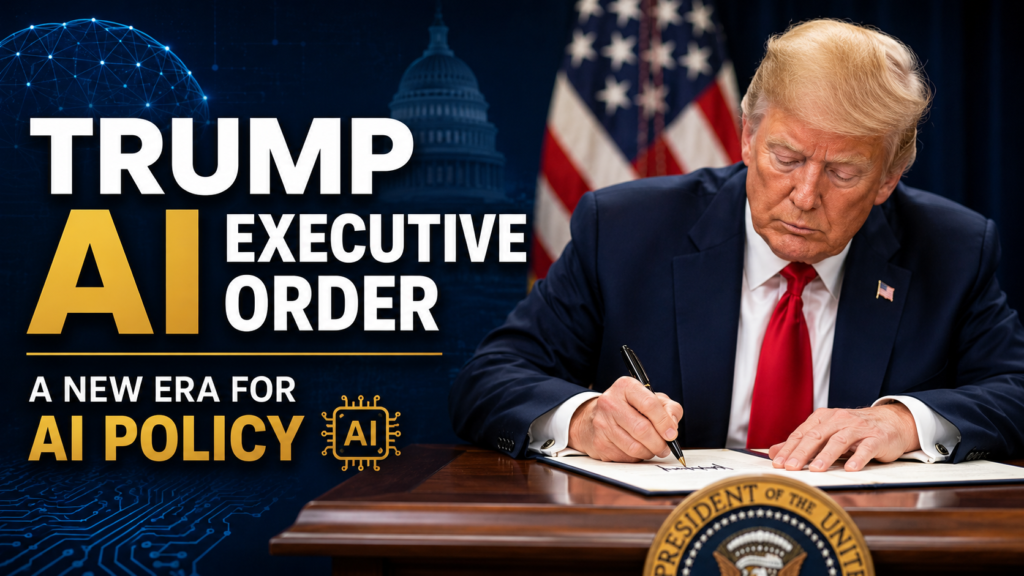
Trump AI Executive Order is rapidly becoming one of the most discussed technology policy developments in the United States. The newly announced directive introduces a significant shift in how the federal government approaches artificial intelligence, creating fresh conversations about innovation, national competitiveness, government oversight, and AI safety.
As artificial intelligence continues transforming industries, workplaces, education, healthcare, and national security, policymakers are facing increasing pressure to determine how these powerful technologies should be governed. The latest executive action signals a new direction that could influence both government agencies and private technology companies for years to come.
Supporters view the move as an effort to accelerate American leadership in artificial intelligence. Critics, however, argue that reducing certain safety-focused requirements could create new challenges as AI systems become more powerful and widely deployed.
Advertisement

Also Read :- Trump Iran Israel Conflict 2026: Could Diplomacy Prevent A New Middle East Crisis?
Trump AI Executive Order Signals a Major Policy Shift
The Trump AI Executive Order marks a notable departure from previous federal approaches to artificial intelligence governance.
The order places strong emphasis on promoting innovation, expanding AI adoption across government agencies, and ensuring that the United States remains competitive in the global technology race. Officials supporting the directive argue that excessive regulatory barriers could slow technological progress and weaken America’s position against international competitors.
Under the new framework, federal agencies are expected to review existing AI-related policies and align their strategies with goals that prioritize efficiency, innovation, and technological advancement.
The administration has presented the order as a response to rapidly evolving AI capabilities that are transforming nearly every sector of the economy.
As governments worldwide race to establish artificial intelligence policies, the United States is seeking to balance economic growth with responsible technology development.
Advertisement

Federal Agencies Face New Artificial Intelligence Requirements
One of the most significant aspects of the policy involves how federal agencies evaluate and deploy AI systems.
Government departments increasingly rely on artificial intelligence tools to improve operations, analyze data, automate tasks, and support decision-making processes. The executive order seeks to streamline the adoption of these technologies while reducing administrative obstacles that some policymakers believe have slowed implementation.
The directive encourages agencies to focus on practical AI deployment strategies and measurable outcomes.
Officials argue that modernizing government systems with advanced artificial intelligence could improve efficiency, reduce costs, and enhance public services.
At the same time, experts note that government use of AI requires careful oversight to ensure accuracy, transparency, and accountability.
The debate surrounding these competing priorities continues to intensify.
AI Safety Standards Become a Central Point of Discussion
The announcement has generated significant attention because of its implications for AI safety policies.
Artificial intelligence safety has become one of the most important issues in technology governance. Researchers, industry leaders, and policymakers have repeatedly warned about risks associated with advanced AI systems, including misinformation, bias, cybersecurity threats, and unintended consequences.
Some experts believe previous federal initiatives placed greater emphasis on safety assessments and risk management procedures.
The Trump AI Executive Order has prompted discussions about whether innovation-focused policies should be accompanied by stronger safeguards.
Supporters of the order argue that excessive caution could limit technological breakthroughs and discourage investment.
Critics counter that powerful AI systems require comprehensive oversight as capabilities continue expanding at unprecedented speed.
The conversation reflects a broader global challenge facing governments worldwide.
Trump AI Executive Order Highlights Global Competition
Artificial intelligence is increasingly viewed as a strategic national asset.
Countries across North America, Europe, and Asia are investing heavily in AI research, infrastructure, and workforce development. Policymakers recognize that leadership in artificial intelligence could influence economic growth, military capabilities, scientific innovation, and geopolitical influence.
The Trump AI Executive Order repeatedly emphasizes the importance of maintaining American competitiveness in this rapidly evolving sector.
Supporters argue that the United States must move quickly to avoid losing ground to international rivals.
The administration has framed artificial intelligence as a critical technology that will help define future economic and national security outcomes.
This competitive perspective has become a major driver behind modern technology policy discussions.
Technology Industry Reacts to New Federal AI Direction
The technology industry is closely monitoring how the executive order will affect future regulations and business operations.
Many companies have invested billions of dollars into artificial intelligence research and product development. As a result, federal policy decisions can have significant implications for investment strategies and innovation roadmaps.
Some industry leaders have welcomed efforts to reduce regulatory uncertainty and encourage AI adoption.
Others believe clear safety standards remain essential for building public trust in artificial intelligence technologies.
Technology firms face increasing pressure from customers, investors, and governments to demonstrate that AI systems are developed responsibly.
The executive order is expected to influence ongoing conversations between regulators, technology companies, and academic researchers.
What the Policy Could Mean for the Future of AI Governance
The long-term impact of the Trump AI Executive Order remains uncertain.
Executive orders often establish broad policy objectives, while implementation details emerge through agency actions, guidance documents, and future regulations.
Observers will be watching closely to see how federal departments interpret and apply the new directives.
Questions remain about how agencies will balance innovation goals with safety considerations.
Artificial intelligence continues evolving at a pace that challenges traditional policymaking frameworks. New capabilities emerge regularly, creating opportunities as well as risks.
As a result, AI governance is expected to remain one of the most important policy issues of the decade.
Future administrations, lawmakers, regulators, and industry stakeholders will likely continue shaping the rules that govern advanced artificial intelligence systems.
Trump AI Executive Order Marks a Defining Moment for AI Policy
Trump AI Executive Order represents a significant moment in the ongoing debate over how artificial intelligence should be regulated and deployed.
The policy underscores a growing belief that AI leadership will play a critical role in economic prosperity and national competitiveness. At the same time, it has reignited discussions about the importance of safety, accountability, and responsible innovation.
Whether viewed as a catalyst for technological progress or a shift that requires closer scrutiny, the executive order has already succeeded in drawing national attention.
As artificial intelligence becomes increasingly embedded in everyday life, decisions made today could shape the future of technology, government operations, and society for decades to come.