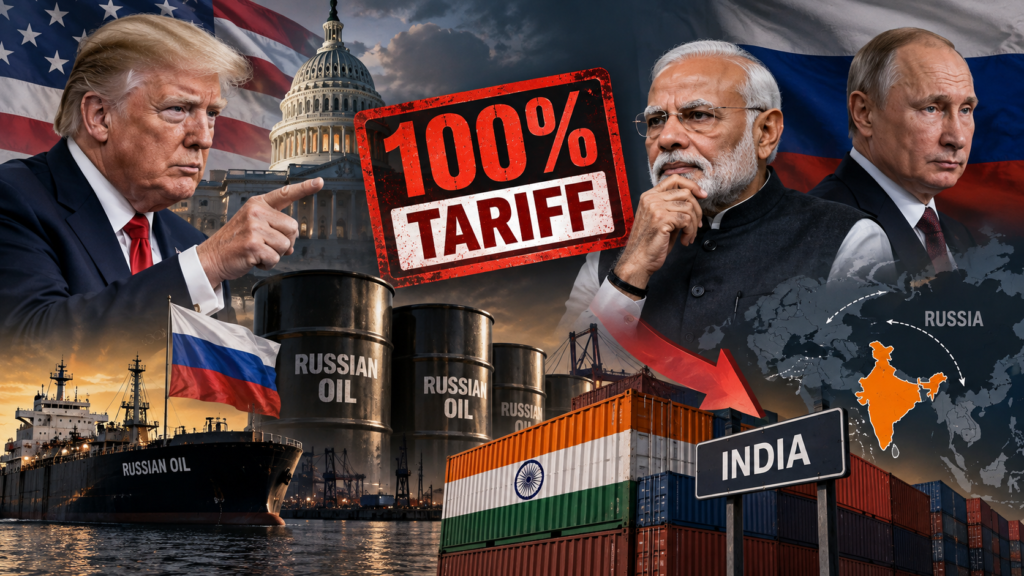
The United States House of Representatives has approved legislation aimed at increasing pressure on Russia’s energy sector, with the measure potentially creating a new tariff risk for countries that continue purchasing Russian crude oil and natural gas.
The development comes at a sensitive point in India-US trade relations, as New Delhi and Washington have been negotiating a preliminary trade agreement while India continues to purchase Russian energy.
House Approves Russia-Targeting Legislation
The U.S. House passed the bill on Wednesday, September 16, 2026, with 262 lawmakers voting in favour and 159 against it. The legislation targets Russia’s energy sector, certain individuals and the network of tankers described as part of the country’s “shadow fleet.”
If signed into law, the measure would give the U.S. President authority to impose tariffs of up to 100% on certain countries that continue purchasing Russian oil and gas under the conditions specified in the legislation.
The bill now moves to President Donald Trump’s desk for consideration.

Why India Is Facing Attention
India has become an important part of the discussion because of its continued imports of Russian crude oil. The latest legislation does not simply announce a new 100% tariff on India. Instead, it establishes conditions under which countries could become subject to additional tariffs.
Under the bill, potential targets would include countries among the five largest importers, by total volume, of Russian-origin crude oil or natural gas during the 12 months before the law is enacted, provided they knowingly make new purchases of Russian crude after the specified period.
This distinction is important because the legislation creates a potential tariff mechanism, rather than automatically applying a 100% tariff to India.
What the Bill Could Mean for Russian Energy Buyers
The proposed measure is designed to put additional economic pressure on Russia by targeting countries that continue to purchase its energy exports.
Countries that fall within the criteria could face tariffs of up to 100% on their goods entering the U.S. market. The legislation also includes provisions concerning countries accused of facilitating sanctions evasion.
At the same time, the US Russia Sanctions Bill contains exemptions for certain countries. Nations that take significant steps to reduce imports of Russian natural gas, or whose gas imports account for less than 15% of Russia’s total gas exports, could qualify for exemptions under the legislation.
India-US Trade Talks Add Another Dimension
The timing of the bill is significant for India because New Delhi and Washington have also been working on trade discussions.
India’s purchases of Russian oil have changed over the past year. According to the reported figures, Indian imports of Russian oil reached an 11-month high in April 2026 after previously falling to a 38-month low in December 2025.
The changing level of Russian oil purchases means the proposed legislation could become an important factor in the wider India-US economic relationship.
Bill Does Not Automatically Mean a 100% Tariff on India
One of the most important points for readers is the difference between authorisation and implementation.
The House-passed legislation would provide the U.S. President with authority to impose tariffs under specified circumstances. It does not itself mean that a 100% tariff on Indian goods has already taken effect.
The final impact on India would depend on whether the bill becomes law, how the provisions are interpreted and whether the presidential authority is subsequently used.
Senate Approval Came Earlier
The measure is an amendment to the Senate’s “Lindsey O. Graham Sanctioning Russia and Iran Act of 2026.” The Senate had previously approved the legislation by an 86–11 vote on August 7, 2026.
The House vote therefore represents another major step in the legislative process, with presidential action now becoming the next key stage.
Concerns About Presidential Tariff Powers
The legislation has also faced criticism from lawmakers who are concerned about the extent of tariff authority it could give the President.
Some lawmakers have argued that expanding presidential tariff powers could have wider economic consequences, including possible effects on American consumers and businesses. Others have expressed concern that the authority could potentially extend to U.S. allies under certain interpretations of the legislation.
These disagreements show that the bill is not only about sanctions against Russia but also about the scope of U.S. presidential authority over tariffs.
What Happens Next?
The immediate next step is consideration by President Donald Trump.
If the legislation becomes law, the administration would then determine how its provisions are implemented. For India, the key issue will be whether the country meets the conditions outlined in the legislation and whether the U.S. administration decides to exercise the tariff authority.
Until those steps occur, it would be inaccurate to state that the United States has already imposed a 100% tariff on India.
Bottom Line
The House passage of the Russia sanctions legislation introduces another potential point of pressure in India-US economic relations. The bill could allow tariffs of up to 100% against qualifying countries that continue certain purchases of Russian energy.
For India, the situation will depend on the final status of the legislation, the conditions applied by the U.S. administration and future decisions regarding Russian oil imports.
The development is therefore significant, but the actual tariff impact on India remains dependent on what happens after the bill reaches the President.
Also visit us: Adeeb Usmani: UAE Cricketer’s Journey, Career And Recent Performances