India’s digital payment ecosystem has entered a fresh debate after the government defended the newly introduced Merchant Discount Rate (MDR) framework for certain UPI merchant transactions. The issue has also triggered a political exchange after Congress leader Rahul Gandhi criticised the decision and demanded that the move be withdrawn.
The government has pointed to the recommendations of the Parliamentary Standing Committee on Finance, arguing that a structured revenue model for UPI had already been discussed at the parliamentary level.
What Has Changed With UPI Payments?
The latest framework concerns selected person-to-merchant UPI transactions rather than every digital payment.
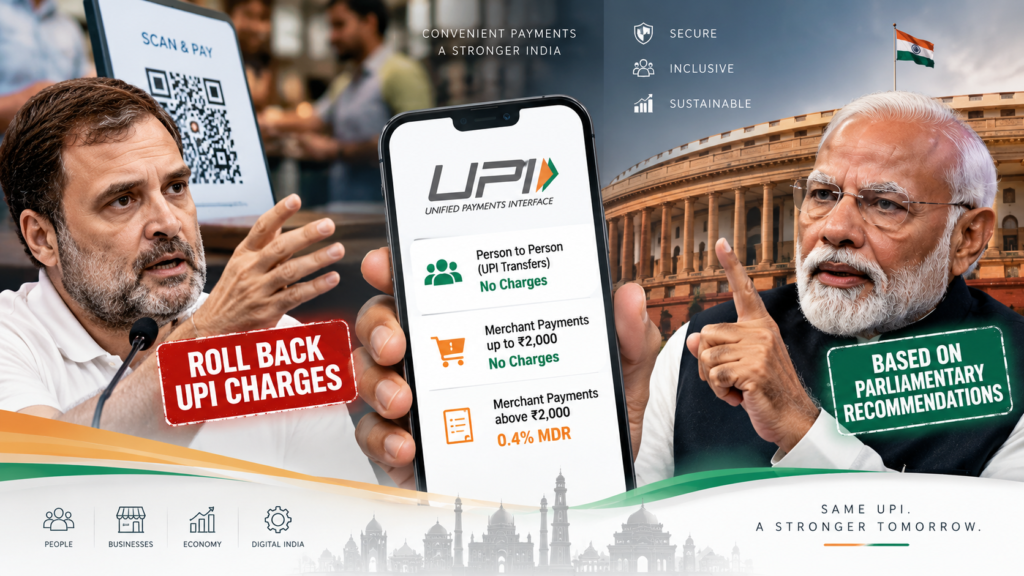
Under the announced structure, eligible merchant transactions above ₹2,000 will attract a 0.4% MDR, subject to applicable limits and exemptions. Person-to-person UPI transfers and eligible payments up to ₹2,000 continue to remain outside the MDR framework.
This distinction is important because the new arrangement does not mean that every person using UPI will suddenly have to pay a transaction fee

Why Has the Government Defended the Decision?
According to the government functionary cited in the source report, the Parliamentary Standing Committee on Finance had recommended a tiered MDR or revenue framework for UPI and had called for its notification and implementation.
The committee’s recommendation was linked to the need for a sustainable revenue model for the country’s rapidly expanding digital payment infrastructure.
The broader argument is that maintaining a nationwide payment network requires spending on areas such as cybersecurity, fraud prevention, technology and infrastructure.
Rahul Gandhi’s Objection
Rahul Gandhi has criticised the decision to introduce charges on certain UPI merchant payments and has called for the move to be rolled back.
His criticism has led to a wider political debate over the cost of maintaining India’s digital payment ecosystem, the effect of MDR on merchants and how UPI should be funded in the long term.
The government, however, has questioned the criticism by referring to the earlier parliamentary committee proceedings.
What Did the Parliamentary Panel Recommend?
The Finance Committee had discussed the possibility of creating a tiered revenue mechanism for UPI. The government functionary cited in the report said the committee had supported moving ahead with such a framework.
Five Congress MPs, including P. Chidambaram, Manish Tewari, Gaurav Gogoi, Kishori Lal and K. Gopinath, were present when the report was adopted on August 12, according to the government functionary. The published minutes were described as showing no dissent from those members.
The point has since become central to the government’s response to the criticism.
Why Is the Revenue Model Important?
UPI has grown into one of India’s most widely used digital payment systems, creating ongoing costs for banks, payment service providers and other participants in the ecosystem.
The committee report cited in the source material highlighted a major difference between government support and estimated operational expenses. It referred to a ₹2,000-crore allocation for the ecosystem against an estimated industry operational cost of around ₹20,700 crore.
The committee therefore argued for a more sustainable revenue structure rather than continued dependence on government support alone.
What Does the New Framework Mean for Users?
For ordinary users, the distinction between merchant payments and person-to-person transfers is particularly relevant.
The government has clarified that individuals will not be charged for sending or receiving money through UPI. Payments to merchants up to ₹2,000 also remain free under the announced framework, while eligible larger merchant transactions fall under MDR rules.
As a result, the effect of the policy will be felt primarily within the merchant and payment-services ecosystem rather than as a general charge on every UPI user.
Businesses Have Also Raised Concerns
The introduction of MDR has prompted concerns among some businesses and industry groups. Reuters reported that retailer organisations warned that additional payment costs could put pressure on merchants, particularly those operating with narrow margins.
At the same time, the policy’s supporters argue that a sustainable funding mechanism is necessary to maintain and develop the infrastructure behind India’s digital payments network.
The debate therefore involves two competing concerns: keeping digital payments affordable for businesses while ensuring that the ecosystem has sufficient resources for long-term operation.
The Bigger UPI Debate
The discussion around UPI Charges is ultimately broader than the question of a single payment rate.
It raises questions about who should bear the cost of maintaining digital payment infrastructure, how merchants should be treated under a tiered system and whether government subsidies can continue to support the ecosystem at its current scale.
The Parliamentary Standing Committee’s recommendations and the government’s latest policy decision have brought these questions into sharper focus.
What Happens Next?
The new MDR framework is expected to shape how merchants, banks, payment platforms and other participants manage UPI transactions going forward.
The political debate is also likely to continue, with the government defending the framework by referring to the committee’s earlier recommendations, while opposition leaders and sections of industry continue to raise concerns about its impact.
For users, the key point remains that the announced framework does not impose a universal charge on all UPI transactions. Person-to-person payments and specified low-value merchant transactions remain outside the MDR structure.
Conclusion
The latest UPI controversy combines a policy change with a larger debate over how India’s digital payment infrastructure should be funded.
The government has cited parliamentary recommendations in defending the MDR framework, while Rahul Gandhi has criticised the move and sought its withdrawal. The disagreement highlights the continuing challenge of balancing affordable digital payments with the financial requirements of maintaining a large-scale payment network.
For now, understanding the distinction between merchant MDR and charges paid directly by UPI users is essential when assessing the impact of the new framework.
Also visit us: US Russia Sanctions Bill: India Faces Potential 100% Tariff Threat