
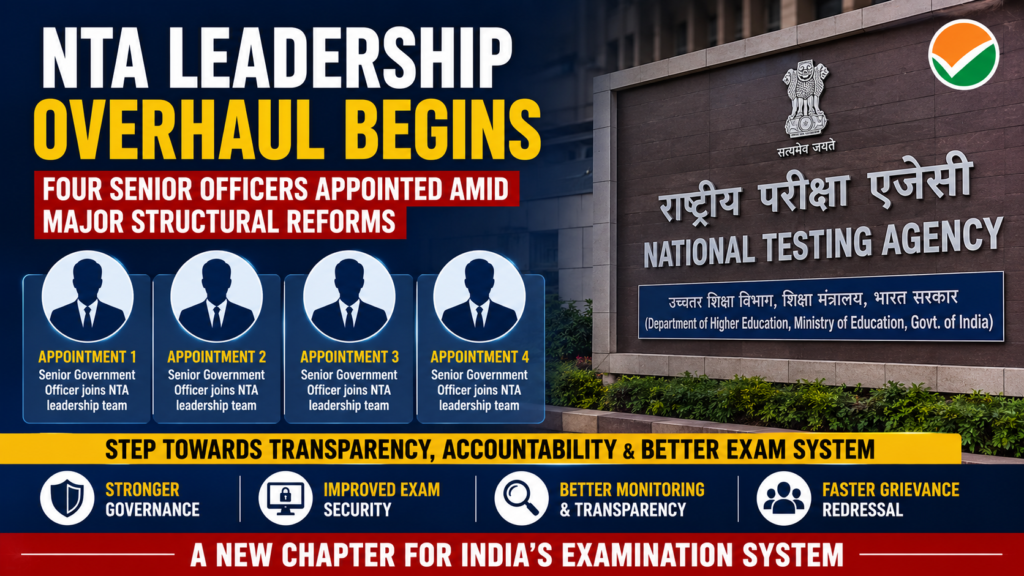
The National Testing Agency (NTA) is undergoing one of the biggest structural transformations in its history.
In a major administrative shake-up, the government has appointed four senior officers to strengthen the agency’s leadership structure amid growing pressure for transparency, accountability, and exam reforms.
The NTA Leadership Overhaul comes at a time when competitive examinations across the country remain under intense public scrutiny.
From paper leak controversies to concerns over exam management and technical failures, the credibility of national-level entrance exams has become a major national discussion.
Now, with new leadership changes being introduced at the top level, students, parents, coaching institutes, and education experts are closely watching what happens next.
Because this may not be just another bureaucratic reshuffle.
Many believe it could redefine the future of India’s examination system.
NTA Leadership Overhaul Introduces Major Administrative Changes
The latest NTA Leadership Overhaul involves the appointment of four senior government officers to key administrative positions inside the National Testing Agency.
Officials say the move is aimed at improving operational efficiency, strengthening accountability, and accelerating institutional reforms.
Reports suggest the restructuring is part of a larger effort to rebuild trust in the examination system after multiple controversies created public concern over exam management processes.
The newly appointed officers are expected to help streamline:
- Examination operations
- Technical monitoring systems
- Coordination processes
- Security mechanisms
- Administrative decision-making
- Student grievance handling
Education experts believe these structural changes could significantly impact how major entrance exams are conducted in the future.
Also Read – Who Is Behind the Cockroach Janata Party? New Political Group Claims 1 Lakh Members in 3 Days
Why the NTA Leadership Overhaul Is Happening Now
Timing has become one of the biggest discussion points surrounding the reforms.
The NTA Leadership Overhaul comes after months of criticism related to examination irregularities, paper leak allegations, and operational challenges in high-profile national entrance tests.
Public trust in competitive examination systems faced serious pressure after multiple controversies triggered nationwide debates involving students, educators, and policymakers.
The government now appears determined to strengthen institutional control and improve examination credibility before future exam cycles begin.
Experts say restoring public confidence has become the agency’s biggest challenge.
And this leadership restructuring may be the first major step toward that goal.

NTA Leadership Overhaul Aims to Improve Exam Transparency
One of the strongest expectations from the NTA Leadership Overhaul is improved transparency in the conduct of national examinations.
Students across India have repeatedly demanded:
- Stronger anti-paper leak systems
- Better technical infrastructure
- Faster grievance resolution
- Fair evaluation systems
- Improved security protocols
- More accountability during exams
Education analysts believe the appointment of experienced government officers may help introduce tighter monitoring and more efficient administrative coordination.
Many students are now hoping the reforms will reduce uncertainty and restore trust in competitive examinations.
NTA Leadership Overhaul Could Impact Major Entrance Exams
The National Testing Agency conducts several of India’s most important entrance examinations.
Any structural change inside the agency immediately affects millions of students nationwide.
The NTA Leadership Overhaul may influence the administration of exams including:
- NEET
- JEE Main
- CUET
- UGC NET
- Common recruitment and entrance examinations
Experts believe stronger leadership systems could help reduce operational risks during future examination cycles.
However, students and parents are also waiting to see whether the reforms lead to visible improvements on the ground.
Education Sector Closely Watching the NTA Leadership Overhaul
The education sector has reacted strongly to the latest developments.
Coaching institutes, academic experts, and policy analysts are closely examining how the new leadership structure may change examination governance in India.
Some experts believe the overhaul could modernize the agency’s functioning significantly.
Others argue that leadership changes alone may not fully solve deeper systemic challenges unless supported by long-term policy reforms and technological upgrades.
Still, most observers agree that stronger institutional oversight has become urgently necessary.
Students React to NTA Leadership Overhaul With Mixed Emotions
The reaction among students has been a mix of hope, caution, and curiosity.
Many students welcomed the decision, believing reforms are essential after repeated controversies damaged confidence in examination systems.
At the same time, some candidates remain skeptical and want visible results rather than administrative announcements alone.
Social media platforms quickly filled with discussions surrounding exam fairness, mental pressure, and accountability.
For millions of aspirants preparing for competitive exams, the reforms carry enormous importance.
Their academic future often depends entirely on the credibility of these examinations.
Can the NTA Leadership Overhaul Restore Public Trust?
This question now dominates conversations across India’s education sector.
Restoring public confidence will likely require more than leadership appointments.
Experts believe the agency must also focus on:
- Technology modernization
- Cybersecurity upgrades
- Faster response systems
- Transparent communication
- Better student support mechanisms
- Strict action against exam irregularities
Still, many analysts believe the NTA Leadership Overhaul signals that authorities recognize the seriousness of public concerns.
And that alone marks an important shift.
NTA Leadership Overhaul Could Shape the Future of India’s Exam System
The latest restructuring inside the National Testing Agency may eventually become one of the most important education reforms in recent years.
As millions of students continue preparing for highly competitive examinations, the pressure on the agency remains enormous.
Every decision taken during this transition period will now be closely monitored by students, parents, educational institutions, and policymakers.
Because for India’s youth, examination credibility is not just an administrative issue.
It directly affects careers, opportunities, and future dreams.
And after the NTA Leadership Overhaul, expectations for change have become higher than ever before.