
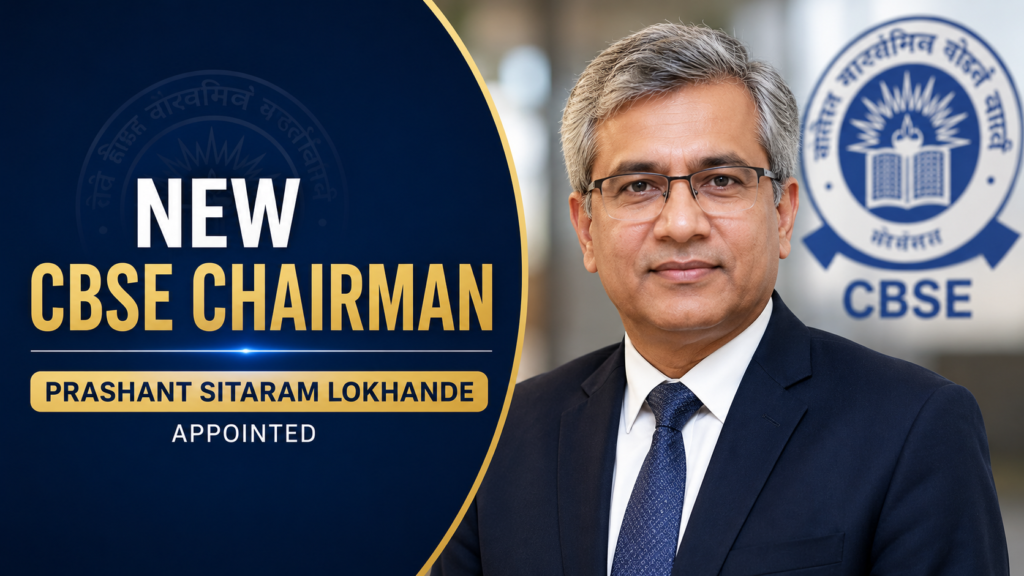
New CBSE Chairman Prashant Sitaram Lokhande has officially been appointed to head the Central Board of Secondary Education (CBSE), marking an important leadership transition for one of India’s most influential educational institutions. The appointment comes at a crucial time when the education sector is witnessing rapid reforms, technological integration, and increasing focus on student-centric learning.
The leadership change is attracting nationwide attention because CBSE plays a critical role in shaping the academic future of millions of students across India and abroad. From curriculum development and examinations to policy implementation and digital transformation, every decision made by the board directly impacts schools, teachers, parents, and learners.
As Prashant Sitaram Lokhande steps into this key position, expectations are rising regarding the future direction of India’s school education ecosystem.
Advertisement

Also Read :- Rupee Falls Against US Dollar as Rising Crude Oil Prices Trigger Market Concerns
New CBSE Chairman Takes Charge at a Critical Time for Education
The appointment of the New CBSE Chairman comes at a significant moment for the education sector.
CBSE has undergone several transformations in recent years, including changes in examination patterns, skill-based learning initiatives, competency-focused assessments, and increased use of digital education platforms.
These reforms have been introduced to align school education with evolving global standards and future workforce requirements.
With millions of students appearing for CBSE examinations every year, the board’s policies often influence educational trends across the country.
Education experts believe the new leadership will play an important role in guiding ongoing reforms and strengthening the board’s commitment to quality education.
The transition has therefore become a closely watched development among stakeholders across the academic community.
Advertisement

Who Is Prashant Sitaram Lokhande?
The New CBSE Chairman, Prashant Sitaram Lokhande, is an experienced Indian Administrative Service (IAS) officer with extensive experience in public administration and governance.
Over the years, he has handled multiple administrative responsibilities, earning recognition for his work in policy implementation and institutional management.
His appointment reflects the government’s confidence in his ability to manage one of the country’s largest educational organizations.
CBSE oversees thousands of affiliated schools across India and internationally, making the chairman’s role both influential and highly demanding.
The position requires balancing administrative efficiency with educational innovation while ensuring smooth execution of board responsibilities.
Observers believe Lokhande’s governance experience could help strengthen institutional effectiveness and policy execution.
New CBSE Chairman Succeeds Rahul Singh
The appointment follows the tenure of Rahul Singh, who previously served as CBSE Chairman and oversaw several important educational initiatives.
During his leadership, CBSE focused on reforms designed to reduce rote learning and promote conceptual understanding among students.
The board also introduced measures aimed at improving assessment quality and encouraging holistic education.
As the New CBSE Chairman, Lokhande inherits an institution that is already undergoing significant transformation.
The challenge now lies in maintaining momentum while introducing improvements that address emerging educational needs.
Many stakeholders are eager to see whether the board will launch additional reforms under the new leadership.
The coming months are expected to provide greater clarity regarding policy priorities and future initiatives.
Education Reforms Remain a Key Area of Focus
One of the most important responsibilities facing the New CBSE Chairman involves supporting ongoing education reforms.
India’s education system is evolving rapidly under the framework of the National Education Policy (NEP).
The policy emphasizes experiential learning, critical thinking, skill development, and multidisciplinary education.
CBSE has already begun implementing several initiatives aligned with these objectives.
As educational expectations continue changing, schools require guidance, resources, and support to adapt effectively.
The chairman’s leadership will be essential in ensuring that reforms are implemented consistently across affiliated institutions.
Successful execution could influence the academic experiences of millions of students nationwide.
Digital Learning and Technology Integration Gain Importance
Technology is becoming increasingly central to modern education.
The New CBSE Chairman will oversee a period in which digital learning tools, online assessments, artificial intelligence, and educational technology platforms continue expanding their role in classrooms.
The pandemic accelerated digital adoption across schools, creating new opportunities as well as challenges.
Educational institutions are now exploring innovative methods to improve learning outcomes through technology-driven solutions.
CBSE has already introduced several digital initiatives, and experts anticipate further advancements under the new leadership.
Balancing innovation with accessibility will remain an important consideration.
Ensuring that students from diverse backgrounds benefit equally from technological progress is expected to be a key priority.
Examination Reforms Continue to Attract Attention
CBSE examinations remain among the most important academic milestones for students.
As the New CBSE Chairman, Lokhande will likely oversee future developments related to assessment systems and examination practices.
In recent years, the board has focused on reducing the emphasis on memorization while encouraging analytical and application-based learning.
This shift reflects broader global educational trends.
Students, parents, and educators are closely monitoring how examination frameworks may continue evolving.
Any changes introduced by CBSE often influence teaching methodologies, study patterns, and academic expectations across schools.
The board’s decisions therefore carry significant educational and social implications.
Expectations From Schools, Teachers, and Parents
The appointment of the New CBSE Chairman has generated interest among various stakeholders.
Schools are looking for clarity regarding future academic policies and administrative procedures.
Teachers expect continued support through training programs and professional development initiatives.
Parents are seeking educational systems that prepare students for future challenges while reducing unnecessary academic pressure.
Students, meanwhile, hope for learning environments that encourage creativity, innovation, and skill development.
Meeting these diverse expectations requires careful planning and effective leadership.
The chairman’s ability to balance these priorities will play an important role in shaping public perception of CBSE’s future direction.
New CBSE Chairman Faces Opportunities and Challenges
While the position brings significant responsibilities, it also presents opportunities to influence educational progress on a large scale.
The New CBSE Chairman assumes leadership at a time when educational transformation is accelerating.
Rapid technological advancements, changing workforce requirements, and evolving learning models are reshaping traditional educational systems.
CBSE’s response to these changes will have long-term implications for students and institutions.
The board’s leadership must ensure that academic standards remain strong while embracing innovation and inclusivity.
Achieving this balance will be critical to future success.
New CBSE Chairman Begins a New Chapter for School Education
New CBSE Chairman Prashant Sitaram Lokhande’s appointment marks the beginning of a new phase for India’s largest school education board.
His leadership arrives during a period of educational reform, digital transformation, and growing expectations from students, teachers, and parents.
With millions of learners depending on CBSE’s policies and initiatives, every decision made under the new administration will carry substantial significance.
As the education landscape continues evolving, stakeholders across the country will closely follow the board’s next steps.
The appointment not only represents a leadership change but also signals fresh possibilities for the future of school education in India.