
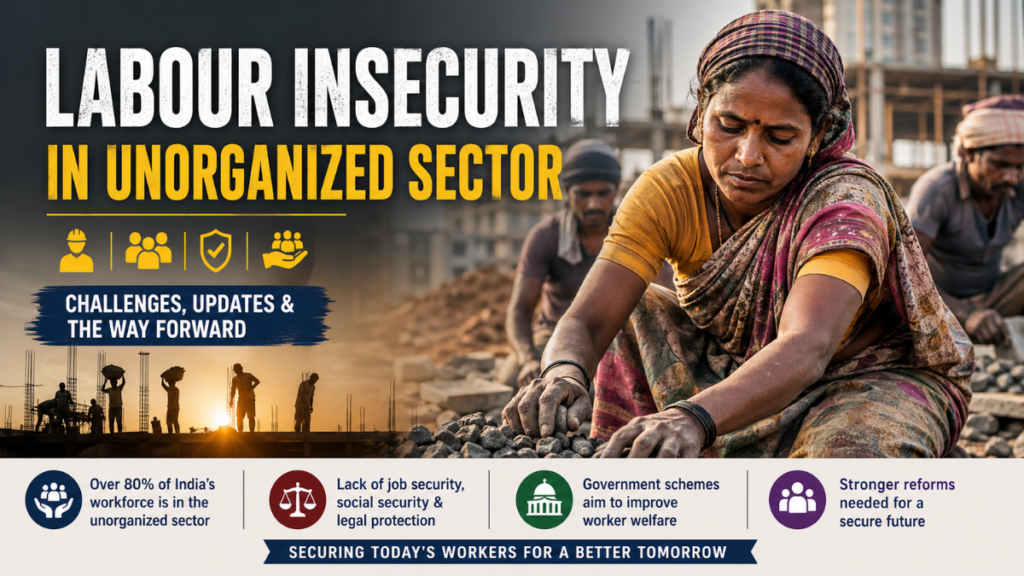
The issue of labour insecurity in India’s unorganized sector has once again come into focus, raising serious concerns among policymakers, workers’ unions, and social organizations. A large percentage of India’s workforce—estimated at over 80%—is employed in the unorganized sector, where job stability, social security, and legal protection remain minimal.
Recent discussions and local reports have highlighted that workers in sectors like construction, agriculture, street vending, and small-scale industries continue to face irregular wages, lack of contracts, and unsafe working conditions.
Challenges Faced by Labour in the Unorganized Sector
One of the biggest challenges contributing to labour insecurity is the absence of formal employment structures. Workers often do not receive written contracts, making it difficult to claim rights or benefits.
Key issues include:
- Lack of minimum wage enforcement
- No access to health insurance or pension schemes
- Unsafe and unhygienic working environments
- Seasonal employment and sudden job loss
Women and migrant workers are particularly vulnerable, often facing exploitation and wage discrimination.
Recent Developments and Government Initiatives
In recent years, the government has introduced initiatives such as the e-Shram portal, aimed at creating a national database of unorganized workers. As of 2026, millions of workers have registered, which is a step toward providing social security benefits.
Additionally, schemes like:
- Pradhan Mantri Shram Yogi Maandhan (pension scheme)
- Ayushman Bharat (health coverage)
- Building and Other Construction Workers Welfare Board
have been launched to reduce labour insecurity.
However, experts argue that implementation gaps and lack of awareness still limit the reach of these programs.
Why Labour Reforms Are Urgently Needed
Experts emphasize that without strong labour reforms, the condition of workers in the unorganized sector will continue to deteriorate. Strengthening labour laws, ensuring enforcement, and increasing awareness about worker rights are essential steps.
Digital platforms and gig economy jobs have further blurred employment boundaries, increasing labour insecurity for millions of workers who lack traditional benefits.
The Way Forward for Protecting Labour Rights
To address labour insecurity, coordinated efforts are needed from both government and private sectors. Some key recommendations include:
- Expanding social security coverage
- Ensuring strict enforcement of labour laws
- Promoting skill development programs
- Increasing awareness about government schemes
Improving working conditions and ensuring fair wages can significantly enhance the quality of life for millions of workers.
Also Read: CUET UG 2026 City Intimation Slip Released: Admit Card to Be Out Soon
Conclusion
The growing concern around labour insecurity in the unorganized sector reflects a deeper structural issue in India’s economy. While government initiatives show promise, effective implementation and policy reforms are crucial to safeguard the rights and livelihoods of workers.