
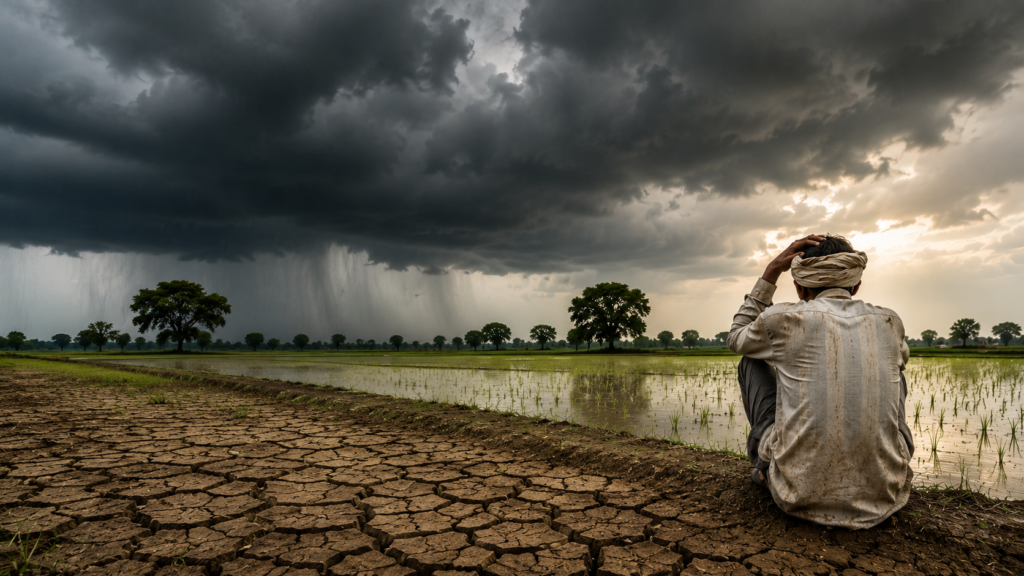
India Monsoon Rainfall has emerged as a major concern after the country recorded rainfall levels nearly 40% below the long-period average during the early phase of the 2026 southwest monsoon. Weather experts have linked the shortfall primarily to El Niño conditions in the Pacific Ocean, while several other atmospheric factors are also delaying widespread rainfall across key agricultural regions.
The development comes at a crucial time for farmers, reservoir management authorities, and policymakers, as the southwest monsoon contributes nearly 70% of India’s annual rainfall and remains vital for agriculture and water security.
Advertisement

Also Read :-NEET UG 2026 Re-Test Conducted Under Unprecedented Security With Air Force Support
India Monsoon Rainfall Faces Significant Deficit in June 2026
According to meteorological assessments, India Monsoon Rainfall remained substantially below normal during the first half of June.
Key Highlights
- Rainfall deficit has approached 40% below the seasonal average.
- Several states in central, northern, and western India have reported delayed monsoon progress.
- Reservoir inflows have remained lower than expected.
- Agricultural sowing activities in some regions have slowed due to insufficient moisture.
- Weather experts continue to monitor evolving ocean-atmosphere conditions.
The current deficit is among the most closely watched weather developments of the season because monsoon performance directly affects food production and rural incomes.
Advertisement

What Is Causing the India Monsoon Rainfall Deficit?
Meteorologists point to multiple factors contributing to weaker monsoon activity.
Major Reasons Behind the Weak Monsoon
- El Niño conditions in the Pacific Ocean are suppressing rainfall-supporting systems.
- Reduced formation of low-pressure systems over the Bay of Bengal.
- Unfavorable wind circulation patterns across the Indian Ocean region.
- Delayed strengthening of monsoon currents over mainland India.
- Higher atmospheric stability limiting cloud development.
While El Niño remains the primary factor, experts emphasize that the monsoon is influenced by a complex combination of ocean temperatures, wind patterns, and regional weather systems.
Impact of India Monsoon Rainfall Shortfall on Agriculture
Agriculture remains the sector most sensitive to monsoon performance.
Potential Agricultural Impact
- Delayed sowing of rice, pulses, and oilseeds.
- Increased dependence on irrigation facilities.
- Higher input costs for farmers.
- Concerns regarding crop productivity if rainfall does not improve.
- Greater pressure on groundwater resources.
Farmers across several states are closely monitoring weather forecasts before expanding sowing operations.
Can India Monsoon Rainfall Recover in Coming Weeks?
Weather agencies believe the monsoon season is still in its early stages.
What Experts Are Watching
- Development of fresh low-pressure systems.
- Rain-bearing weather activity over the Bay of Bengal.
- Changes in El Niño intensity.
- Monsoon advancement into northern and western regions.
- Rainfall recovery during July, traditionally India’s wettest monsoon month.
Is the Monsoon Season Already in Trouble?
Not necessarily. Experts note that monsoon rainfall can recover significantly if stronger weather systems develop during late June and July.
Why Does India Monsoon Rainfall Matter So Much?
The monsoon supports agriculture, drinking water supplies, hydropower generation, and overall economic activity across the country.
Key Points at a Glance
- India’s monsoon rainfall is nearly 40% below normal during early June 2026.
- El Niño is considered the primary reason for the rainfall deficit.
- Delayed rainfall is affecting agricultural planning in several regions.
- Reservoir levels and water management remain under close observation.
- Meteorologists expect clearer trends to emerge over the coming weeks.
- July rainfall performance will be critical for determining the overall monsoon outcome.
The coming weeks will be crucial for India Monsoon Rainfall, as farmers, weather agencies, and policymakers await stronger monsoon activity that could help reduce the current rainfall deficit and stabilize agricultural prospects for the season.