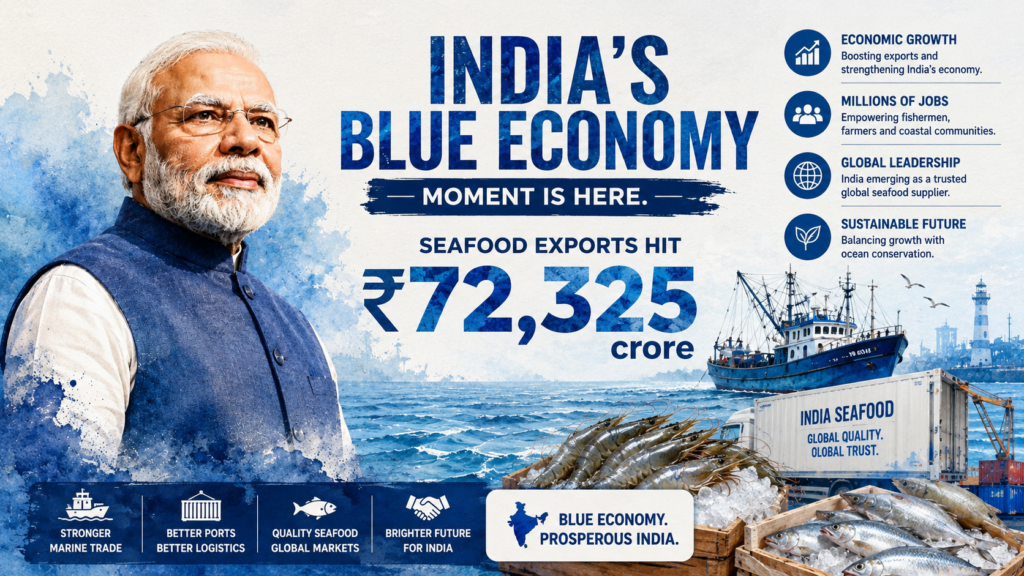
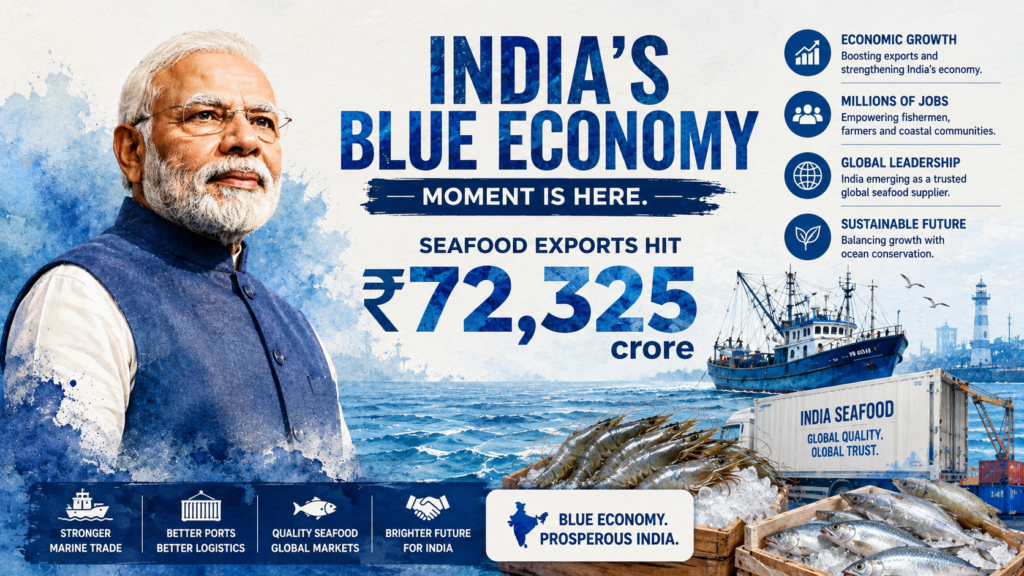
The rise of the India Blue Economy is becoming one of the biggest economic stories in the country. India’s growing focus on marine resources, seafood exports, coastal development, and ocean-based industries is creating a major shift in the economy. The image above highlights a strong achievement where seafood exports crossed ₹72,325 crore, proving that the India Blue Economy is no longer just a policy discussion but a real economic driver.
India has one of the longest coastlines in the world, and for decades, the country underutilized its marine potential. Today, the government is investing heavily in ports, fisheries, shipping, renewable energy, and seafood exports to unlock the power of the India Blue Economy. This transformation is helping India increase exports, generate jobs, and improve global trade competitiveness.
The seafood industry is now playing a major role in the success of the India Blue Economy. Indian seafood products are being exported to countries across the United States, Europe, Japan, China, and the Middle East. Shrimp exports, frozen seafood products, and marine processing businesses are witnessing rapid expansion.
One reason the India Blue Economy is growing quickly is because global demand for seafood continues to rise. As international markets search for reliable seafood suppliers, India is emerging as a strong player because of its large coastline, fishing ecosystem, and marine infrastructure.

How India Blue Economy Is Strengthening Marine Trade
The success of the India Blue Economy depends heavily on infrastructure development. India is modernizing ports, improving cold storage systems, upgrading marine logistics, and increasing shipping efficiency. These changes are helping seafood exporters deliver products faster and maintain quality standards in global markets.
The government’s Sagarmala project and coastal economic initiatives are directly connected to the growth of the India Blue Economy. Better ports and transport systems reduce export costs and increase profitability for marine businesses. This is especially important for seafood exporters competing in international markets.
The seafood sector has also created employment opportunities for millions of people. Fishermen, seafood processors, exporters, logistics companies, packaging units, and transport workers all benefit from the expansion of the India Blue Economy. Coastal states such as Kerala, Gujarat, Andhra Pradesh, Tamil Nadu, and Odisha are seeing strong economic benefits from marine trade growth.
Another major advantage of the India Blue Economy is foreign exchange earnings. When seafood exports rise, India earns more foreign currency, which supports the economy and strengthens trade performance. Crossing ₹72,325 crore in seafood exports is not just a number; it reflects India’s growing position in global marine trade.
Technology is also improving the India Blue Economy. Modern fishing methods, cold-chain logistics, GPS systems, marine processing technology, and digital export systems are helping businesses become more efficient. Indian exporters are now competing with international seafood giants more effectively than before.
At the same time, sustainability is becoming increasingly important. The future of the India Blue Economy depends on balancing growth with marine conservation. Overfishing, pollution, and climate risks can damage long-term growth if marine ecosystems are not protected.
Why India Blue Economy Matters for India’s Future Economy
The importance of the India Blue Economy goes beyond seafood exports alone. It represents a larger vision where oceans become engines of economic growth. Shipping, tourism, offshore renewable energy, marine biotechnology, and coastal infrastructure all contribute to the expanding blue economy ecosystem.
India’s strategic geographic location also gives the country a major advantage. Positioned near critical international trade routes, India can become a global maritime hub if investments in the India Blue Economy continue at the current pace.
The rise of the India Blue Economy is also important for rural and coastal communities. Many coastal families depend directly on fishing and marine activities for survival. Higher seafood exports mean higher income opportunities for these communities, improving living standards and regional economic development.
Global investors are also paying attention to the India Blue Economy because marine industries offer long-term growth potential. As India focuses on export expansion and infrastructure modernization, more domestic and international companies may enter the sector.
Prime Minister Narendra Modi has repeatedly emphasized the importance of ocean-based growth for India’s future. His government views the India Blue Economy as a strategic opportunity to strengthen exports, create jobs, and expand India’s global economic influence.
However, challenges still remain. Climate change, rising fuel prices, international competition, and environmental sustainability require careful management. Without long-term planning, rapid expansion could create pressure on marine ecosystems.
Despite these challenges, the future of the India Blue Economy looks extremely promising. Rising seafood exports, better infrastructure, government support, and increasing global demand are creating strong momentum. The ₹72,325 crore seafood export milestone reflects how India is turning its marine strength into economic power.
In the coming years, the India Blue Economy could become one of the strongest pillars of India’s growth story. From exports and employment to trade and infrastructure, the ocean economy is positioning India as a major global maritime player.