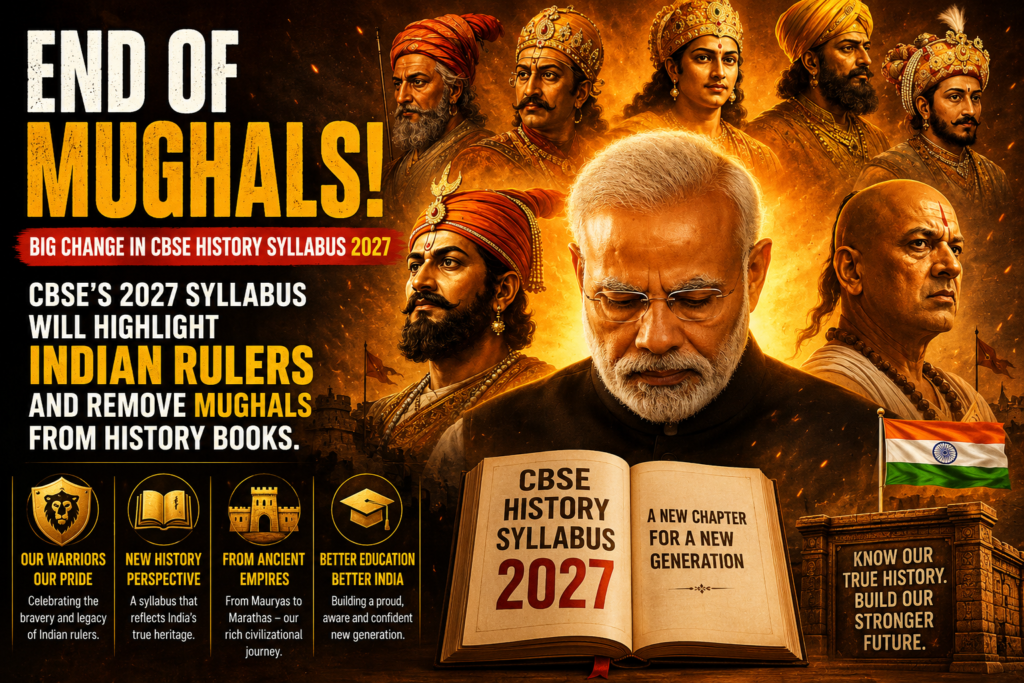
The discussion around the CBSE History Syllabus 2027 is becoming one of the most debated education topics in India. Reports and social media discussions suggest that future history textbooks may place stronger focus on Indian rulers, dynasties, and regional kingdoms while reducing the dominance of Mughal history chapters. This possible shift in the CBSE History Syllabus 2027 has triggered strong reactions from educators, parents, historians, and political observers.
For decades, Indian history education has been criticized by some groups for giving disproportionate attention to Mughal rulers while underrepresenting ancient and regional Indian kingdoms. Supporters of the proposed CBSE History Syllabus 2027 changes believe that Indian students should learn more about empires such as the Marathas, Cholas, Mauryas, Rajputs, Vijayanagara Empire, Ahoms, and other indigenous rulers who shaped Indian civilization.
At the same time, critics argue that history should remain balanced and fact-based instead of politically influenced. This debate has transformed the CBSE History Syllabus 2027 into more than an academic issue. It is now connected to identity, nationalism, education policy, and cultural representation.

Why CBSE History Syllabus 2027 Is Creating National Debate
The biggest reason the CBSE History Syllabus 2027 is attracting attention is because school textbooks shape how future generations understand the nation’s past. History education influences cultural awareness, patriotism, and national identity. Any major syllabus change naturally becomes politically and socially sensitive.
Supporters of the proposed changes argue that Indian students know more about Mughal emperors than many Indian kings and dynasties. According to them, the CBSE History Syllabus 2027 can correct historical imbalance by introducing broader coverage of Indian warriors, philosophers, scientists, and empires.
Several people believe the revised CBSE History Syllabus 2027 could increase awareness about rulers like Chhatrapati Shivaji Maharaj, Maharana Pratap, Chandragupta Maurya, Krishnadevaraya, and the Ahom kings. These rulers played significant roles in defending kingdoms, expanding trade, developing administration systems, and preserving Indian culture.
Another reason the CBSE History Syllabus 2027 debate is growing rapidly is social media influence. Viral posts, political narratives, and online campaigns have amplified public interest. Images like the one above create emotional reactions because they connect historical change with national pride and cultural identity.
However, historians warn against oversimplifying history into “good versus bad” narratives. India’s history is deeply layered, involving multiple kingdoms, religions, trade networks, cultural exchanges, invasions, and political transformations. Experts argue the CBSE History Syllabus 2027 should focus on comprehensive understanding instead of selective glorification.
Educational experts also believe that syllabus reforms should prioritize analytical thinking. Students should learn how different empires contributed to architecture, governance, economy, diplomacy, literature, and society. A balanced CBSE History Syllabus 2027 would ideally include both achievements and failures of all historical rulers.
How CBSE History Syllabus 2027 Could Impact Students
One major impact of the CBSE History Syllabus 2027 could be increased interest in Indian regional history. Many students currently study limited information about southern kingdoms, northeastern rulers, and tribal resistance movements. Expanding these topics could make history more inclusive and geographically diverse.
The proposed CBSE History Syllabus 2027 may also encourage deeper discussion about India’s civilizational roots. Ancient universities, trade routes, scientific contributions, temple architecture, maritime networks, and cultural achievements may receive stronger focus in future textbooks.
Another possible impact is political polarization. Since history often intersects with ideology, any change in the CBSE History Syllabus 2027 may continue generating controversy between different political groups. Some may view the reforms as cultural correction, while others may see them as historical revisionism.
Students themselves may experience both advantages and challenges. On one hand, the revised CBSE History Syllabus 2027 could create stronger awareness of India’s diverse dynasties and regional heroes. On the other hand, rapidly changing textbooks may create confusion if historical interpretation becomes politically contested.
Globally, many countries periodically revise history textbooks to reflect changing academic research and cultural priorities. India is not unique in this process. However, the scale of discussion surrounding the CBSE History Syllabus 2027 reflects how emotionally connected Indians are to their historical identity.
The future direction of the CBSE History Syllabus 2027 will depend on policymakers, historians, education boards, and public response. Whether the changes become extensive or moderate, one thing is certain: history education in India is entering a new phase of national discussion.
The larger question is not simply whether Mughal chapters are reduced or Indian rulers receive more focus. The real challenge for the CBSE History Syllabus 2027 is creating a balanced, accurate, and intellectually strong understanding of India’s past. A modern education system must teach students to think critically while appreciating the complexity of Indian civilization.
Also read : Narendra Modi Foreign Awards Reflect Global Leadership Recognition