
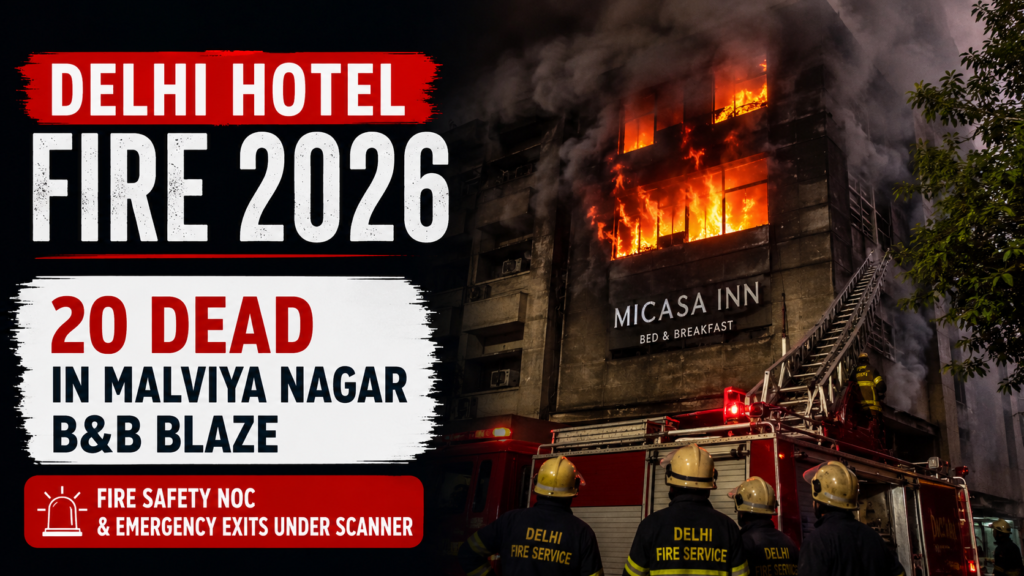
Delhi Hotel Fire 2026 has emerged as one of the deadliest fire incidents reported in the national capital this year, leaving families devastated and authorities facing serious questions over safety compliance. The tragic blaze erupted at a bed-and-breakfast facility operating in Delhi’s Malviya Nagar area, claiming at least 20 lives and injuring several others.
As rescue teams continue to examine the site, preliminary findings have revealed details that are raising fresh concerns about fire safety enforcement in commercial accommodations across the city.
The incident has not only shocked residents but has also reignited a national debate over building safety regulations, emergency preparedness, and the consequences of ignoring mandatory fire protection measures.
Advertisement

Also Read :- New CBSE Chairman Prashant Sitaram Lokhande Appointed to Lead India’s Largest School Board
Delhi Hotel Fire 2026 Claims 20 Lives in Overnight Disaster
The Delhi Hotel Fire 2026 tragedy unfolded when flames rapidly spread through a multi-storey accommodation facility in Malviya Nagar. Witnesses described scenes of panic as guests attempted to escape thick smoke that quickly engulfed corridors and rooms.
Emergency calls triggered an immediate response from the Delhi Fire Service. Multiple fire tenders were rushed to the location, and rescue operations continued for several hours as firefighters battled intense flames and dense smoke.
Many victims were reportedly trapped inside upper floors, making rescue efforts increasingly difficult. Authorities later confirmed that 20 people lost their lives while several others sustained injuries requiring medical treatment.
The scale of the disaster has made the incident one of the most closely watched fire investigations in Delhi in recent months.
Advertisement

Fire Safety NOC and Emergency Exit Concerns Surface
A major development in the Delhi Hotel Fire 2026 investigation involves allegations regarding the building’s fire safety compliance.
Initial reports indicate that the facility was operating without a valid fire safety No Objection Certificate (NOC), a mandatory requirement for many commercial establishments. Investigators are also examining claims that adequate emergency exits were either missing or insufficient for safe evacuation.
These findings have intensified scrutiny of building management practices and regulatory oversight.
Safety experts note that fire safety approvals are designed to ensure the presence of essential systems such as:
- Fire alarms
- Smoke detection systems
- Emergency lighting
- Fire extinguishers
- Clearly marked evacuation routes
- Functional emergency exits
Authorities are now reviewing whether lapses in any of these areas contributed to the high casualty count.
How the Blaze Spread So Quickly
One of the key questions surrounding the Delhi Hotel Fire 2026 incident is how the fire expanded with such devastating speed.
Fire officials believe that smoke accumulation played a major role in trapping occupants. In many fire emergencies, smoke inhalation causes more fatalities than direct exposure to flames.
Investigators are examining:
- Internal building layout
- Ventilation systems
- Electrical infrastructure
- Exit accessibility
- Fire suppression mechanisms
Experts suggest that limited evacuation routes and rapidly spreading smoke may have significantly reduced escape opportunities for those inside the building.
The final cause of the fire will be determined after a detailed forensic examination.
Rescue Teams Faced Challenging Conditions
The rescue operation during the Delhi Hotel Fire 2026 incident presented significant challenges.
Firefighters had to navigate smoke-filled passages while searching room by room for survivors. Emergency personnel used specialized breathing equipment and rescue gear to enter affected sections of the building.
Medical teams were also deployed to provide immediate assistance to injured occupants.
Officials stated that the priority was to evacuate survivors as quickly as possible while preventing the fire from spreading to nearby structures in the densely populated neighborhood.
Local residents gathered near the scene throughout the night as rescue operations continued under difficult conditions.
Investigation Expands Beyond the Fire Itself
The Delhi Hotel Fire 2026 investigation is now focusing on multiple aspects beyond the origin of the blaze.
Authorities are reviewing:
- Licensing records
- Fire safety approvals
- Occupancy permissions
- Structural compliance documents
- Inspection history
Officials are expected to determine whether negligence, regulatory violations, or operational failures contributed to the disaster.
If serious violations are confirmed, legal action could follow against responsible parties.
The findings may also influence future enforcement measures for hotels, guest houses, and bed-and-breakfast facilities operating across Delhi.
Why This Incident Matters for Urban Safety
The Delhi Hotel Fire 2026 tragedy highlights a larger issue affecting rapidly growing urban centers.
As commercial accommodations expand, safety infrastructure must keep pace with increasing occupancy levels. Experts argue that regular inspections and strict compliance monitoring are essential to prevent similar disasters.
Building owners are expected to maintain safety systems not only during licensing procedures but throughout the operational life of their properties.
The incident has renewed calls for stronger enforcement of fire safety regulations and more frequent audits of establishments that accommodate guests.
What Happens Next?
The aftermath of the Delhi Hotel Fire 2026 continues to unfold as investigators gather evidence and analyze the circumstances that led to the deadly blaze.
Authorities are expected to release detailed findings once technical inspections and forensic assessments are completed.
For many families, however, the focus remains on seeking answers and understanding how a facility reportedly facing safety concerns could become the site of such a devastating tragedy.
As Delhi mourns the loss of 20 lives, the incident serves as a powerful reminder that fire safety compliance is not merely a regulatory formality—it is a critical safeguard that can determine whether people survive an emergency.
The coming weeks are likely to reveal whether preventable failures played a role in one of the city’s most tragic fire incidents of 2026.