
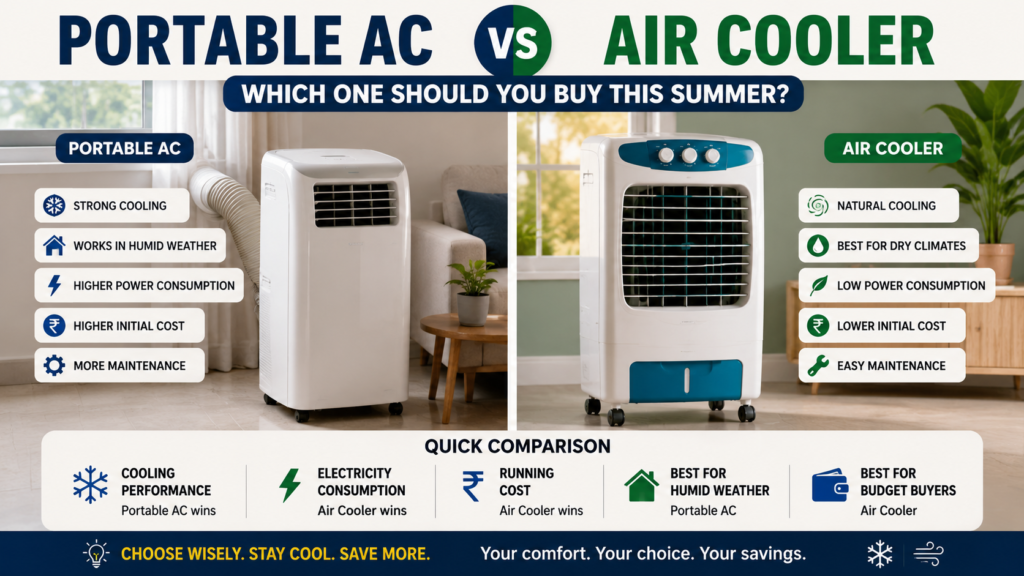
As temperatures continue to rise, many households are facing the same summer question: Should you buy a Portable AC or an Air Cooler?
At first glance, both products promise relief from heat, both appear more affordable than installing a traditional air conditioner, and both are popular choices during peak summer months.
But there is a catch.
What looks like a smart purchase today could turn into an expensive mistake later if the decision is based only on price.
Many buyers focus on the initial cost and ignore an important question:
Which one actually delivers better value in daily use?
The answer depends on more than just cooling power.
Electricity consumption, room size, weather conditions, maintenance, and long-term costs all play a major role.
Before spending money this summer, understanding the differences can help avoid buyer regret.
Advertisement

Also Read :- Ebola Virus News: WHO Declares Global Health Emergency as Global Concern Grows
Portable AC vs Air Cooler: Understanding the Basic Difference
Portable ACs and air coolers may appear similar because both are designed to reduce heat, but they work in completely different ways.
A Portable Air Conditioner uses refrigeration technology to actively remove heat from indoor air and release it outside through an exhaust system.
An Air Cooler, often called an evaporative cooler, cools air using water evaporation.
The difference sounds simple.
But in practical use, it changes everything.
Portable ACs create colder and more controlled temperatures, while air coolers depend heavily on surrounding weather conditions.
Advertisement

Portable AC vs Air Cooler: Which Provides Better Cooling?
Cooling performance is often the biggest deciding factor.
Portable ACs generally produce stronger and more consistent cooling because they actively lower room temperature.
Advantages of Portable AC cooling:
- Works effectively in high temperatures
- Delivers controlled temperature settings
- Performs better in humid conditions
- Provides faster cooling
Air coolers work differently.
They perform best when the environment is dry and hot.
Advantages of Air Cooler cooling:
- Creates natural airflow
- Works well in low-humidity climates
- Uses water-based cooling technology
- Suitable for ventilated rooms
In humid weather, however, air coolers may become less effective because the surrounding air already contains moisture.
This often becomes a deciding factor for many buyers.
Portable AC vs Air Cooler: Electricity Consumption Comparison
Electricity usage can significantly affect long-term expenses.
Portable ACs generally consume more power because compressors and cooling systems require additional energy.
Estimated power consumption:
Portable AC:
- Approximately 900–1500 watts depending on capacity
Air Cooler:
- Approximately 80–250 watts depending on model size
The difference can directly affect monthly electricity bills.
For households concerned about energy savings, air coolers often become an attractive option.
However, lower electricity use should also be considered alongside cooling performance.
Saving energy means little if the room still feels uncomfortable.
Initial Cost vs Long-Term Cost
Price frequently influences buying decisions.
Portable ACs usually involve a higher initial investment.
Average price range:
Portable AC
- Higher purchase cost
- Potentially higher maintenance expenses
- Increased electricity expenses over time
Air Cooler
- Lower purchase cost
- Lower maintenance requirements
- Reduced electricity consumption
Many consumers initially choose air coolers because of affordability.
However, people living in extremely hot regions may eventually upgrade if cooling expectations are not met.
Maintenance Requirements Can Change Your Experience
Maintenance is another factor buyers often overlook.
Portable ACs require:
- Filter cleaning
- Exhaust setup maintenance
- Occasional servicing
Air coolers require:
- Water tank cleaning
- Pad replacement when necessary
- Regular water refilling
Portable AC systems generally involve slightly more technical maintenance, while air coolers require more routine attention during daily use.
Portable AC vs Air Cooler: Which One Should You Buy?
Choosing between these two products ultimately depends on your needs.
You may consider a Portable AC if:
- You live in humid regions
- You want stronger cooling
- You need controlled room temperatures
- Higher electricity costs are manageable
You may consider an Air Cooler if:
- You want lower operating costs
- You live in dry weather conditions
- You need an affordable option
- Energy efficiency matters most
There is no universal winner.
The right choice depends on balancing comfort, budget, and long-term expenses.
Final Thoughts
Summer shopping decisions often begin with excitement and end with unexpected expenses.
Portable ACs deliver stronger cooling performance but consume more electricity.
Air coolers save money and use less power but may not perform equally in every climate.
The question is no longer simply about cooling.
The real question becomes:
What kind of comfort are you willing to pay for?