
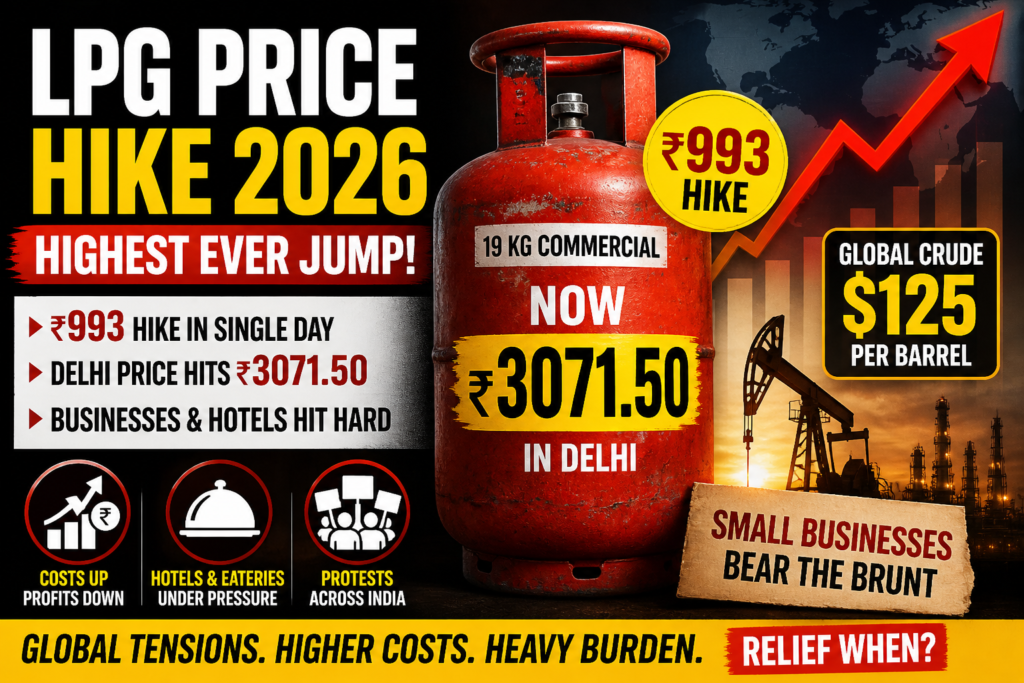
New Delhi: In a record-breaking move that has sent shockwaves through the hospitality sector, state-run oil marketing companies (OMCs) raised the price of a 19-kg commercial LPG cylinder by a staggering ₹993 on May 1, 2026. This marks the steepest commercial LPG cylinder price hike in Indian history, pushing the retail rate in Delhi to ₹3,071.50.
For millions of small business owners, from roadside dhabas to urban cafes, this isn’t just a statistic—it’s a survival challenge. The latest increase is the third in as many months, following a ₹144 rise in March and ₹203 in April. Cumulatively, commercial users now pay 81% more than they did just 90 days ago.
Why Domestic Kitchens Are Spared, But Eateries Aren’t
In a rare silver lining for households, domestic LPG prices remain unchanged. However, that offers little comfort to hoteliers, restaurant owners, and caterers who depend entirely on commercial cylinders. Unlike the subsidized domestic LPG, commercial cylinders track global energy markets directly.
This commercial LPG cylinder price hike means our monthly cooking gas bill has nearly doubled, said Ramesh Kumar, who runs a small eatery in Bengaluru’s Indiranagar. We have no choice but to raise plate prices. Customers are already angry.

From ₹658 to ₹3,071: A 17-Year Price Shock
To understand the magnitude of this surge, consider the historic price trajectory of a 19-kg commercial cylinder in Delhi:
- 2008: ₹831
- 2009: ₹658 (all-time low)
- 2020 (pandemic period): ₹1,100–₹1,300
- Early 2025: ₹1,500–₹1,700
- May 1, 2026: ₹3,071.50
At current levels, a commercial cylinder costs nearly five times what it did in 2009. For a typical mid-sized hotel using 10 cylinders a month, the additional monthly expense exceeds ₹15,000 overnight. This commercial LPG cylinder price hike is unprecedented in both scale and speed.
Protests Erupt as Small Businesses Feel the Pinch
In Bengaluru, members of the Karnataka Youth Congress staged a dramatic protest at Freedom Park, holding empty cylinders and placards reading Stop the Attack on Livelihoods. Similar demonstrations have been reported in Hyderabad, Lucknow, and Patna.
Hotel operators warn of a cascading effect on food inflation. We absorb small increases, but ₹993 in one go is impossible, said a representative from the Federation of Hotel & Restaurant Associations of India (FHRAI). The final commercial LPG cylinder price hike impact will be on the customer’s plate.
Political Firestorm: “Election Bill” or Global Reality?
The massive hike, coming just weeks before state elections in multiple states, has triggered sharp political reactions. Congress leader Rahul Gandhi called it the largest single-day increase in recent memory, terming it an “election bill” and warning that petrol and diesel could follow suit.
Mayawati urged the government to revert to earlier price moderation measures, while Akhilesh Yadav argued the commercial LPG cylinder price hike will make even basic food items unaffordable for the common man.
Global Tensions Behind the Surge
Why such a sharp increase? India imports more than 60% of its LPG requirements, making domestic prices highly sensitive to global trends. Recently, crude oil prices have risen to around $120–$125 per barrel, driven by escalating tensions in West Asia and concerns over potential supply disruptions through the Strait of Hormuz.
Although a recent LPG shipment to India safely passed through the region, analysts caution that if crude oil prices remain above $120 for an extended period, further price hikes may be unavoidable.
Every dollar increase in crude oil directly raises India’s import bill, an energy economist noted. The commercial LPG cylinder price hike clearly reflects how global energy pressures are impacting local businesses.
Also Read:Great Nicobar Project Explained: Why Rahul Gandhi and BJP Are at Odds

What Comes Next?
For now, domestic users can breathe easy, but commercial operators face a difficult summer. With no government subsidy on the horizon and global markets volatile, industry insiders expect further price revisions in June unless crude cools significantly.
If you run a small hotel or café, revisit your menu pricing strategy immediately. For millions of Indians eating out, that humble plate of idli or biryani is about to get more expensive—directly because of the relentless commercial LPG cylinder price hike.