
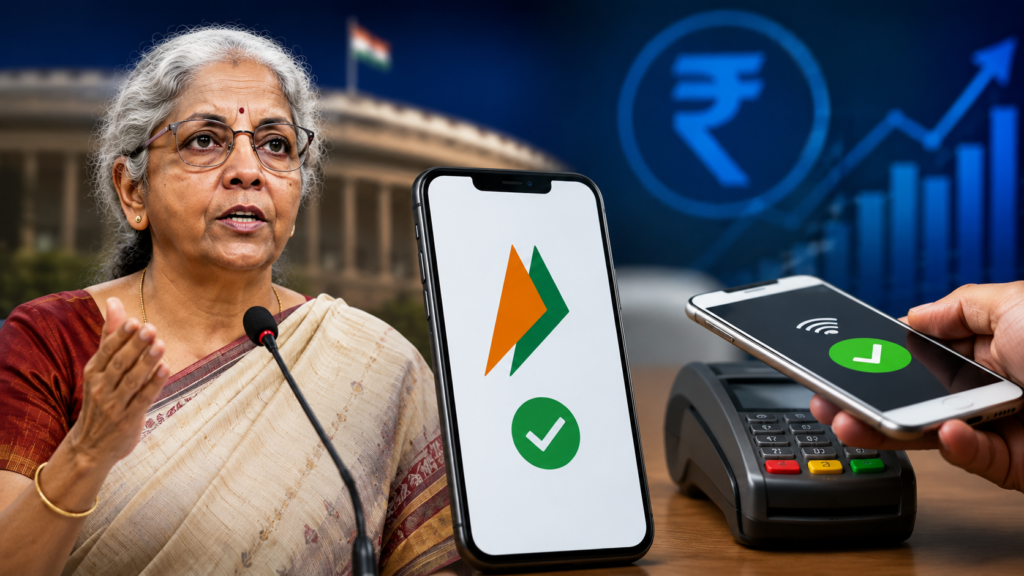
New Delhi: Finance Minister Nirmala Sitharaman has clarified that ordinary users would not directly bear a proposed Merchant Discount Rate (MDR) on UPI transactions. Her comments came after Congress leader Jairam Ramesh raised concerns about the possibility of users eventually having to pay for digital payments.
Sitharaman said that MDR, if introduced for UPI transactions, would apply to merchants rather than customers. However, she also made it clear that no decision has yet been taken to introduce an MDR on UPI payments.
What Is UPI MDR?
The Merchant Discount Rate (MDR) is a fee associated with processing certain digital payment transactions. It is generally paid by the merchant to the entities involved in processing a digital payment.
UPI transactions have largely remained free for consumers, and the government has supported the ecosystem through various measures. The latest discussion is about whether a mechanism could be introduced to support the long-term development of the digital payments infrastructure.
According to Sitharaman’s clarification, any MDR considered for UPI would be applicable to merchants and not directly charged to end users.

Sitharaman Responds to Concerns Over UPI Charges
Responding to concerns raised by Jairam Ramesh on social media, the Finance Minister said that MDR applies to merchants and not to customers.
She also explained that the purpose of considering such a mechanism would be to help banks and fintech companies invest more in digital payment infrastructure, innovation and security.
The clarification is important because reports and political statements about possible UPI charges had raised concerns among consumers who use UPI regularly for everyday payments.
No Decision on UPI MDR Yet
One of the key points in the Finance Minister’s statement is that there is currently no final decision to impose MDR on UPI transactions.
Sitharaman said the UPI and Services Steering Committee, headed by the National Payments Corporation of India (NPCI), would examine the matter after Parliament passes the Taxation and Other Laws (Amendment) Bill, 2026.
This means the discussion about UPI MDR is still at the policy and legislative stage rather than being an immediate change for UPI users.
What Does the Proposed Bill Have to Do With It?
The proposed legislation would give the central government the power to notify which electronic payment modes or transactions would continue to remain free.
The provision has therefore attracted attention because of its potential implications for India’s rapidly expanding digital payment ecosystem.
However, the Finance Minister’s latest clarification indicates that consumers should not assume that they will suddenly have to pay a fee every time they make a UPI payment.
Why Is MDR Being Discussed?
UPI has become one of India’s most widely used digital payment systems, with millions of transactions taking place every day.
Maintaining such a large payment network requires continued investment in technology, cybersecurity, infrastructure and payment processing. The discussion around MDR is partly linked to how banks and fintech companies can continue investing in these areas.
Sitharaman said that such investment would help strengthen the overall digital payments ecosystem.
Will UPI Payments Become Chargeable?
At present, there is no confirmed decision to charge consumers for making UPI payments.
The government is yet to take a final decision on an MDR framework, and the relevant committee is expected to examine the matter following the passage of the proposed legislation.
Therefore, reports suggesting that UPI users will immediately have to start paying transaction fees should not be treated as a confirmed policy change.
Also Read: ITR Filing Last Date 2026: Complete These Important Financial Tasks Before July 31
Key Takeaways
- Any proposed UPI MDR charges would apply to merchants, according to Sitharaman’s clarification.
- Customers would not be directly charged under the proposal discussed.
- No final decision has been taken to introduce MDR on UPI.
- The UPI and Services Steering Committee is expected to examine the issue.
- The proposed framework is linked to the Taxation and Other Laws (Amendment) Bill, 2026.
- The objective under discussion is to support investment in digital payment infrastructure, innovation and security.