
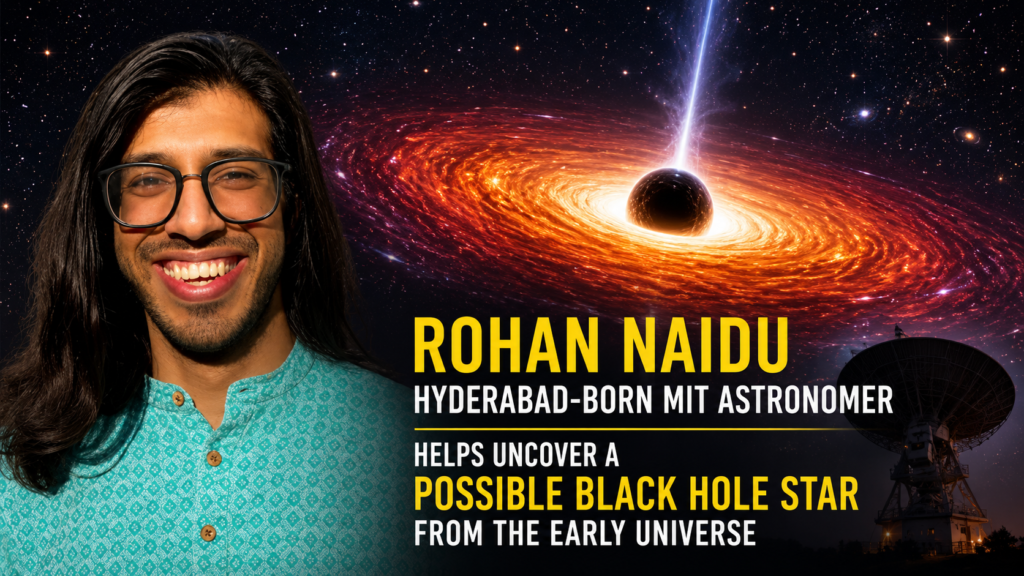
Rohan Naidu has emerged at the centre of a remarkable astronomy discovery involving a possible black hole star from the early universe, drawing attention to how the first massive objects in the cosmos may have formed.
The Hyderabad-born astronomer, associated with the Massachusetts Institute of Technology (MIT), contributed to research that has identified evidence for an unusual cosmic object that could provide clues about the origins of some of the earliest black holes.
Rohan Naidu and the Possible Black Hole Star Discovery
- Rohan Naidu is an astronomer of Indian origin whose work focuses on distant galaxies and the early universe.
- His research has helped scientists investigate extremely ancient cosmic systems that existed when the universe was still relatively young.
- The newly reported object is considered a possible black hole star, a rare theoretical type of object linked to the formation of massive black holes.
- Researchers are studying whether the observed characteristics are consistent with a star-like object containing a rapidly growing black hole at its centre.
- The finding is significant because astronomers are still trying to explain how the universe produced enormous black holes so early in cosmic history.
Also Read :- IPS Officer Ashutosh Mishra’s 95-Year-Old Mother Found Murdered in UP Home; Jewellery Missing
Why Is the Black Hole Star Important?
The discovery connected with Rohan Naidu could help address one of astronomy’s biggest questions: how did the first supermassive black holes form so quickly?
One possibility is that some early stars were fundamentally different from stars observed in the modern universe.
Scientists have proposed that certain massive primordial stars could have formed around rapidly growing black holes. Such objects could potentially act as an intermediate stage in the development of the enormous black holes now observed at the centres of galaxies.
- The candidate object comes from the early universe.
- Its unusual properties make it important for studying early black-hole formation.
- The research could provide evidence supporting theoretical models of black hole stars.
- Further observations are needed before scientists can establish the object’s exact nature.

What Did Rohan Naidu Do Before MIT?
The story of Rohan Naidu has also attracted attention because of his unconventional academic journey.
According to reports, Naidu left engineering at the age of 18 before eventually pursuing astronomy and building a career in astrophysics.
His path eventually led him to MIT, where his research has focused on some of the most distant and difficult-to-observe objects in the universe.
The career of Rohan Naidu highlights how scientific research can involve a long and unconventional route rather than a straightforward academic path.
What Does This Discovery Mean for Astronomy?
The work involving Rohan Naidu is important because observing the early universe allows astronomers to look back billions of years into cosmic history.
- It may improve understanding of supermassive black hole formation.
- It could offer evidence for unusual stellar objects predicted by theoretical models.
- It may help explain how massive black holes appeared surprisingly early after the Big Bang.
- It adds another potential target for future observations with powerful space and ground-based telescopes.
A Discovery Still Under Investigation
The object associated with the research should currently be described as a possible black hole star, rather than a confirmed new class of astronomical object.
More observations and analysis will be required to determine whether the evidence conclusively supports the black-hole-star interpretation.
For Rohan Naidu, the research represents another step in understanding a period of the universe that remains one of astronomy’s greatest scientific mysteries.