
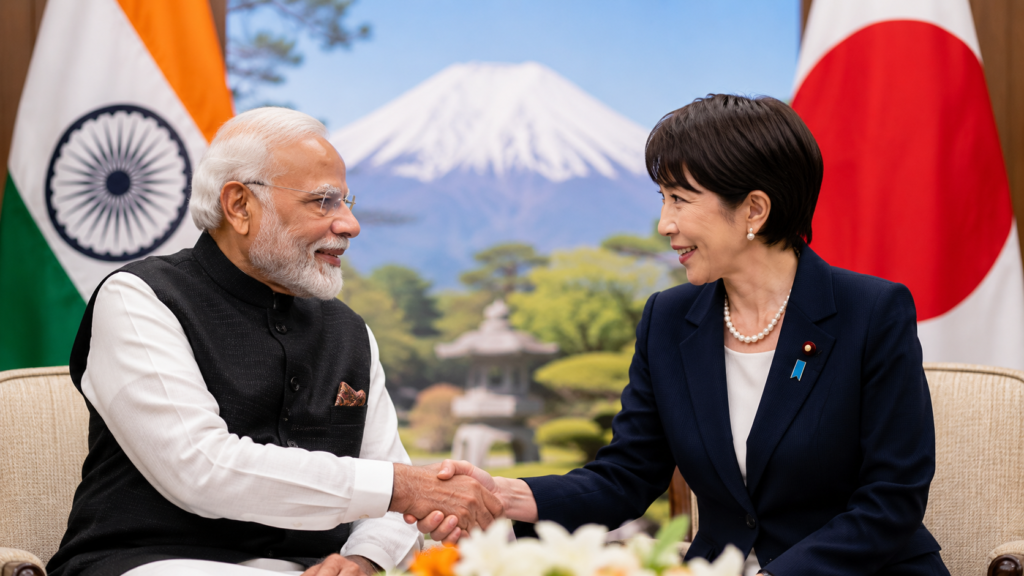
India and Japan have reaffirmed their commitment to strengthening bilateral ties following a high-level meeting between Prime Minister Narendra Modi and Japanese Prime Minister Sanae Takaichi. The PM Modi Japan Meeting focused on expanding cooperation in key sectors such as defence, pharmaceuticals, technology, investment, and regional security.
The discussions highlighted the growing strategic partnership between the two countries, which continues to play an important role in ensuring peace, stability, and economic growth across the Indo-Pacific region.
India and Japan Reiterate Commitment to Strong Bilateral Relations
During the meeting, Prime Minister Narendra Modi and Prime Minister Sanae Takaichi reviewed the progress of ongoing India-Japan partnerships and explored new opportunities for collaboration.
Both leaders emphasized the importance of maintaining close diplomatic relations while expanding cooperation in areas that can benefit the economies and people of both nations.
The meeting also reflected the shared vision of India and Japan to strengthen strategic and economic engagement amid evolving global challenges.

Defence Cooperation Remains a Key Focus
Defence cooperation emerged as one of the major topics during the PM Modi Japan Meeting. India and Japan have steadily increased military coordination over the past few years through joint exercises, defence technology discussions, and maritime security initiatives.
Officials from both countries are expected to continue discussions on enhancing defence collaboration and strengthening security partnerships in the Indo-Pacific region.
Pharma and Healthcare Collaboration
The two leaders also discussed expanding cooperation in the pharmaceutical and healthcare sectors.
India’s pharmaceutical manufacturing capabilities and Japan’s expertise in advanced medical technology provide significant opportunities for future collaboration. Both countries are expected to explore partnerships related to medicine production, healthcare innovation, and medical research.
Such cooperation could contribute to improving healthcare access while supporting resilient global supply chains.
Technology, Investment and Trade
Technology and investment were also important areas of discussion. India and Japan have maintained strong economic ties through infrastructure development, manufacturing, digital innovation, and clean energy projects.
The meeting highlighted the need to encourage greater private-sector investment, promote advanced manufacturing, and strengthen cooperation in emerging technologies.
Both governments expressed interest in creating new opportunities for businesses and investors.
Shared Vision for the Indo-Pacific
India and Japan continue to support a free, open, and inclusive Indo-Pacific. During the meeting, both leaders discussed regional developments and reaffirmed their commitment to promoting peace, stability, and adherence to international law.
The Indo-Pacific remains a priority for both countries due to its strategic importance for global trade, maritime security, and economic cooperation.
Why the Meeting Matters
The PM Modi Japan Meeting comes at a time when India and Japan are expanding cooperation across multiple sectors. Stronger collaboration in defence, technology, healthcare, and investment is expected to deepen the strategic partnership and create new opportunities for both nations.
Experts believe the growing relationship will contribute to regional stability while supporting economic development and innovation.
Also Read: PM Modi Iran President Meeting: India Reaffirms Support for Peace and Stability in West Asia
Conclusion
The meeting between Prime Minister Narendra Modi and Japanese Prime Minister Sanae Takaichi reflects the continued commitment of India and Japan to strengthening their long-standing partnership. By focusing on defence, pharmaceuticals, technology, investment, and regional security, both countries are working toward a broader strategic relationship that benefits not only their citizens but also the wider Indo-Pacific region.
As discussions progress, further announcements and agreements are expected to reinforce the strong diplomatic and economic ties between the two nations.