
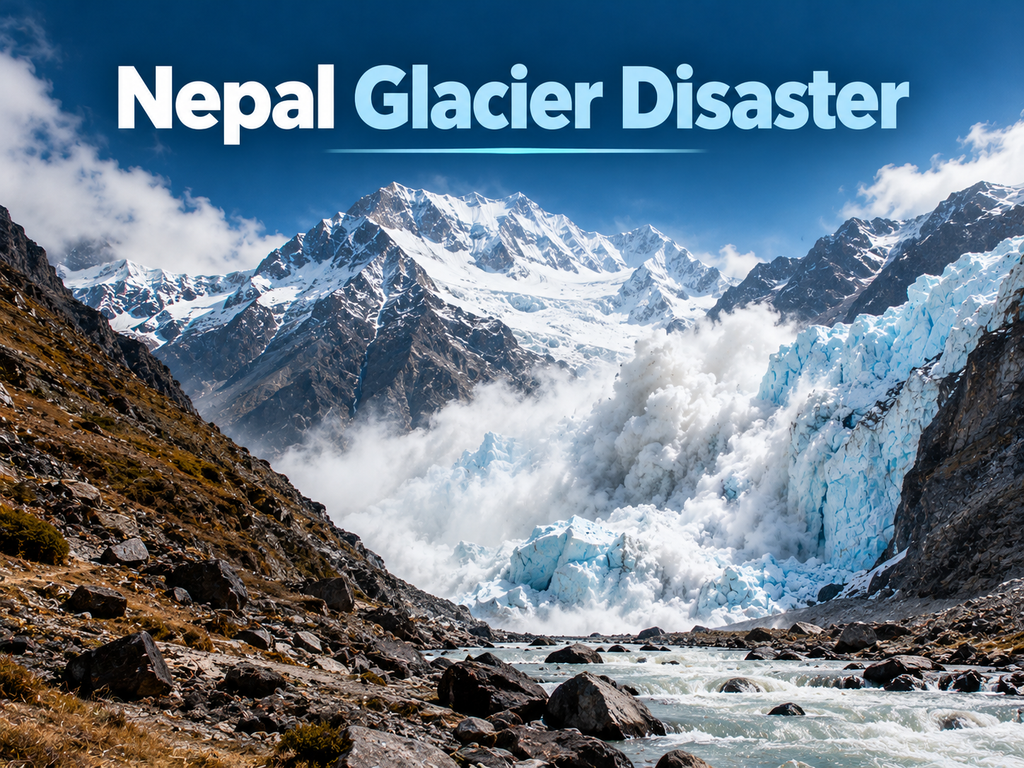
The mountains that define Nepal’s identity have delivered one of the region’s most devastating shocks in years. The Nepal glacier disaster near the China border has killed hundreds, left thousands missing and prompted urgent warnings about climate change in the Himalayas.
What Happened in Nepal?
The US Geological Survey said the disaster, which struck on a Wednesday near the high-altitude China-Nepal border, was caused by a glacial collapse that sent a torrent of debris downstream. Early reports put the toll at 682 confirmed dead and nearly 3,000 missing. arynewsarynews
Photos from Trishuli Bazar in Nepal’s Nuwakot district showed rescue workers moving through damaged buildings. The Nepal Army deployed helicopters and disaster response personnel to the affected area. Officials later described a tsunami-like surge of freezing water, rocks and debris that tore through everything in its path. Former environment minister Madhav Prasad Chaulagain called the scale unprecedented, saying a civilization that flourished on the riverbank was swept away in moments. nuktasentinelassam
Was Climate Change Behind It?
The exact trigger is still unclear. As one report put it, while the cause of the collapse is not certain, climate change is melting glaciers worldwide and raising the risk of such disasters. newsofbahrain
The Himalayas are warming, and glaciers are retreating and destabilising. They can leave behind unstable lakes and loose debris that can fail without much warning. Scientists often describe the Hindu Kush Himalayan range as a “third pole” because of the vast amount of ice it holds.
“A Warning Signal” From Nepal’s Foreign Minister
Foreign Minister Shisir Khanal said the tragedy should be treated as a warning signal about the risk climate change poses to Nepal. He also said that international support should be seen through the lens of climate justice, not just aid or charity. macaubusinessomanobserver
That argument rests on a stark imbalance. Khanal noted that Nepal contributes about 0.01 percent of global greenhouse gases, yet its people are among the major victims of a changing climate. He also stressed long-term support, because the disaster hit lives and public infrastructure alike. Nepal, he said, needs help with both adaptation and mitigation. arynews

China’s Role: Data, Satellites and Early Warnings
The disaster also put Nepal-China cooperation in the spotlight. After a call between Khanal and his Chinese counterpart Wang Yi, both sides agreed to increase the sharing of real-time hydrological data. thesun
China’s foreign ministry said Beijing had shared disaster-area imagery, satellite and hydrological data, and early warnings about upstream barrier lakes. That last item matters because barrier lakes formed by debris can burst and trigger a second wave of flooding. Khanal confirmed that China has shared a lot of data for the region where the disaster occurred. arynewsmacaubusiness
Why Regional Cooperation Matters
Himalayan rivers ignore borders. A collapse high in the mountains can endanger communities across several countries. Khanal acknowledged the risk extends beyond Nepal, to downstream communities and China itself. thesun
Chaulagain argued that Nepal, India and China should work together, since the glaciers they share are a ticking time bomb. For India, which depends on Himalayan-fed rivers like the Ganga and Brahmaputra, this is directly relevant. sentinelassam
Also visit us: PHP Security Vulnerabilities
What Needs to Happen Next
Experts and officials point to several priorities:
- Faster data sharing. Khanal said the disaster gives more urgency to building early-alert mechanisms on a much faster timeline.
- More research. Nepal needs a better understanding of the changing dynamics of the Himalayan ecosystem. newsofbahrain
- Climate finance. Vulnerable countries need funding for adaptation, not only emergency relief.
- Cross-border monitoring. Satellite tracking of glaciers and glacial lakes should be shared among Himalayan nations.
- Community preparedness. Warning systems and evacuation plans for river-valley settlements can save lives.
The Bottom Line
The Nepal tragedy is a human catastrophe first. It is also a clear signal that Himalayan glacier risks are growing and that small, low-emitting nations bear a heavy share of the burden. Nepal glacier disaster whether the world answers with cooperation, climate finance and early-warning systems will shape how many lives are lost the next time a mountain gives way.