
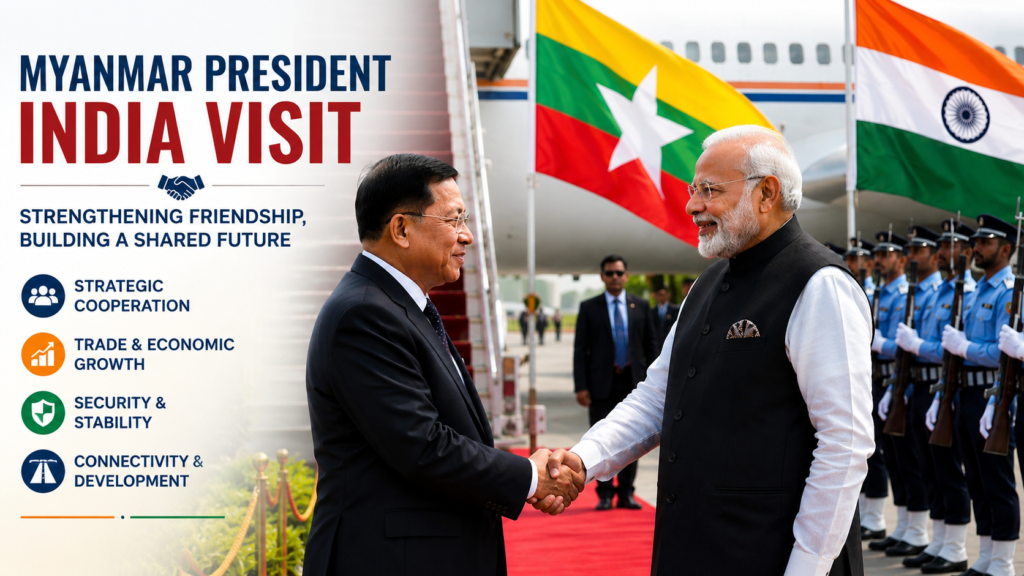
Myanmar President India Visit has become one of the most closely watched diplomatic developments in South Asia this week. The five-day visit by Myanmar’s President U Min Aung Hlaing is drawing attention from policymakers, security experts, and regional observers who are eager to understand what this engagement could mean for the future of India-Myanmar relations.
As geopolitical dynamics continue to evolve across Asia, this visit is expected to shape discussions on security cooperation, border management, trade connectivity, and regional stability. The timing of the visit has made many analysts wonder whether a new chapter is about to begin between the two neighboring countries.
Advertisement

Also Read :- Gaza Ceasefire Violation Raises Global Concerns as Israel Expands Military Control in Gaza
Myanmar President India Visit Signals Growing Strategic Cooperation
The Myanmar President India Visit comes at a time when both countries are looking to strengthen diplomatic engagement and address shared regional challenges. India and Myanmar share a long land border, making cooperation essential for economic development and security coordination.
Officials from both nations are expected to discuss several critical issues, including infrastructure projects, cross-border connectivity, and measures to improve trade routes. These discussions are particularly important as both countries seek to enhance regional integration and economic opportunities.
Observers believe the visit demonstrates a mutual commitment to maintaining open channels of communication despite changing geopolitical circumstances.
Advertisement

Why Connectivity Is Expected to Dominate Discussions
One of the most anticipated topics during the Myanmar President India Visit is connectivity. India has invested in multiple infrastructure initiatives designed to improve links with Southeast Asia through Myanmar.
Projects involving highways, transport corridors, and trade infrastructure are expected to receive significant attention. Improved connectivity could facilitate smoother movement of goods and people while creating new opportunities for businesses operating across borders.
Experts suggest that progress in these projects could strengthen regional commerce and support long-term economic growth for both countries.
Security Cooperation Remains a Major Priority
Security is likely to remain a key agenda item throughout the Myanmar President India Visit. The shared border between India and Myanmar creates a need for close coordination on issues related to border management and regional stability.
Both sides are expected to explore ways to enhance cooperation against cross-border criminal activities and strengthen communication mechanisms between relevant agencies. Such efforts are viewed as essential for maintaining peace and security in border regions.
The discussions may also focus on broader regional security concerns that affect both nations and their neighboring countries.
Trade and Economic Opportunities Under the Spotlight
Beyond strategic and security matters, the Myanmar President India Visit is generating interest among business communities. Economic cooperation has the potential to unlock new opportunities for trade, investment, and industrial collaboration.
Analysts believe that expanding commercial ties could benefit sectors ranging from agriculture and manufacturing to logistics and infrastructure development. Businesses on both sides are closely monitoring developments that may emerge from the high-level meetings.
The visit could also encourage greater engagement between private sector stakeholders seeking to explore cross-border partnerships.
Regional Implications of the Visit
The significance of the Myanmar President India Visit extends beyond bilateral relations. Many regional observers view the engagement as an important step in shaping broader cooperation across South and Southeast Asia.
With increasing emphasis on regional connectivity and economic integration, stronger India-Myanmar relations could contribute to wider stability and development efforts. The outcomes of the discussions may influence future diplomatic initiatives involving neighboring countries as well.
As leaders continue their meetings, attention remains focused on what agreements, commitments, or collaborative frameworks may emerge during the visit.