
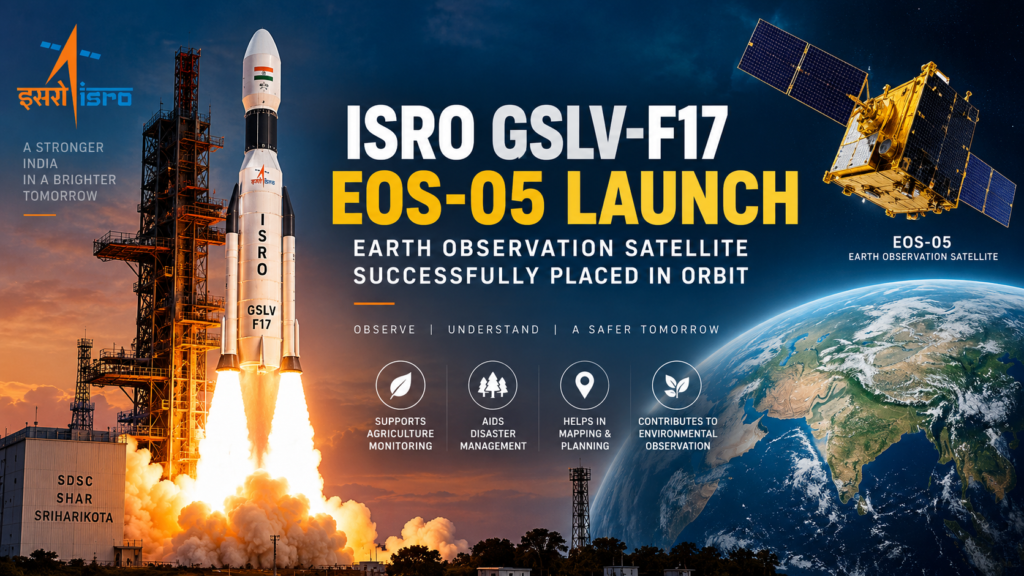
ISRO GSLV-F17 EOS-05 Launch has marked another important milestone for India’s space programme, with the Geosynchronous Satellite Launch Vehicle (GSLV-F17) successfully carrying the EOS-05 Earth observation satellite into its designated geosynchronous orbit.
The launch took place from the Satish Dhawan Space Centre in Sriharikota, Andhra Pradesh, putting the focus once again on India’s growing Earth-observation capabilities.
Also Read :- PM Modi to Visit SRCC on September 5: 5 Key Details About the Gen Z-Focused Event
ISRO GSLV-F17 EOS-05 Launch: What Happened?
- The GSLV-F17 rocket was used to carry the EOS-05 Earth observation satellite.
- The mission was conducted from Sriharikota’s Satish Dhawan Space Centre.
- After liftoff, the launch vehicle followed its planned flight sequence to place the satellite into geosynchronous orbit.
- The successful deployment adds another mission to ISRO’s series of satellite launches designed to strengthen India’s space-based observation capabilities.
- The mission is significant because GSLV is designed to place heavier payloads into higher orbits compared with ISRO’s smaller launch vehicles.

What Is EOS-05?
EOS-05 is an Earth observation satellite developed for applications that require satellite-based imaging and observation of the Earth.
Its capabilities are expected to support applications where timely and detailed information from space is useful. Earth observation satellites are commonly used for areas such as land monitoring, agriculture, disaster management, mapping and environmental observation.
The satellite’s placement in geosynchronous orbit is an important part of the mission because the orbit allows the spacecraft to operate at a high altitude while maintaining a specific relationship with Earth’s rotation.
Why Is GSLV-F17 Important?
The GSLV-F17 mission is important not only because of the satellite it carried but also because of the launch vehicle itself.
GSLV is one of ISRO’s major operational launch vehicles and uses a combination of solid, liquid and cryogenic propulsion stages. Its cryogenic upper stage enables the rocket to deliver payloads to higher-energy orbits.
The successful mission therefore demonstrates the continued operational importance of GSLV for India’s larger satellite requirements.
What Will EOS-05 Be Used For?
EOS-05 is an Earth observation mission, meaning its primary purpose is to collect information about Earth from space.
Such satellite data can provide valuable inputs for:
- Earth and land-surface observation
- Agricultural monitoring
- Disaster management
- Natural-resource assessment
- Environmental monitoring
- Mapping and planning applications
The satellite’s usefulness ultimately depends on the imagery and data generated during its operational life.
Does EOS-05 Have a Commercial Price?
There is no publicly reported retail or consumer price for EOS-05 because it is a government space mission and not a commercially sold satellite product.
Similarly, the mission should not be viewed as a conventional market product with different consumer variants. Its importance lies in its Earth-observation role, satellite technology and data capabilities.
What Does the Successful Launch Mean for India?
The successful ISRO GSLV-F17 EOS-05 Launch strengthens India’s capability to deploy Earth-observation spacecraft using its indigenous launch systems.
The mission also highlights the continuing demand for satellite-based Earth observation, particularly as space-derived data becomes increasingly important for agriculture, infrastructure planning, environmental monitoring and disaster response.
For ISRO, the successful deployment represents another operational achievement for the GSLV programme and another step in expanding India’s satellite-based observation infrastructure.