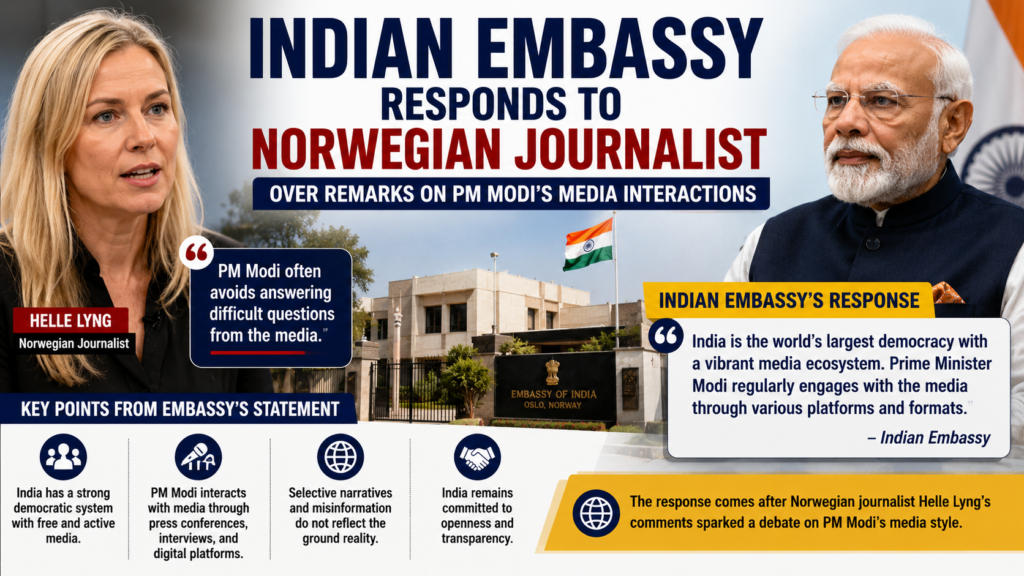
The Indian Embassy has issued a response after Norwegian journalist Helle Lyng reportedly criticized Prime Minister Narendra Modi’s media interaction style during an international discussion that quickly gained attention online.
The controversy began after remarks made by the journalist regarding press interactions involving PM Modi started circulating across social media and news platforms.
The latest Indian Embassy response to Norwegian journalist has now sparked political debate and international media discussions.
What Did the Norwegian Journalist Say?
According to reports, Norwegian journalist Helle Lyng questioned whether Prime Minister Narendra Modi avoids difficult media questions during official interactions and public appearances.
Her comments reportedly focused on:
- Press conference formats
- Media accessibility
- Political communication styles
- Question-answer interactions
The remarks quickly became viral online and triggered reactions from political supporters and critics alike.

Indian Embassy Issues Response
In its official reaction, the Indian Embassy reportedly defended India’s democratic and media environment while responding to the journalist’s observations.
The Indian Embassy response to Norwegian journalist emphasized:
- India’s strong democratic institutions
- Active media participation
- Public engagement mechanisms
- Large-scale press communication systems
Officials also reportedly criticized what they viewed as selective or misleading narratives regarding India’s political communication practices.
Also Read:PM Modi’s Netherlands Visit Sparks Diplomatic Clash Over Press Freedom Remarks.
Social Media Debate Intensifies
The issue rapidly gained attention across social media platforms, where users expressed mixed opinions.
Some users supported the journalist’s comments and argued for:
- More open media interactions
- Increased press conferences
- Greater transparency
Meanwhile, others defended PM Modi’s communication approach and highlighted:
- Direct public outreach
- Digital engagement
- Radio and online communication formats
The Indian Embassy response to Norwegian journalist became a major discussion point among political observers online.
Political Communication Styles Under Spotlight
The controversy has renewed broader conversations around how world leaders interact with media organizations and journalists.
Experts note that political leaders globally adopt different communication methods, including:
- Press conferences
- Interviews
- Social media outreach
- Public addresses
- Digital campaigns
Supporters argue that direct digital communication helps leaders reach wider audiences quickly, while critics stress the importance of unscripted press interactions.
International Media Attention on India
India’s political environment and media landscape often receive global attention due to:
- Its democratic structure
- Large voter base
- International geopolitical role
- Expanding digital influence
The latest Indian Embassy response to Norwegian journalist has once again brought international focus to discussions around media freedom and political communication in India.
Government Supporters Defend PM Modi
Supporters of Prime Minister Modi argued online that:
- The PM frequently addresses the nation directly
- Government initiatives are communicated publicly
- Digital outreach has expanded citizen engagement
Several users also criticized foreign commentary on India’s domestic political matters.
Critics Call for More Open Press Conferences
Critics and opposition voices used the controversy to call for:
- More regular press conferences
- Open questioning formats
- Direct media engagement by senior leaders
The issue has therefore evolved beyond a single comment into a wider debate around media access and political transparency.

Conclusion
The latest Indian Embassy response to Norwegian journalist has triggered fresh political and media discussions both in India and internationally. While the embassy defended India’s democratic communication systems, the controversy has also reopened debates regarding media interaction styles and transparency in modern political leadership.
As online reactions continue, the issue remains a major talking point across news platforms and social media discussions.