
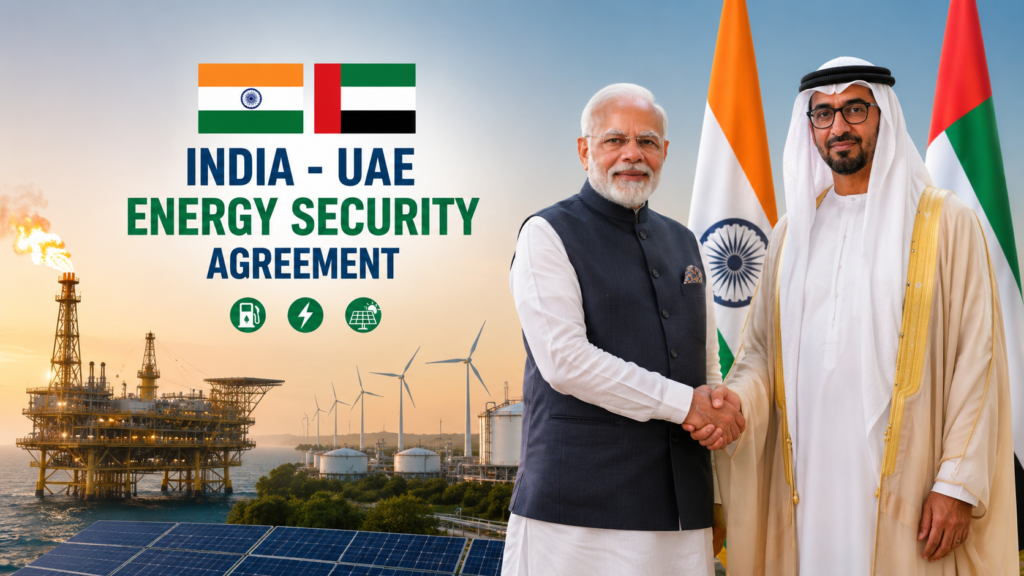
India imports nearly 90% of its crude oil requirements. That makes the world’s sixth-largest economy highly vulnerable to every geopolitical tremor, shipping bottleneck, or price spike. The ongoing US-Iran conflict, which disrupted supplies through the critical Strait of Hormuz, has exposed this weakness with brutal clarity.
Now, during Prime Minister Narendra Modi’s visit to the UAE on Friday, India has taken two significant steps to shield itself from future energy shocks. Two key Memorandums of Understanding (MOUs) were signed – one on strategic petroleum reserves and another on long-term LPG and LNG supply.
This UAE visit also saw the conclusion of key agreements across vital areas such as energy, defence, infrastructure, shipping and advanced technology, giving fresh impetus to the India-UAE Comprehensive Strategic Partnership, PM Modi said on social media.
Here is everything you need to know about these deals, why they matter, and how they will benefit India.
The Core Problem: Why India Needs Energy Security
Before diving into the agreements, understand the vulnerability:
- 90% of crude oil is imported. Any disruption in global supply directly hits India.
- The Strait of Hormuz – a narrow chokepoint between Oman and Iran – is a critical route for Indian oil imports. The US-Iran conflict has disrupted flows through this strait.
- LPG (cooking gas) is also heavily imported, mostly from the Middle East, making India dependent on a single volatile region.
Strategic petroleum reserves act as a buffer. They are underground stockpiles of crude oil that a country can tap into during emergencies – wars, natural disasters, or supply blockades – to keep the economy running and prevent panic buying.
Compared to the US, Japan, and China, India’s strategic reserves have been woefully inadequate. These new agreements aim to change that.

What Was Signed: Two Key MOUs Explained
| MOU | Parties | Key Provisions |
|---|---|---|
| Strategic Collaboration on Reserves | Indian Strategic Petroleum Reserves Limited (ISPRL) & Abu Dhabi National Oil Company (ADNOC) | • ADNOC to store up to 30 million barrels of crude in India’s existing reserves (Visakhapatnam, Andhra Pradesh) • Development of new reserve facilities in Chandikol, Odisha • Potential storage of Indian crude in Fujairah, UAE to form part of India’s strategic reserve |
| LPG Supply Agreement | Indian Oil Limited (IOCL) & ADNOC Gas Limited | • Long-term sale and purchase of LPG (cooking gas) • Exploration of opportunities in LNG storage facilities in India |
How India Benefits: Beyond Just Stockpiling Oil
1. A Buffer Against Geopolitical Shocks
The US-Iran war has been a wake-up call. With the Strait of Hormuz disrupted, countries with large strategic reserves are coping better. India’s agreement with the UAE effectively expands India’s reserve capacity without having to build everything from scratch.
Larger and more collaborative reserve arrangements can reduce exposure to short-term volatility, and provide policymakers with more space to respond during crises, said Sourav Mitra, Partner – Oil & Gas at Grant Thornton Bharat.
Storing oil in Fujairah (UAE) is particularly strategic – it lies outside the Strait of Hormuz, giving India a backup supply that bypasses the most dangerous chokepoint.
2. Reduced Dependence on Volatile Spot Markets for LPG
India’s LPG demand is rising steadily due to urbanization and government clean-cooking initiatives. The long-term agreement with ADNOC means India locks in supplies at predictable prices, avoiding sudden spikes in the spot market.
Securing long-term LPG supply arrangements with the UAE can help India reduce reliance on volatile spot cargo markets, improve supply visibility, and enhance affordability and availability for domestic consumers, said Sumit Ritolia, Manager – Modelling and Refining at Kpler.
For the common citizen, this translates to more stable cooking gas prices.

3. Closer Coordination with a Trusted Partner
The UAE is one of India’s top five crude oil suppliers. Its geographical proximity means supplies can arrive quickly. Moreover, the UAE recently left OPEC and OPEC+, freeing it to step up oil production without cartel restrictions. This works to India’s advantage.
Recent data from Kpler shows that India’s crude imports from the UAE during late April and May have already recovered to pre-conflict levels – proof of close coordination despite challenging market conditions.
4. Long-Term Strategic Planning, Not Just Crisis Management
Strategic reserves are no longer just emergency storage assets but strategic instruments that strengthen national energy resilience, Mitra added.
The agreements allow India to think beyond immediate procurement. They build resilience into the system, so the next time a crisis hits, India will have more breathing room.
What Experts Are Saying
Gaurav Moda, Partner & Leader – Energy Sector, EY-Parthenon India:
India and UAE have a long shared history and diaspora, increasingly closer in recent times. Given the global uncertainties, such bilateral engagement is timely and mutually beneficial to both countries in a major way.
Sumit Ritolia, Kpler:
The agreements reinforce India’s broader strategy of securing diversified and reliable energy partnerships while improving preparedness against future market disruptions. At a time when energy security has become increasingly intertwined with geopolitics, logistics, and trade flows, these MoUs could provide India with greater supply stability, strategic resilience, and stronger coordination with one of its key Middle Eastern energy partners.
The Immediate Reality: Short-Term Challenges Remain
A note of caution: These agreements will yield long-term benefits, not an instant fix. The Strait of Hormuz is still disrupted. Immediate supply constraints remain.
The immediate short-term impact of the MOUs may remain somewhat limited as trade flows through the Strait of Hormuz continue to face restrictions and elevated geopolitical risks, Ritolia acknowledged.
However, the deals improve India’s positioning in terms of supply preference, bilateral coordination, and long-term import security.
Beyond Oil & LPG: What Else Was Announced?
PM Modi’s UAE visit also saw:
- $5 billion investment from UAE into India, further deepening economic ties.
- Agreements in defence, infrastructure, shipping, and advanced technology – part of the broader India-UAE Comprehensive Strategic Partnership.
Bottom Line: A Game-Changer for India’s Energy Future
For a country that imports almost all its oil and relies on the Middle East for cooking gas, these agreements are not just diplomatic achievements – they are strategic necessities.
- Larger reserves mean more buffer during wars or blockades.
- Long-term LPG contracts mean more stable prices for households.
- Storage in Fujairah means bypassing the Strait of Hormuz.
- Closer UAE ties mean a reliable partner in a volatile neighborhood.
As one expert put it, the value of strategic reserves lies in creating “room for thinking.” India now has more room – and that is a significant step toward true energy security.
Also Read:Fact Check: Has Defence Minister Rajnath Singh Removed Army Chief General Upendra Dwivedi?
In another important development, UAE announced investments worth $5 billion in India. This will further deepen economic ties, PM Modi said.