
The Supreme Court’s recent acceptance of a height based definition for the Aravalli hills has triggered protests across parts of Rajasthan and Haryana, with environmental activists warning that the move could weaken long-standing legal protections for one of India’s oldest mountain systems.
The centre of the controversy is a revised benchmark that determines what officially qualifies as the Aravalli hills. Protesters argue that the new definition risks excluding large swathes of ecologically sensitive terrain — areas they say are critical for groundwater recharge, biodiversity and climate regulation in North India.
What has changed
The court accepted a definition recommended by an expert committee constituted under the Ministry of Environment, Forest and Climate Change (MoEFCC), aimed at introducing uniformity in identifying the Aravalli region, particularly in cases linked to mining and land-use regulation.
Under the revised framework:
- A landform will qualify as an Aravalli hill only if it rises at least 100 metres above the surrounding terrain.
- An Aravalli range will be recognised when two or more such hills exist within a 500-metre distance.
The Centre has said the clarification was necessary to address ambiguity that had led to inconsistent enforcement and prolonged legal disputes.
Why activists are opposing
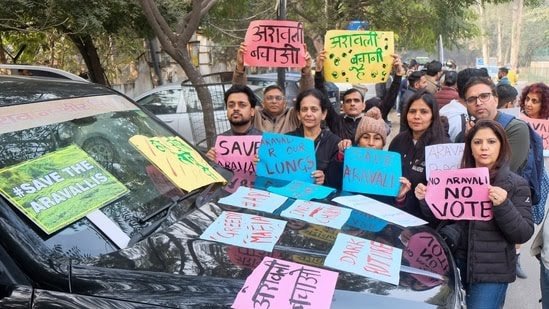
Environmentalists argue that the Aravallis cannot be reduced to a height-based classification. Much of the range consists of low-lying ridges, forested hillocks and rocky outcrops that may not meet the 100-metre criterion but perform essential ecological functions.
“These formations play a key role in groundwater recharge, forest connectivity and slowing desertification. Excluding them from protection simply because they are not tall enough is deeply problematic,” said an environmental activist involved in protests in Gurugram.
Conservation groups also point out that parts of the Aravalli system support aquifers in semi-arid regions of Haryana and Rajasthan, where groundwater depletion and water stress are already severe.
Fears over mining and urban expansion
The Aravalli range has long been under pressure from illegal mining and rapid urbanisation, particularly in the Delhi-NCR region.
Over the past two decades, courts have repeatedly intervened to curb mining activities after studies linked them to environmental degradation, loss of forest cover and declining water tables.
Activists fear that land no longer recognised as part of the Aravallis under the new definition could become vulnerable to fresh mining leases, construction projects and land-use changes.
“Once an area loses its legal identity as Aravalli, environmental safeguards become easier to bypass,” said a protest organiser in Udaipur.
Protests and political response
Protests have been reported in Gurugram, Faridabad, Alwar and Udaipur, with demonstrators demanding a rollback of the revised definition. Rallies have featured placards reading “Save Aravalli, Save Future” and “Aravalli is not just height”.
Opposition leaders have also criticised the move, describing the Aravallis as a natural shield that protects North India from dust storms, rising temperatures and worsening air quality.
Legal challenge underway
A petition challenging the 100-metre criterion has been admitted by the Supreme Court. Petitioners argue that the definition is arbitrary and fails to reflect the geological continuity and ecological role of the Aravalli system, potentially undermining earlier judicial orders aimed at conservation.
The matter is expected to be heard in detail in the coming weeks.
The government’s stand
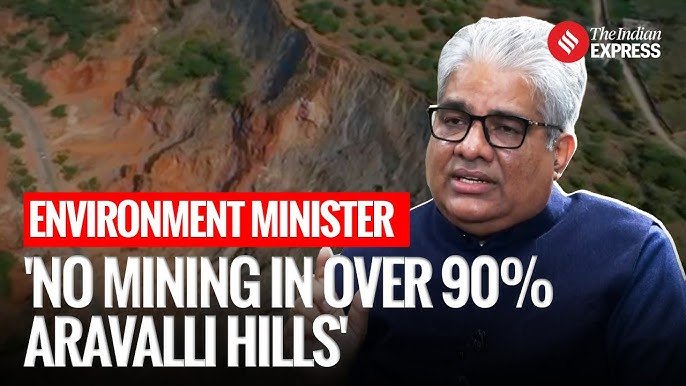
The Union government has defended the revised definition, maintaining that it does not dilute environmental protection. Officials have said that a majority of the Aravalli landscape will continue to remain protected under existing laws and that the clarification is intended to improve enforcement rather than facilitate exploitation.
Unwires Insight
The debate over the Aravalli definition highlights a recurring challenge in environmental governance: balancing administrative clarity with ecological reality.
Natural systems do not function according to neat numerical thresholds. The Aravallis operate as an interconnected ecological barrier — regulating climate, recharging aquifers and slowing desertification — regardless of whether individual formations meet a specific height benchmark.
For regions like Delhi-NCR and western Rajasthan, already grappling with water scarcity, extreme heat and air pollution, even incremental weakening of ecological safeguards could have long-term consequences.
As legal scrutiny continues, the controversy raises a broader question for policymakers and courts alike: should environmental protection be guided primarily by measurable convenience, or by ecological function? The answer may shape not just the future of the Aravallis, but how India chooses to define and defend its natural heritage.