
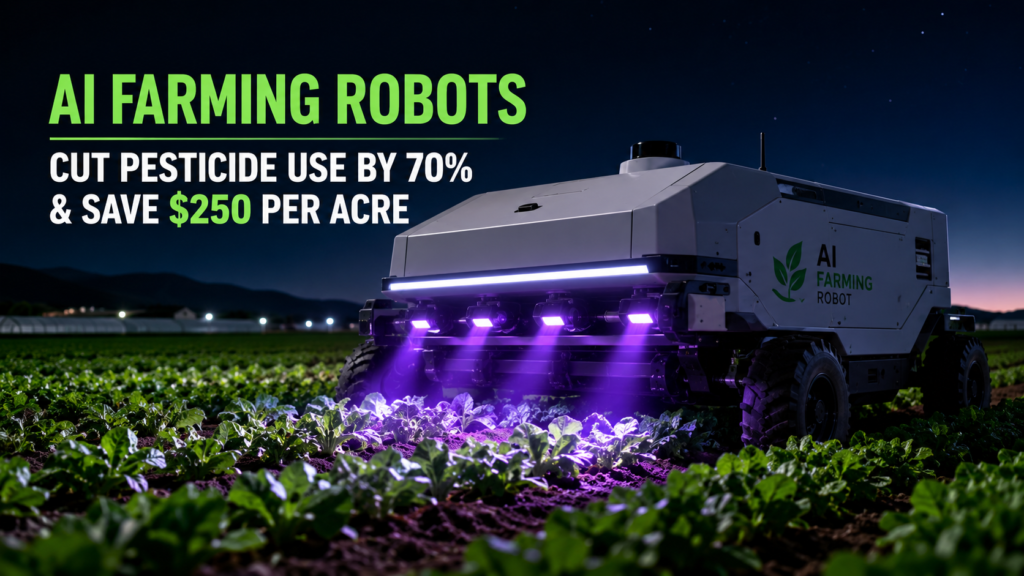
AI Farming Robots are transforming agriculture in California as farmers increasingly adopt advanced robotic systems capable of reducing pesticide usage, lowering costs, and improving crop protection. The technology is drawing global attention after reports showed that farms using these intelligent machines achieved significant reductions in chemical applications while maintaining crop health.
The development highlights how artificial intelligence is becoming an important part of modern agriculture, helping growers address rising production costs, labor shortages, and environmental concerns.
Advertisement

Also Read :- E20 Fuel Insurance Claims: ICICI Lombard Issues Clarification Amid Viral Confusion
AI Farming Robots: Key Highlights
- California farmers are using AI-powered robotic systems in crop fields.
- The technology can reduce pesticide use by up to 70%.
- Farmers have reported savings of approximately $250 per acre.
- Robots operate during nighttime hours for maximum effectiveness.
- UV light technology is being used to control crop diseases.
- AI systems analyze crops and target treatment areas precisely.
- The technology reduces chemical dependency and operational costs.
- Interest in AI-based farming solutions continues to grow globally.
Advertisement

AI Farming Robots Use UV Light Instead of Heavy Chemical Sprays
One of the most innovative aspects of AI Farming Robots is their ability to use ultraviolet (UV) light to combat fungal diseases and crop-related problems.
Unlike traditional methods that rely heavily on pesticide spraying, the robotic systems move through fields during nighttime and expose crops to controlled UV light treatment. Researchers have found that certain pathogens become more vulnerable during night hours, making the treatment more effective.
This targeted approach allows farmers to reduce chemical applications without compromising crop protection.
How AI Farming Robots Work
The AI Farming Robots combine several advanced technologies into a single agricultural solution.
Key features include:
- Artificial intelligence-based crop analysis.
- Autonomous field navigation.
- UV light disease treatment systems.
- Precision farming capabilities.
- Real-time data collection.
- Automated operation during nighttime.
- Reduced dependence on manual labor.
The robots can identify treatment areas and apply targeted solutions only where needed, helping reduce waste and improve efficiency.
How Much Are Farmers Saving?
The answer is significant.
According to reports, farms using AI Farming Robots have recorded savings of nearly $250 per acre due to reduced pesticide requirements and lower operational costs.
The technology is helping growers:
- Reduce chemical expenditure.
- Lower labor costs.
- Improve resource efficiency.
- Increase sustainability efforts.
- Enhance long-term farm productivity.
These benefits have contributed to growing interest among agricultural businesses.
Why Are AI Farming Robots Gaining Attention?
The AI Farming Robots arrive at a time when agriculture faces several major challenges, including rising input costs, environmental regulations, and labor shortages.
Farmers are increasingly looking for solutions that can:
- Improve efficiency.
- Reduce production costs.
- Support sustainable farming practices.
- Minimize environmental impact.
- Maintain crop quality and yield.
The ability to achieve these objectives simultaneously has made AI-driven agricultural technology a major area of investment and research.
Growing Market Demand for AI Farming Robots
Industry experts believe demand for AI Farming Robots will continue to increase as more farmers adopt precision agriculture technologies.
Key factors driving market growth include:
- Expansion of AI-powered farming solutions.
- Increased focus on sustainable agriculture.
- Rising labor costs in agriculture.
- Need for efficient resource management.
- Growing awareness of environmental protection.