
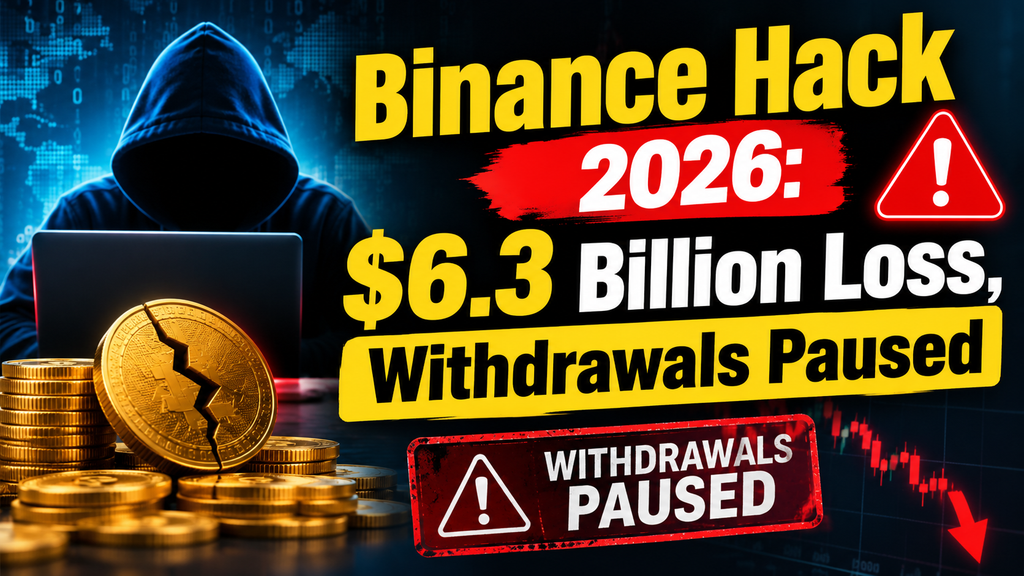
The Binance hack has sent shockwaves through the crypto world. On Friday, 30 October 2026, the world’s largest cryptocurrency exchange temporarily suspended all withdrawals and deposits after a major security breach, with the estimated impact reaching $6.3 billion. Bitcoin, Ethereum and several other top coins slid as investors rushed to understand the damage. Here is a clear breakdown of what happened, what Binance says, and what it means for your money.
What Happened in the Binance Hack?
Binance detected security threats in the early hours of Friday and moved quickly to shut down withdrawals and deposits across its platform. The company says the pause is temporary.
In the first hours, figures for the frozen amount varied widely, from $1.8 billion to $3 billion. Binance later clarified that the verified total frozen stood at $2.54 billion, a number that may rise as teams work with law enforcement, token issuers, blockchain intelligence firms and industry partners to trace and freeze more assets. Binance also said roughly $3 billion had been frozen on-chain so far with the help of blockchain partners, while estimating the total impact at $6.3 billion.
How Did the Attack Happen?
According to Binance’s latest update, the incident may involve a compromised laptop belonging to a DevOps engineer. That access allegedly let the attacker reach a service container and submit unauthorised withdrawal transactions.
Binance says it has found no evidence that any wallet private key was leaked. A detailed technical post-mortem will be shared once the investigation is complete and the facts are fully verified.

Are Your Funds Safe? Binance’s Response
Binance has made three key commitments to users:
- Losses will be covered. The exchange says it will cover all losses using the SAFU fund and the company’s own funds.
- User funds are safe. Binance has stated this directly while remediation continues.
- Transparency is coming. An updated Proof of Reserves will be published once remediation is complete.
The exchange has also warned users to stay alert for scams. Do not trust unofficial links, messages or requests for account information, as attackers often exploit moments of panic like this.
What Is the SAFU Fund?
The Secure Asset Fund for Users (SAFU) is an emergency reserve Binance set up in July 2018 to protect users during extreme events such as security breaches or platform-level incidents. As of 2026, the fund holds roughly $1 billion, held entirely in Bitcoin, following a conversion completed in early 2026. Since the estimated impact far exceeds the SAFU balance, Binance says company funds will also be used to cover losses.
Also visit us: PHP Security Vulnerabilities
Crypto Prices Today: Market Reaction
The news triggered a broad sell-off. At the time of reporting:
- Bitcoin fell about 3% to around $77,840, touching a six-week low of $77,646.
- Ethereum dropped about 4% to near $2,226.
- BNB, Binance’s own token, crashed more than 5% to around $715.
- XRP and Solana slipped 3-4%, with XRP near $1.22 and Solana near $94.46.
- Dogecoin, Chainlink, Cardano and Stellar also declined, between roughly 2.6% and 4.5%.
The total crypto market cap fell about 2% to $2.65 trillion, while Bitcoin’s market dominance stood near 59%.
What Experts Are Saying
Fredrick Collins, CEO and co-founder of Velo Data, said the rumoured breach is clearly pulling prices down. Because Binance is so large, any dent in confidence in the exchange becomes a dent in confidence in the whole industry, especially with investors already nervous about growing AI-driven cyber capabilities.
Vikram Subburaj, CEO of Giottus.com, noted that Bitcoin fell even though US spot Bitcoin ETFs recently saw inflows, suggesting institutional buying was not strong enough to offset security worries. He placed Bitcoin’s immediate support near $76,600 and resistance near $78,100. He added that the wider decline reflects general risk aversion rather than weakness in one specific crypto sector. The latest Fed policy outcome is another factor weighing on prices.
What Should Investors Do Now?
The Binance hack is a reminder that even the biggest platforms are not immune to attack. A few sensible steps:
- Avoid panic selling or aggressive dip-buying. Analysts suggest staggered entries and modest position sizes until Bitcoin stabilises.
- Use only official Binance channels. Ignore unsolicited links, DMs and emails.
- Enable strong security. Use two-factor authentication, anti-phishing codes and withdrawal whitelists.
- Do not keep everything on one exchange. Consider spreading holdings or using self-custody for long-term assets.
- Wait for the post-mortem and Proof of Reserves. These will show the true scale and how well reserves hold up.
Key Takeaways
- Binance suspended withdrawals and deposits after a hack estimated at $6.3 billion.
- Around $2.54 billion is verified as frozen, with about $3 billion frozen on-chain.
- The breach may stem from a compromised DevOps engineer’s laptop, with no evidence of private key leaks.
- Binance promises to cover all losses from the SAFU fund and company funds.
- Bitcoin, Ethereum, BNB and other major coins fell sharply on the news.
The situation is still developing, so keep an eye on Binance’s official announcements for updates on when services will resume.