
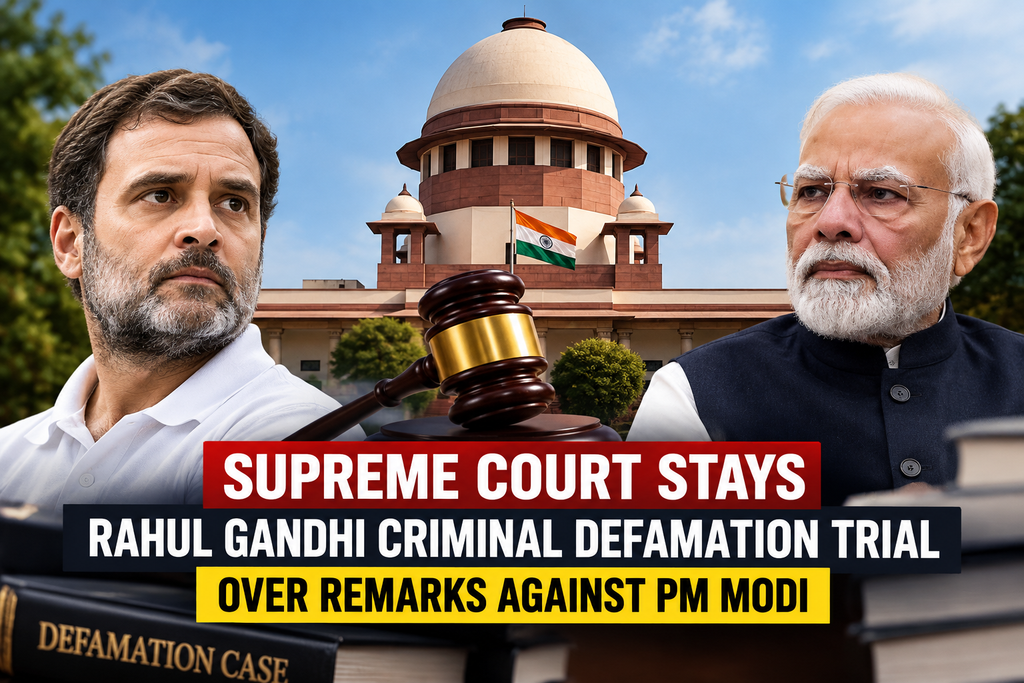
The Supreme Court of India has temporarily stopped the criminal defamation trial against Congress leader Rahul Gandhi over his alleged remarks about Prime Minister Narendra Modi. The order was passed on October 13, 2026, while the court considers Gandhi’s challenge to an earlier Bombay High Court decision.
The case relates to remarks in which Gandhi allegedly referred to the Prime Minister as “Choro Ke Sardar” and “Commander-in-Thief”. The Supreme Court has issued notice with a four-week return period and directed that further proceedings before the trial court remain stayed in the meantime.
Why Did the Supreme Court Stay the Trial?
The Supreme Court stays Rahul Gandhi criminal defamation trial proceedings temporarily while his plea is being considered. Gandhi had challenged the Bombay High Court’s September 8 order, which refused to quash the criminal defamation proceedings against him over his alleged remarks about Prime Minister Narendra Modi. The Supreme Court has issued notice with a four-week return period, and further proceedings before the trial court will remain stayed in the meantime.
A bench comprising Justice Vikram Nath and Justice Aparesh Kumar Singh issued notice on his plea. The court has not finally decided whether the alleged remarks amount to criminal defamation.
The temporary stay means the trial court proceedings cannot continue while the order remains in force.

What Is the Rahul Gandhi Defamation Case About?
The complaint was filed by Mahesh Shrishrimal, a BJP worker, before a Metropolitan Magistrate. The complainant alleged that Gandhi’s remarks harmed the reputation of the Prime Minister and, by extension, the Bharatiya Janata Party and its members.
According to the complaint, the statements could be understood as portraying BJP members as thieves. The complainant argued that party workers had grounds to bring a criminal defamation case because the remarks affected their reputation. The Supreme Court stays Rahul Gandhi criminal defamation trial proceedings temporarily while examining his plea challenging the continuation of the case.
The case raises a legal question about whether remarks directed at a political leader can form the basis of a criminal defamation complaint involving a wider, identifiable group.
What Was Rahul Gandhi’s Argument?
Rahul Gandhi challenged the continuation of the case, arguing that the complaint was not legally maintainable. His side submitted that he had not expressly named the BJP or its members in the remarks.
The defence also argued that criminal defamation requires an identifiable person or group that can claim to have been harmed. According to Gandhi’s argument, interpreting the remarks as applying to every BJP member was not sufficient to justify the prosecution.
The Bombay High Court rejected this argument in its September 8 order. It observed that a registered national political party could be considered an identifiable body and that the effect of the alleged remarks needed to be examined during the trial.
What Did the Bombay High Court Say?
While refusing to quash the case, the Bombay High Court relied on legal reasoning concerning whether a registered political party can be treated as an identifiable group for criminal defamation purposes.
The court referred to a Delhi High Court judgment in the Shashi Tharoor case, which discussed the status of a registered political party as an identifiable body.
The High Court concluded that the questions raised in the complaint required consideration at the trial stage rather than being dismissed at the preliminary stage.
Also visit us: Kumar Kushagra Replaces Rishabh Pant In India A Squad For New Zealand Tour
What Happens Next?
The Supreme Court will consider Rahul Gandhi’s challenge after the notice process. The temporary stay remains important because it prevents further trial court proceedings while the matter is pending.
The central issue is whether the alleged remarks can legally support a criminal defamation complaint brought by an individual party worker when the political party and its members were not expressly named.
The Supreme Court’s final decision on Gandhi’s plea will determine how the case proceeds. Until then, the allegations remain subject to judicial consideration.
Conclusion
The Supreme Court has temporarily stayed the criminal defamation trial against Rahul Gandhi over his alleged remarks concerning Prime Minister Narendra Modi. The order follows his challenge to the Bombay High Court’s refusal to quash the case. The Supreme Court stays Rahul Gandhi criminal defamation trial proceedings until further consideration, providing temporary relief while the legal challenge remains pending.
The matter now returns to the Supreme Court for further consideration. The temporary stay should not be treated as a final decision on the merits of the defamation allegations.