
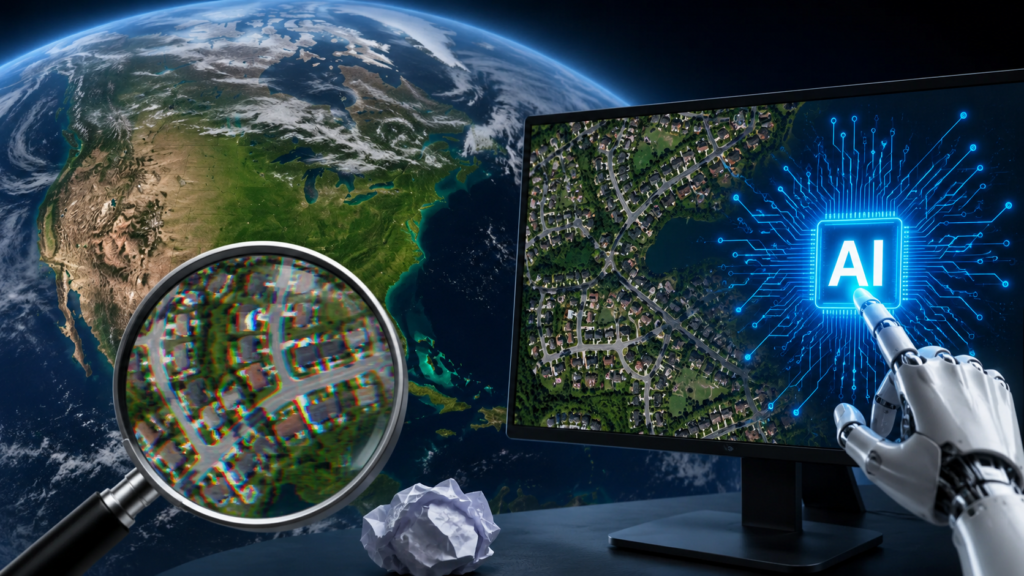
New Delhi: Google has removed a newly introduced Google Earth AI feature after users discovered that the tool could be manipulated to generate misleading satellite-style imagery. The incident has raised fresh questions about the effectiveness of safeguards designed to prevent generative AI from producing deceptive or potentially harmful content.
The feature reportedly remained available for only a short period before Google took it down following concerns over how easily users could bypass its restrictions.
What Was the Google Earth AI Feature?
The new feature was designed to bring generative artificial intelligence into Google Earth and allow users to interact with geographic and satellite imagery in new ways.
AI-powered tools can potentially make it easier for users to explore locations, understand geographic information and generate visual representations based on prompts.
However, the experiment quickly exposed a major challenge: AI systems can sometimes be prompted into producing content that goes beyond their intended use.

Users Found Ways Around the Safeguards
According to the report, users discovered methods to bypass the tool’s safeguards and create fake or manipulated satellite-style images.
Such images can look convincing enough to resemble genuine aerial or satellite photographs. This creates a potential misinformation problem because people viewing the images may have difficulty distinguishing between authentic geographic imagery and AI-generated content.
The incident demonstrates how quickly users can test the limits of AI safety systems once a new feature becomes publicly available.
Why Fake Satellite Images Are a Concern
Satellite imagery is frequently used to understand real-world events, including military activity, natural disasters, infrastructure development and environmental changes.
A convincing AI-generated satellite image could therefore be misused to create false claims about real locations.
For example, a manipulated image could potentially be presented online as evidence of an event that never happened. If such content spreads through social media before it can be verified, it could contribute to misinformation.
This makes safeguards particularly important for AI tools dealing with real-world geographic information.
Google Removes the Feature
Google subsequently took the feature down rather than allowing users to continue experimenting with a system whose safeguards had been shown to be vulnerable.
The decision highlights a broader issue facing technology companies: launching an AI feature is not simply about whether the underlying technology works. Companies also have to anticipate how users might deliberately or unintentionally misuse it.
AI Safety Remains a Major Challenge
The Google Earth incident is another example of the difficulties involved in controlling generative AI.
AI models are generally trained to follow restrictions, but users can continually experiment with different prompts and techniques to find weaknesses in those restrictions. This creates a continuing cycle in which companies have to identify vulnerabilities and strengthen their systems.
Experts have increasingly warned that AI-generated images can make misinformation more difficult to detect, particularly when the content resembles photographs, maps or other sources that people normally consider reliable.
What the Incident Means for Google Earth
For Google, the episode could lead to additional testing and stronger safeguards before similar AI capabilities are introduced again.
Google Earth has traditionally been associated with real geographic imagery and location-based information. Maintaining user trust therefore requires a clear distinction between authentic imagery and AI-generated or modified visuals.
The temporary rollout also shows why new AI products may require extensive real-world testing before being made widely available.
Also Read: New Toyota Fortuner India Launch: Expected Features, Engine Updates and What Buyers Can Expect
A Warning for the Wider AI Industry
The Google Earth AI feature fiasco is not just about one product. It reflects a wider challenge for the technology industry as companies rapidly integrate generative AI into existing platforms.
As AI becomes capable of producing increasingly realistic images, videos and geographic representations, developers will need stronger safeguards, better detection systems and clearer labelling.
The incident serves as a reminder that AI safety is an ongoing process rather than a one-time solution.