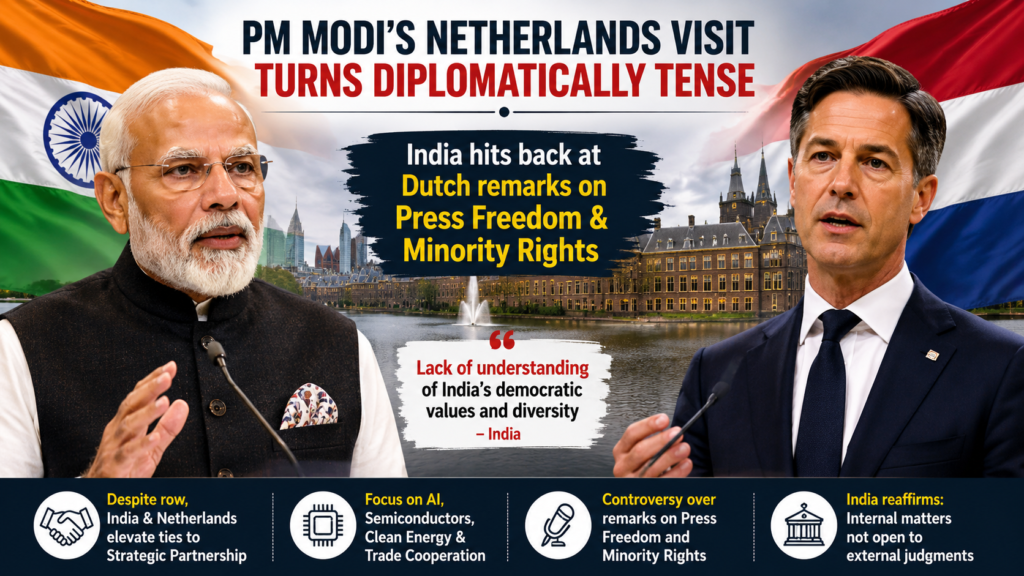
PM Modi Netherlands Visit was meant to strengthen one of Europe’s fastest-growing partnerships with India.
Instead, a diplomatic controversy suddenly stole the spotlight.
A discussion expected to revolve around technology, trade, semiconductors, clean energy, and strategic cooperation quickly turned tense after remarks linked to press freedom and minority rights in India surfaced during the visit.
And India’s response came immediately.
Officials from the Ministry of External Affairs strongly pushed back against the concerns raised during interactions involving Dutch leadership and media, saying such comments reflected a “lack of understanding” of India’s democratic system and social structure.
The moment instantly became one of the most talked-about developments from PM Modi’s Europe outreach.
PM Modi Netherlands Visit Turns Into Diplomatic Flashpoint
PM Modi arrived in the Netherlands with a major strategic agenda.
India and the Netherlands discussed expanding cooperation in artificial intelligence, semiconductor manufacturing, green hydrogen, water management, maritime security, agriculture technology, and resilient global supply chains.
Both countries also elevated bilateral relations to a stronger strategic partnership framework during high-level meetings.
The visit was being projected as another major step in India’s growing engagement with Europe.
But during a media interaction, questions linked to minority rights and freedom of the press in India shifted the atmosphere dramatically.
Reports suggested Dutch Prime Minister Rob Jetten’s remarks and related discussions touched upon concerns often raised by Western observers regarding democratic freedoms in India.
That single moment triggered a sharp diplomatic rebuttal from New Delhi.
India clarified that external observers often fail to understand the scale, diversity, constitutional protections, and democratic processes of the country.
Officials emphasized that India remains one of the world’s largest and most vibrant democracies with strong institutions, independent elections, and constitutional safeguards for all communities.
Also Read – Tushar Kumar Creates History: The Young Leader Who Just Shocked UK Politics
India Rejects Remarks On Press Freedom And Minority Rights
India’s Ministry of External Affairs did not dilute its response.
MEA Secretary (West) Sibi George publicly stated that there was a need for “better understanding of India” before making such observations.
The statement was carefully diplomatic — but clearly firm.
Indian officials highlighted that India’s democratic system functions through constitutional accountability, judicial oversight, free elections, and a highly active media landscape that includes thousands of digital, print, and television platforms operating across multiple languages.
The government also underlined India’s cultural and religious diversity, arguing that isolated narratives presented internationally often fail to reflect the country’s broader social reality.
The response signaled that India was unwilling to allow its internal matters to become a subject of external political commentary during an official bilateral visit.

Why The Controversy Matters Beyond The Netherlands
The exchange was bigger than a routine diplomatic disagreement.
It reflected a growing global pattern surrounding India’s rise as a major economic and geopolitical power.
As India strengthens relationships with Western nations, discussions around democracy, media freedom, and minority protections increasingly accompany strategic negotiations.
Several Western governments and international organizations have previously expressed concerns regarding these issues in India.
However, New Delhi has repeatedly maintained that such matters are internal issues and that foreign governments should avoid making public judgments without fully understanding India’s democratic complexities.
That tension is becoming more visible as India’s global influence expands.
Interestingly, despite the controversy, the visit itself remained diplomatically successful in several areas.
India and the Netherlands signed agreements and expanded cooperation across technology, clean energy, innovation, agriculture, and maritime sectors.
Both nations also discussed strengthening semiconductor supply chains — a strategically critical sector as countries worldwide attempt to reduce dependence on limited manufacturing hubs.
Strategic Partnership Still Moves Forward
Even after the sharp exchange, neither country indicated any damage to long-term relations.
In fact, officials from both sides continued emphasizing cooperation, trade expansion, and shared global priorities.
The Netherlands remains an important European partner for India, especially in technology, logistics, sustainable infrastructure, and clean energy investments.
For India, maintaining strong partnerships with European economies is becoming increasingly important amid shifting global trade and geopolitical dynamics.
But politically, the controversy changed the narrative of the visit.
What began as a diplomatic and economic mission suddenly evolved into an international debate about democracy, global criticism, and India’s response to Western scrutiny.
And in modern geopolitics, those moments often travel faster than the agreements signed behind closed doors.