
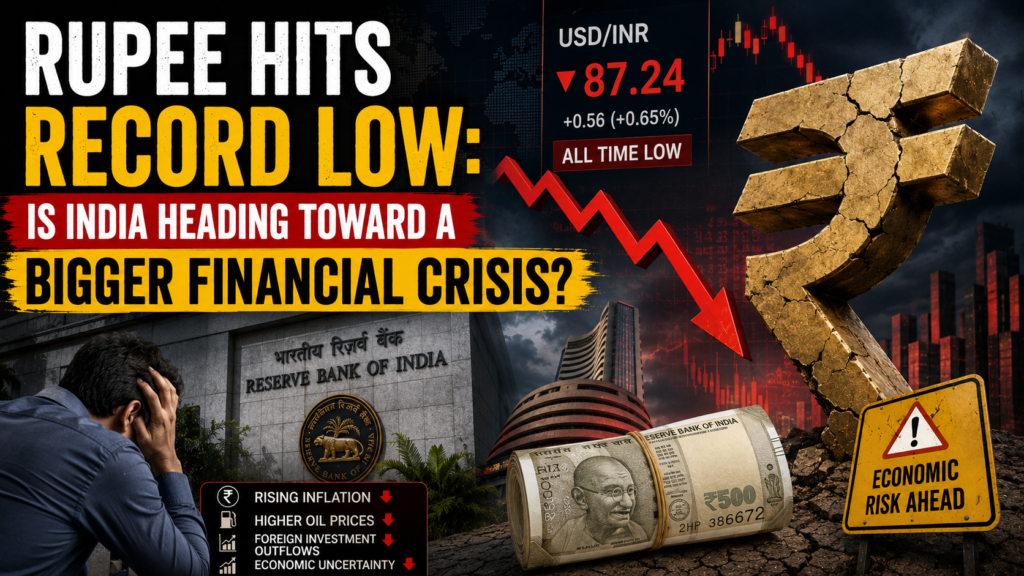
The Indian rupee has once again fallen to a record low against the US dollar, triggering serious concerns across financial markets, businesses, and households. Economists, investors, and policy experts are now debating whether the weakening currency is a temporary global reaction or an early warning sign of deeper economic stress.
The growing concern around Rupee Hits Record Low headlines is not just about currency exchange rates. A weak rupee directly affects inflation, fuel prices, imports, investments, and consumer spending across India.
Whenever the rupee loses value against the dollar, India becomes more expensive to run because the country imports massive amounts of crude oil, electronics, machinery, and industrial materials using US dollars.
As the Rupee Hits Record Low story dominates financial discussions, experts are warning that India could face increasing economic pressure if the currency continues weakening.

Why the Rupee Is Falling
There are several reasons behind the recent decline in the Indian currency.
One major factor is the strengthening US dollar globally. Investors across the world are moving money toward safer assets in the United States due to economic uncertainty, geopolitical tensions, and changing interest rates.
This global trend puts pressure on emerging market currencies like the Indian rupee.
Another reason behind the Rupee Hits Record Low concern is rising crude oil prices. India imports nearly 85% of its oil needs, and every increase in oil prices raises the demand for dollars.
As companies buy more dollars to pay for imports, the rupee weakens further.
Foreign investor withdrawals from Indian markets have also contributed to currency pressure in recent months.
Why a Weak Rupee Is Dangerous
Many people believe a falling currency only affects international travelers. In reality, the impact reaches almost every Indian household.
When the Rupee Hits Record Low, imports become more expensive. This affects fuel prices, electronics, medicines, food products, and transportation costs.
Oil is especially important because higher crude prices eventually increase inflation across the economy.
If transportation costs rise, businesses pass those expenses to consumers through higher product prices.
This creates a chain reaction where common citizens end up paying more for daily necessities.
Economists warn that prolonged currency weakness could increase inflation pressure significantly in India during 2026.
Is India Facing a Bigger Financial Risk?
The biggest fear surrounding the Rupee Hits Record Low situation is whether India may be entering a more serious financial slowdown.
Several warning signs are already visible:
- Rising import costs
- Global economic uncertainty
- Oil price volatility
- Inflation pressure
- Weak global demand
- Foreign investment outflows
Although India’s economy remains one of the fastest-growing among major nations, external risks are increasing rapidly.
If the rupee continues falling sharply, the Reserve Bank of India may be forced to intervene aggressively by using foreign exchange reserves or adjusting monetary policy.
Higher interest rates can stabilize currencies temporarily, but they also slow borrowing, investment, and economic growth.
This creates a difficult balancing act for policymakers.
The Rupee Hits Record Low concern therefore goes beyond currency markets — it reflects broader fears about economic stability.
How Global Events Are Affecting India
India’s currency situation is also heavily influenced by international developments.
Wars, energy disruptions, rising global interest rates, and slowing world trade are increasing uncertainty across financial markets.
Whenever global investors become nervous, they usually move money toward the US dollar. Emerging economies then face currency pressure.
India is relatively stronger compared to many developing economies, but it cannot fully escape global financial trends.
The Rupee Hits Record Low story is therefore connected not only to domestic policy but also to worldwide economic instability.
Experts believe prolonged geopolitical tensions and expensive crude oil could create additional challenges for India in the coming months.
What the Government and RBI May Do
The Reserve Bank of India has several tools to control excessive currency volatility.
Possible actions include:
- Selling dollars from forex reserves
- Increasing interest rates
- Controlling inflation aggressively
- Encouraging foreign investment inflows
- Managing liquidity in markets
The government may also focus on boosting exports and reducing import dependency in critical sectors like energy and electronics.
However, these measures take time.
The immediate challenge is maintaining investor confidence while controlling inflation risks linked to the Rupee Hits Record Low situation.
Should Common Indians Be Worried?
Experts say there is no immediate reason to panic, but the risks should not be ignored.
India still has strong foreign exchange reserves, a growing domestic market, and relatively stable banking systems compared to many countries.
However, if global crude oil prices rise further and the rupee continues weakening, inflation may become harder to control.
Middle-class households could feel pressure through:
- Higher fuel prices
- Increased food costs
- Expensive imported goods
- Rising travel expenses
- Costlier electronics and gadgets
Businesses may also face shrinking profit margins because imported raw materials become more expensive.
This is why the Rupee Hits Record Low issue is attracting so much national attention.
Final Thoughts
The weakening rupee is more than just a currency story. It reflects growing pressure from global uncertainty, rising oil prices, inflation risks, and investor concerns.
The Rupee Hits Record Low headlines should not automatically create fear about an economic collapse, but they do highlight vulnerabilities that India cannot ignore.
Much will depend on how global oil markets behave, how inflation is controlled, and whether investor confidence remains stable.
India has faced currency pressure before and recovered successfully. But in a highly uncertain global economy, policymakers will need careful financial management to prevent temporary currency weakness from turning into a larger economic crisis.

Also Read: Oil Companies Losing ₹1000 Crore: Why Petrol Prices Are Still Stable