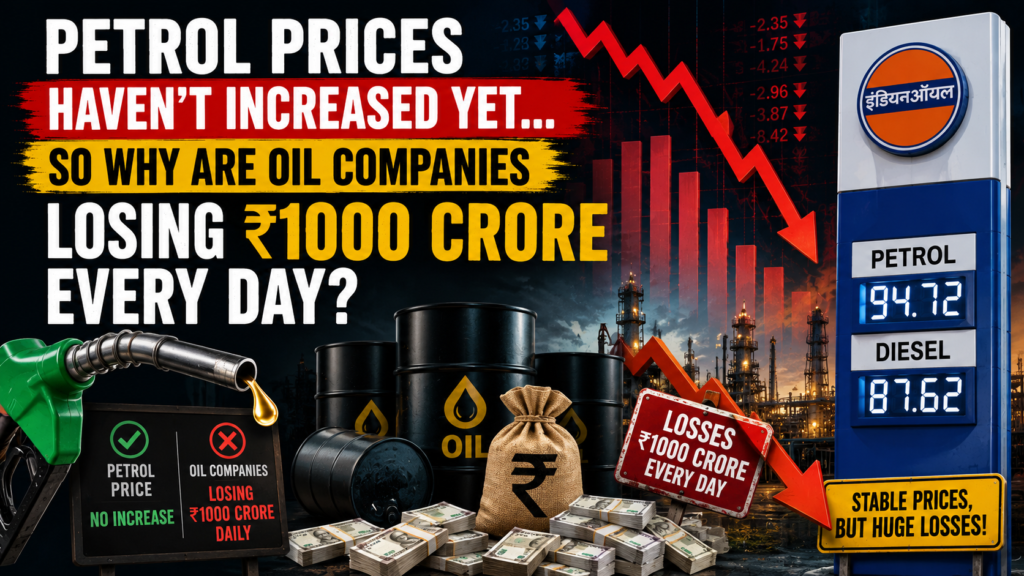
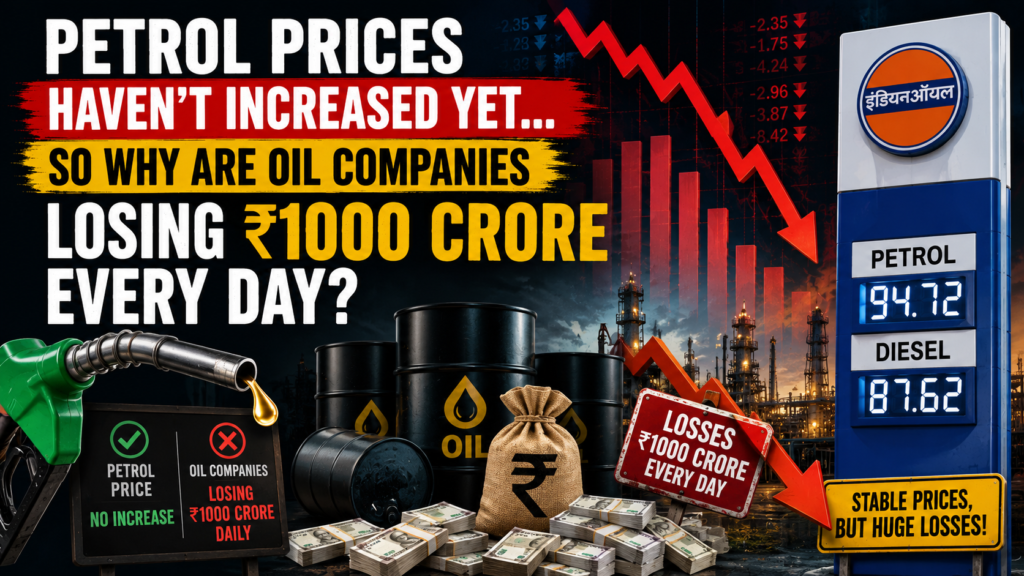
India’s oil sector is facing a strange and worrying situation. Petrol prices in many cities have not increased sharply, yet reports suggest that public sector oil companies are losing nearly ₹1000 crore every day. This contradiction has triggered intense debate among economists, investors, and common citizens.
The biggest question now is simple — if fuel prices are stable, why are oil companies under massive financial pressure?
The answer lies in global crude oil prices, government policy, currency pressure, and political calculations ahead of important economic decisions.
The issue of Oil Companies Losing ₹1000 Crore daily is becoming one of the biggest hidden economic stories in India right now.
Why Oil Companies Are Under Pressure
India imports nearly 85% of its crude oil requirements. This means Indian oil companies are heavily dependent on international oil markets. Whenever crude prices rise globally, Indian refiners and fuel retailers face immediate pressure.
Normally, companies increase petrol and diesel prices to recover higher costs. But this time, retail prices have remained relatively controlled in many parts of India.
This is where the crisis begins.
If global crude oil becomes expensive while domestic fuel prices stay unchanged, oil marketing companies start absorbing losses themselves. Over time, these losses become massive.
The growing concern around Oil Companies Losing ₹1000 Crore daily reflects this imbalance between international oil costs and domestic fuel pricing.

Global Oil Prices Are Rising Again
One major reason behind the losses is rising international crude oil prices. Global tensions in oil-producing regions, supply cuts by major exporters, and shipping disruptions have pushed energy prices upward.
Every small increase in crude oil prices significantly impacts India because of the country’s high import dependence.
At the same time, the Indian rupee has shown volatility against the US dollar. Since oil imports are paid in dollars, a weaker rupee makes crude oil even more expensive for Indian companies.
This double pressure is increasing the scale of Oil Companies Losing ₹1000 Crore every single day.
Why Petrol Prices Are Not Increasing Immediately
Many people assume petrol prices rise automatically when crude oil becomes expensive. But fuel pricing in India is more political than most consumers realize.
Sharp fuel price hikes can increase inflation rapidly. Transport costs rise, food prices increase, and public anger grows quickly.
Governments therefore try to avoid sudden fuel price increases, especially during periods of economic uncertainty.
Instead of immediately increasing prices, oil companies sometimes absorb temporary losses with the expectation that crude prices may fall later.
However, if expensive crude oil continues for weeks or months, the burden becomes extremely difficult to sustain.
That is exactly why the discussion around Oil Companies Losing ₹1000 Crore has become economically important.
The Hidden Impact on India’s Economy
Losses in the oil sector do not remain limited to oil companies alone. They eventually affect the entire economy.
When oil companies lose large amounts of money:
- Government dividends may reduce
- Fiscal pressure increases
- Investors lose confidence
- Inflation risks rise
- Subsidy burdens increase
- Public sector balance sheets weaken
India’s economy is highly sensitive to energy prices because transportation impacts almost every industry.
If losses continue rising, the government may eventually face only three difficult options:
- Increase petrol and diesel prices
- Reduce taxes on fuel
- Provide financial support to oil companies
Each option carries economic and political consequences.
The issue of Oil Companies Losing ₹1000 Crore daily is therefore not just a business problem — it is becoming a national economic challenge.
Are Consumers Being Protected Temporarily?
Many experts believe consumers are currently being shielded from the full impact of global oil prices.
If petrol prices had fully reflected international crude rates, fuel could already be much more expensive in several Indian cities.
Instead, oil marketing companies are absorbing part of the burden to avoid immediate inflation shocks.
But this strategy cannot continue forever.
If crude oil prices remain elevated, companies may eventually be forced to increase fuel prices. This could create another wave of inflation across India.
That is why economists are closely watching the scale of Oil Companies Losing ₹1000 Crore every day.
Political and Economic Timing Matters
Fuel pricing in India is deeply connected with politics, inflation management, and economic stability.
A sudden increase in petrol and diesel prices affects public sentiment almost instantly. Transport workers, middle-class families, businesses, and farmers all feel the impact.
This is why governments usually prefer gradual price adjustments instead of sudden hikes.
However, delaying price increases also creates hidden financial stress inside the energy sector.
The current situation suggests India may be entering a delicate economic phase where balancing inflation control and corporate losses will become increasingly difficult.
Final Thoughts
The story of Oil Companies Losing ₹1000 Crore daily reveals how fragile the global energy system has become. Stable petrol prices may appear positive on the surface, but the financial pressure underneath is growing rapidly.
India’s economy depends heavily on affordable energy, and prolonged crude oil volatility can create serious economic risks.
For now, consumers are benefiting from relatively stable petrol prices. But if global crude oil prices remain high for longer, price increases may eventually become unavoidable.
The real concern is not just today’s fuel prices — it is whether India can continue protecting consumers without weakening its oil companies and broader economy in the process.

Also Read: PM Modi Fuel Saving Warning: Is India Facing an Economic Crisis?