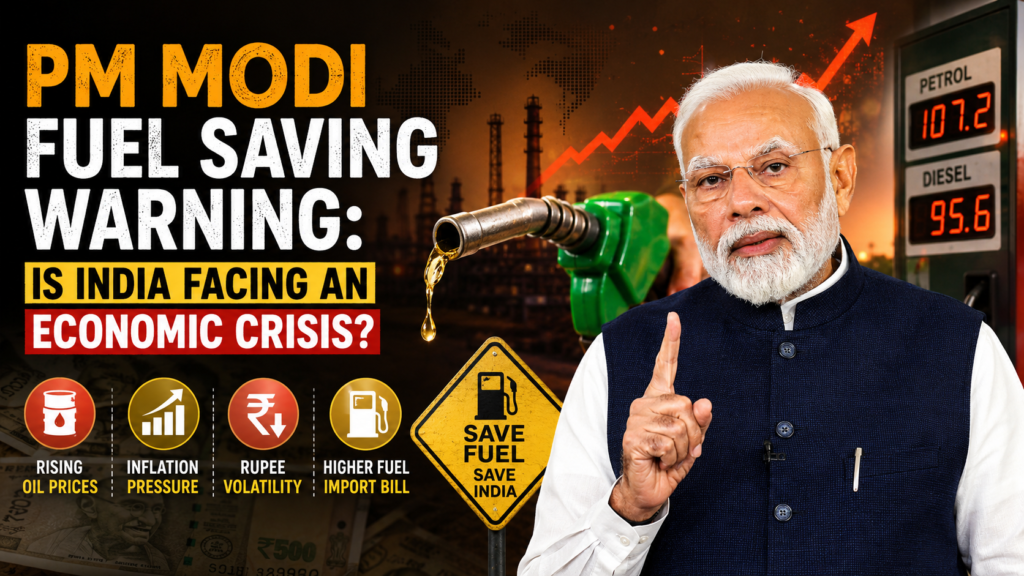
Prime Minister Narendra Modi’s recent appeal asking Indians to save fuel has triggered intense discussion across political, financial, and business circles. While fuel conservation campaigns are not new in India, the timing of this message has raised an important question — is the government seeing early signs of economic trouble ahead?
The PM Modi Fuel Saving Warning comes at a time when global oil prices are becoming unpredictable due to geopolitical tensions, supply disruptions, and economic uncertainty across major nations. For a country like India, which imports nearly 85% of its crude oil needs, even a small rise in global oil prices can create massive pressure on the economy.
Many experts believe this is not just an environmental message. Instead, it may be an early signal that India needs to prepare for difficult economic conditions in the coming months.
Why Fuel Matters So Much for India
India’s economy depends heavily on imported crude oil. Every time international oil prices rise, India’s import bill increases sharply. This affects the value of the rupee, increases inflation, and raises transportation and manufacturing costs.
The PM Modi Fuel Saving Warning is significant because fuel prices directly impact the daily lives of Indians. Petrol and diesel costs influence food prices, cab fares, airline tickets, logistics, and even electricity production in some regions.
If oil prices remain high for a long period, inflation can become difficult to control. This reduces consumer spending power and slows economic growth.
That is why fuel conservation suddenly becomes both a financial and national priority.

Global Tensions Are Increasing Economic Risks
One of the biggest reasons behind the government’s concern is global instability. Conflicts in the Middle East, uncertainty around the Strait of Hormuz, and supply chain disruptions have made energy markets highly volatile.
India cannot fully control global crude prices, but it can reduce internal consumption pressure. The PM Modi Fuel Saving Warning may therefore be part of a larger strategy to improve energy resilience and reduce unnecessary fuel usage.
Economic analysts say India is trying to avoid the mistakes made during earlier oil crises when rising fuel costs damaged economic growth and weakened currencies across developing countries.
This time, the government appears to be acting before the situation worsens.
Is This an Economic Warning Sign?
The biggest debate surrounding the PM Modi Fuel Saving Warning is whether it signals a deeper economic concern.
Several warning signs already exist:
- Rising crude oil prices
- Inflation pressure on households
- Weak global demand
- High logistics costs
- Pressure on government subsidies
- Rupee volatility against the US dollar
When fuel costs rise, businesses spend more on transportation and production. Eventually, consumers pay higher prices for goods and services. This creates a chain reaction across the economy.
If inflation rises too quickly, the Reserve Bank of India may keep interest rates higher for longer. Higher rates can slow borrowing, investment, and business expansion.
This is why many economists are treating the fuel-saving appeal seriously rather than as a routine public campaign.
Political Messaging or Economic Preparation?
Opposition parties argue that the government is using fuel-saving messaging to avoid criticism over rising petrol and diesel prices. However, supporters of the government believe the move reflects responsible economic planning.
The reality may lie somewhere in between.
The PM Modi Fuel Saving Warning also fits into India’s long-term push toward renewable energy, electric vehicles, and reduced dependence on imported oil. Over the last few years, India has invested heavily in solar power, ethanol blending, and EV infrastructure.
By encouraging citizens to reduce fuel usage now, the government may be trying to prepare the public psychologically for a period of higher energy costs.
In politics, perception matters. But in economics, preparation matters even more.
What Indians Should Learn From This
The fuel-saving appeal is not just about switching off vehicle engines at traffic signals. It reflects a broader message about economic discipline and resource management.
Indian households may need to prepare for:
- Higher transportation costs
- Inflation in food and consumer goods
- Increased electricity expenses
- More focus on energy-efficient lifestyles
At the same time, businesses may need to rethink logistics strategies, remote work policies, and fuel dependency.
The PM Modi Fuel Saving Warning could ultimately become a turning point in how India approaches energy security and economic resilience.
Final Thoughts
India is not facing an economic collapse, but the warning signs cannot be ignored. Rising global oil prices have historically affected India’s economy in major ways, and the government appears determined to act early.
The PM Modi Fuel Saving Warning is therefore more than a simple public appeal. It is a reminder that energy security and economic stability are deeply connected.
Whether this becomes a short-term precaution or the beginning of a larger economic challenge will depend largely on global oil markets, inflation control, and India’s ability to reduce dependence on imported fuel.
One thing is clear — when a Prime Minister publicly asks citizens to save fuel, the message is usually bigger than fuel alone.

Also read: Stock Market Surges as Sensex and Nifty Rally Amid Global Optimism