
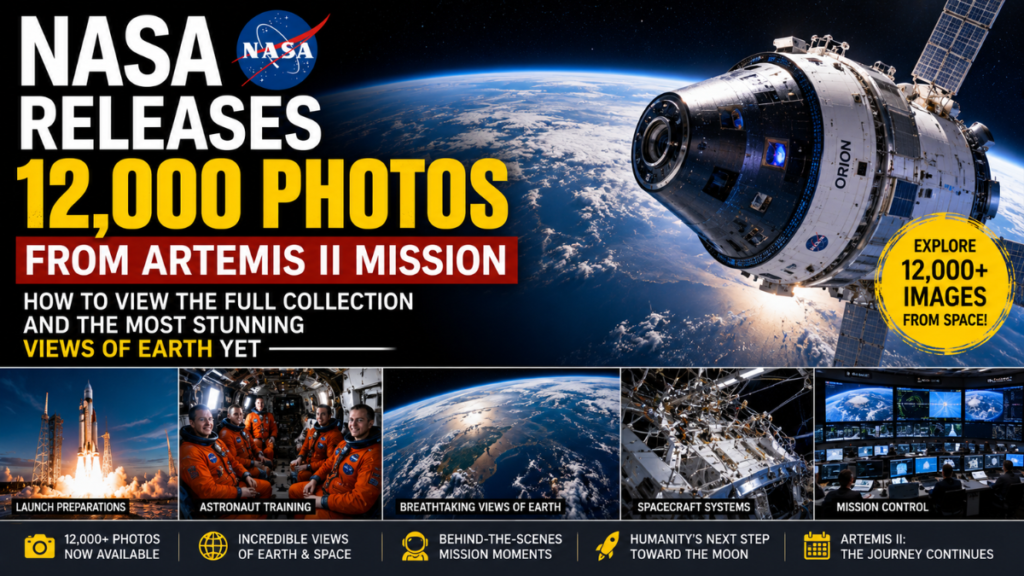
There is something profoundly humbling about seeing Earth from deep space. It is not just a blue marble anymore; it becomes a fragile, distant memory. Now, NASA has released over 12,000 new images from the Artemis II mission, giving the public the most complete visual record yet of humanity’s first crewed journey to the Moon’s orbit in more than five decades.
Unlike the carefully curated mission highlights shared during the flight, this archive feels raw, authentic, and vast. From the fiery launch to the silent lunar flyby, these Artemis II photos capture what the four astronauts actually saw—not through robotic eyes, but through their own windows and handheld cameras.
Looking at these images, you feel the distance. You feel the solitude, a space enthusiast commented online. It’s not like the polished Apollo photos. These are more intimate.
What Was the Artemis II Mission? (Key Facts)
Before diving into the images, here is the mission background you need to know:
| Mission Aspect | Detail |
|---|---|
| Duration | 10 days (April 1 – April 10, 2026) |
| Spacecraft | Orion |
| Crew | Reid Wiseman (Commander), Victor Glover (Pilot), Christina Koch (Mission Specialist), Jeremy Hansen (Mission Specialist) |
| Primary Goal | Test Orion’s systems in lunar orbit – a dress rehearsal for Artemis III (planned Moon landing) |
| Significance | First crewed flight to the Moon’s vicinity since Apollo 17 in 1972 |
The mission did not land on the Moon. Instead, it flew a precise trajectory around our celestial neighbor, testing life support, navigation, and heat shield performance. Artemis III, targeted for 2027 or 2028, aims to land the first woman and first person of color on the lunar surface.

The 12,000-Image Archive: What You Will See
NASA has uploaded the complete collection to its Gateway to Astronaut Photography of Earth platform, an open-access database that anyone can browse for free. Because the archive contains over 12,000 high-resolution photos, the website may load slowly at times—patience is rewarded.
Here is what makes these Artemis II photos stand out from previous space photography:
- The Vanishing Earth: Several sequences show Earth progressively shrinking as Orion moves away. One particularly emotional frame captures a crescent Earth above the Orion spacecraft’s docking port, with the blackness of space swallowing the background.
- Lunar Close-Ups: During the spacecraft’s closest lunar flyby, astronauts photographed craters, valleys, and the gray, desolate landscape with stunning clarity. Unlike robotic orbiter images, these have a human perspective.
- Interior & Everyday Objects: Some photos are not grand vistas at all. They show pens floating, a half-eaten meal bag, Christina Koch’s handwritten notes taped to a wall, and a small plush toy acting as a zero-g indicator. These candid shots make the mission feel real and relatable.
- Crew Selfies & Portraits: The four astronauts documented each other working, sleeping in tethered bags, and looking out the window. A widely shared image shows Victor Glover smiling while holding a camera, Earth reflected in his helmet visor.
How to View the Full Artemis II Photo Collection
To explore the archive yourself, follow these steps (based on NASA’s public access guidelines):
- Go to the Gateway to Astronaut Photography of Earth website (search for NASA Gateway to Astronaut Photography if the direct link is unavailable).
- Filter by mission: Select Artemis II from the mission list. You can also filter by camera, date, or subject (Earth, Moon, spacecraft interior).
- Browse or download: Each image includes metadata—time, location, camera settings, and a brief description. Downloads are free for public use (credit NASA).
Note: Due to the high volume of data (12,000+ images), NASA recommends using a desktop computer with a stable internet connection for the best experience.
Why These Photos Matter More Than You Think
You might ask: Hasn’t NASA released thousands of space photos before? Yes, but these Artemis II photos carry a unique weight.
- They are human, not robotic. Unlike images from Hubble or James Webb, these were framed and captured by people who were actually there. Every click of the shutter was a conscious choice by an astronaut looking out into the void.
- They bridge a 50-year gap. The last time humans photographed Earth from deep space was during Apollo. This is a new generation’s perspective—digital, high-definition, and emotionally nuanced.
- They prepare us for what comes next. Artemis II was a test flight. The real prize is Artemis III, when humans will walk on the Moon again, possibly with commercial landers from SpaceX and Blue Origin. These photos are the opening chapter of a new lunar age.
As one NASA commentator noted during the mission, “We are not just going back to the Moon. We are learning to stay.” These images prove that the journey has already begun.
Also Raed: Delhi Metro Phase V Expansion Approved with 7 New Corridors
Final Thoughts: A Quiet Archive of Grandeur
You do not need to be a space scientist to appreciate this collection. Scroll through a few dozen Artemis II photos, and you will feel what the crew felt: distance, awe, and a fierce protectiveness for the pale blue dot we call home.
Whether it is the perfectly composed shot of the Moon rising over Orion’s hull or a blurry, spontaneous snapshot of a floating banana, each image tells a story. Together, the 12,000 photos form a mosaic not just of a mission, but of human curiosity pushing outward.

These photos convey what words cannot. They show that space exploration is not just technical—it is deeply emotional.– TOI Science Desk (adapted)