
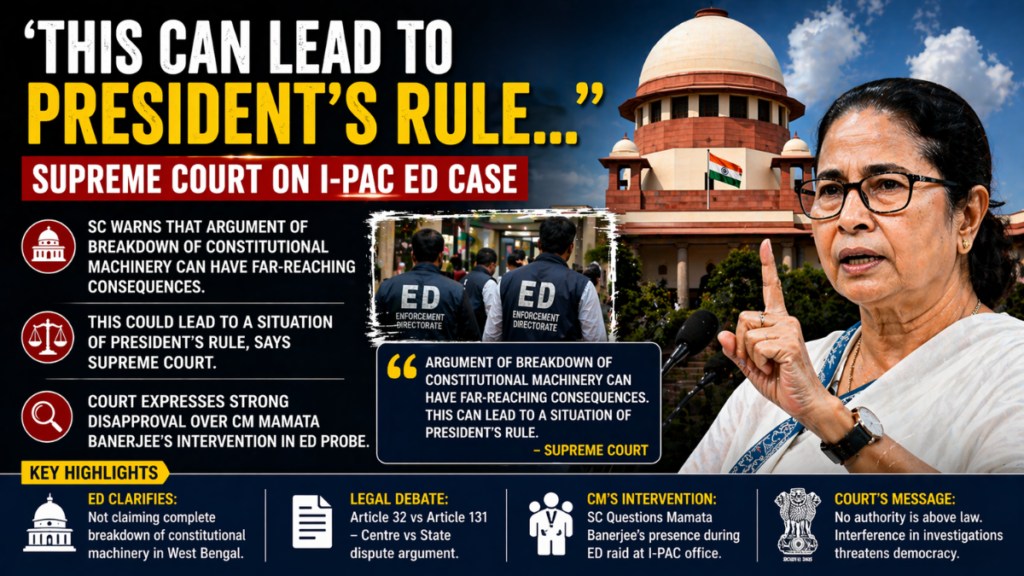
The Supreme Court has made strong observations in the ongoing I-PAC ED case, expressing concern over arguments related to the breakdown of constitutional machinery in West Bengal. The court cautioned that such claims could have far-reaching consequences, including the possibility of President’s Rule.
Supreme Court Flags Serious Constitutional Implications
During the hearing, the Supreme Court stated that invoking the argument of a “constitutional breakdown” is not a minor issue and can lead to serious implications.
The bench noted that such claims could potentially justify extreme measures like President’s Rule, which directly impacts the democratic framework of a state.
ED Clarifies Its Stand
The Enforcement Directorate (ED), through Solicitor General Tushar Mehta, clarified its position before the court.
- ED stated that it is not claiming a complete breakdown of constitutional machinery in West Bengal
- The agency emphasized that its concern is limited to alleged obstruction in the investigation
- It clarified that the issue relates to rule of law, not constitutional failure
This clarification came after arguments raised concerns about the broader interpretation of the situation.
Mamata Banerjee’s Intervention Under Scrutiny
A key issue in the case is the alleged intervention of West Bengal Chief Minister Mamata Banerjee during an ED raid at the I-PAC office in Kolkata.
The Supreme Court expressed strong disapproval, stating that:
- A Chief Minister entering an ongoing central agency investigation raises serious concerns
- Such actions cannot be seen merely as a Centre vs State dispute
- It may impact the integrity of investigative processes
The court emphasized that interference in investigations could pose risks to democratic functioning.
Legal Debate: Article 32 vs Article 131
The case also involves an important constitutional debate regarding the correct legal route:
- The West Bengal government argued that the matter should be filed under Article 131 (Centre-State dispute)
- ED approached the court under Article 32, citing violation of fundamental rights
The Supreme Court questioned the state’s position and indicated that such arguments cannot justify interference in an ongoing investigation.
Court’s Strong Message on Rule of Law
The bench made it clear that maintaining the rule of law is crucial and that no authority is above legal processes, including elected officials.
Also Read: Delimitation Bill Defeat: MK Stalin Says Democracy Won as South Stands United
It warned that actions which obstruct investigations could undermine democratic institutions and create larger constitutional issues.
Conclusion
The I-PAC ED Case Supreme Court hearing has brought forward critical questions about the balance between state authority and central investigative agencies.
While the court has not passed a final verdict yet, its observations underline the importance of:
- Respecting investigative procedures
- Avoiding political interference
- Upholding constitutional values
The case is expected to have significant implications for Centre-State relations and the functioning of investigative agencies in India.