
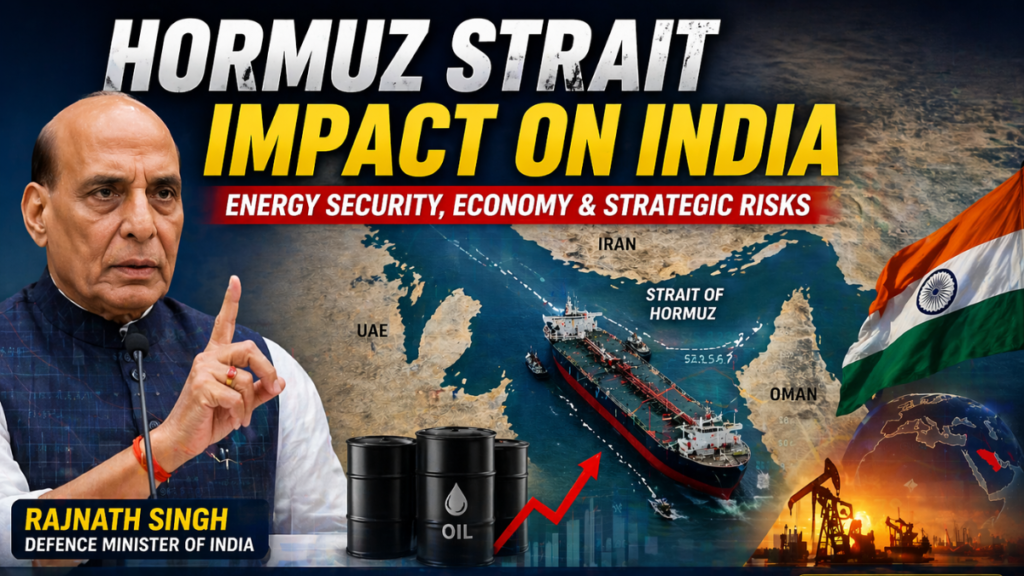
Defence Minister Rajnath Singh has raised serious concerns over the growing geopolitical instability in West Asia, stating that any disruption in the Strait of Hormuz could have direct implications for India’s energy security and economic stability.
Speaking during his official visit to Berlin, Singh emphasized that the ongoing tensions involving the US, Iran, and Israel are no longer limited to a regional issue but have global consequences.
Hormuz Strait Impact on India: Why It Matters
The Hormuz Strait Impact on India is critical because:
- India imports a significant portion of its crude oil from West Asia
- The Strait of Hormuz is a key global oil transit route
- Any disruption can lead to:
- Rising fuel prices
- Inflation
- Economic instability
“For a developing country like India, disruptions in the Strait of Hormuz are not distant events—they are stark realities,” Singh said.
Hormuz Strait Impact on India: Global Conflict and Economic Risks
Rajnath Singh highlighted that the West Asia conflict is impacting:
- Global energy security
- Food supply chains
- Economic stability worldwide
The uncertainty around a possible escalation or disruption in oil supply routes has already begun influencing global markets.
In Hormuz Strait Impact on India: Government’s Strategic Response
To tackle the evolving crisis, India has taken proactive steps:
- Formation of a Group of Ministers on West Asia
- Continuous monitoring of geopolitical developments
- Policy measures to minimise economic impact
This coordinated approach ensures India remains prepared for any sudden disruptions.
Hormuz Strait Impact on India: Strengthening India-Germany Defence Ties
During his three-day visit to Germany, Singh is focusing on:
- Defence industrial cooperation
- Military-to-military collaboration
- Emerging technologies like:
- Artificial Intelligence (AI)
- Cybersecurity
- Drone systems
India and Germany are also expected to sign a defence cooperation roadmap, strengthening strategic ties.
Hormuz Strait Impact on India: Submarine Deal and Defence Boost
A key highlight of the visit is progress on Project 75I, valued at ₹70,000 crore:
- India to build 6 advanced submarines
- Collaboration between:
- Mazagon Dock Shipbuilders Limited (MDL)
- Germany’s thyssenkrupp Marine Systems (tkMS)
These submarines will feature Air Independent Propulsion (AIP) systems, enhancing underwater endurance and stealth capabilities.
Hormuz Strait Impact on India: Push for Atmanirbhar Bharat
Rajnath Singh also promoted India’s Atmanirbhar Bharat initiative, inviting global partners to:
- Co-develop defence technologies
- Invest in India’s defence ecosystem
- Collaborate with startups and private players
He highlighted the synergy between German engineering excellence and India’s growing defence capabilities.
Also Read: Iran-Israel-US War News Live: Ceasefire Talks, Airstrikes and Rising Hormuz Tensions
Conclusion
The Hormuz Strait Impact on India is a serious concern amid rising tensions in West Asia. With heavy dependence on energy imports, any disruption in this critical route could directly affect India’s economy and security.
India’s proactive strategy, combined with stronger global partnerships like Germany, reflects a forward-looking approach to tackle emerging geopolitical and defence challenges.