
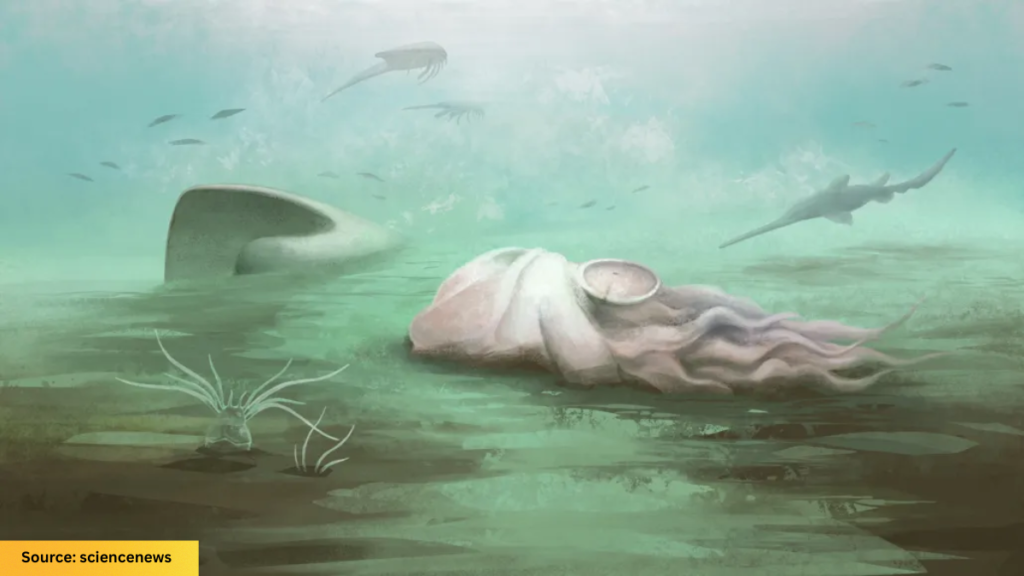
A fossil once believed to be the oldest octopus ever discovered has now been reclassified, rewriting a long-standing scientific assumption.
According to a new study, the 300-million-year-old fossil is not an octopus, but rather a nautiloid, a marine animal related to modern-day nautiluses that possess an external shell and tentacle-like structures.
A Scientific Misidentification Finally Corrected
The fossil, known as Pohlsepia mazonensis, was discovered at the Mazon Creek fossil site in Illinois, USA. For years, scientists believed it represented an ancient octopus — pushing back the evolutionary timeline of octopuses by hundreds of millions of years.
However, new research published in the journal Proceedings of the Royal Society B has challenged that assumption.
Lead researcher Thomas Clements, a lecturer in invertebrate zoology at the University of Reading (UK), explained that the fossil had been misinterpreted due to its unusual preservation.
Why It Looked Like an Octopus
One of the biggest reasons behind the confusion was the fossil’s shape. The creature had decomposed significantly before being buried, causing its structure to resemble an octopus.
Scientists were puzzled because:
- The fossil was far older than any known octopus fossil (previous record: ~90 million years)
- Some physical features didn’t fully match octopus anatomy
- Its arm structure seemed unusual
These inconsistencies led researchers to revisit the fossil using modern techniques.
Advanced Technology Solves the Mystery
To uncover the truth, scientists used a range of advanced analytical methods, including:
- Scanning Electron Microscopy
- Geochemical analysis
- Synchrotron imaging (high-powered X-ray technology)
This cutting-edge imaging allowed researchers to see hidden anatomical features beneath the rock surface.
The Key Discovery: Tiny Teeth Structure
The breakthrough came when scientists identified a radula — a feeding structure made up of rows of tiny teeth.
This detail changed everything:
- The fossil showed 11 teeth per row
- Octopuses typically have only 7 to 9 teeth per row
This crucial difference confirmed that the fossil was not an octopus, but a nautiloid.
What This Means for Science
This discovery reshapes our understanding of marine evolution and highlights how scientific conclusions can change with better technology.
According to Clements, the study is a reminder that:
New tools can completely transform our understanding of ancient life.
Also Read: LG LP0721WSR0 Portable Air Conditioner Review: Best Mid-Range Cooling Option?
Conclusion
The case of Pohlsepia mazonensis shows how even well-accepted scientific beliefs can be overturned. What was once thought to be the oldest octopus on Earth is now identified as a different marine species altogether.
As technology continues to evolve, more such discoveries could emerge — offering deeper insights into the history of life on our planet.