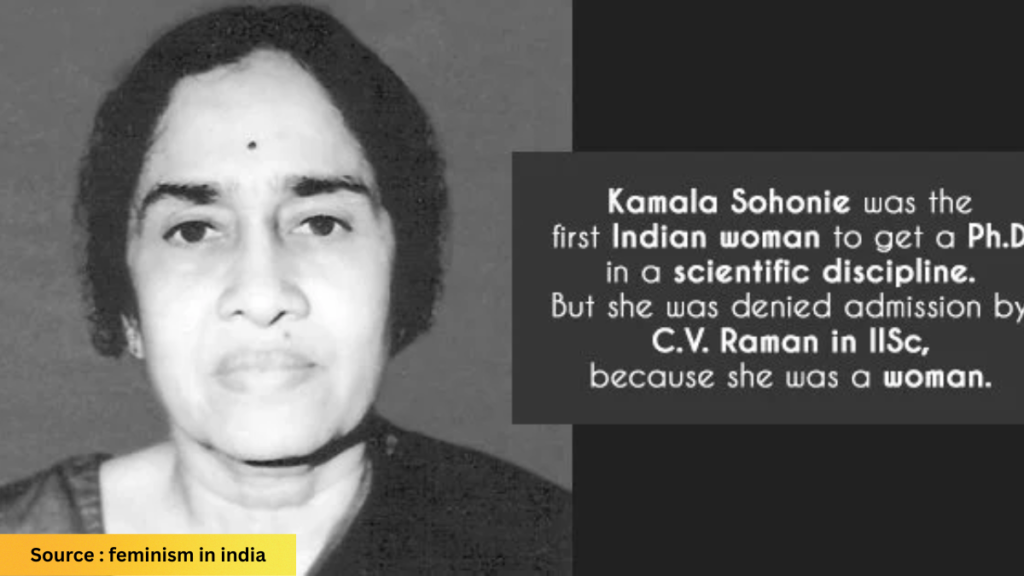
“I decided that my work would speak for me.”– These words by Kamala Sohonie define the spirit of a woman who took on a Nobel Laureate, shattered gender barriers, and became India’s first woman to earn a PhD in science.
Who Was Kamala Sohonie?
Born in 1911 in Indore,Kamala Sohoniegrew up surrounded by scientific minds. After excelling in her Bachelor’s degree at Bombay University, she dreamed of pursuing research at the Indian Institute of Science (IISc) in Bengaluru.
But in 1933, she faced a wall of prejudice.
The Satyagraha Against C.V. Raman
When Kamala Sohonie applied to IISc, Director C.V. Raman rejected her outright. His reason? Women were “not competent” for research and would be a “distraction.”
Refusing to accept this,Kamala Sohoni staged a satyagraha outside Raman’s office. He finally relented but imposed humiliating conditions: a one-year probation, no official recognition until he approved, and a warning not to “spoil the environment.”
She accepted—and excelled.
Within a year, her work was so outstanding that Raman was forced to change the rules.Kamala Sohoniehad just opened the doors of IISc to every woman who followed.
India’s First Woman PhD in Science
In 1936,Kamala Sohonie went to the University of Cambridge. In just 14 months, she completed her PhD after discovering the enzymeCytochrome C—a vital component of cellular energy production.
In 1939, she made history asIndia’s first woman to earn a doctorate in a scientific discipline.
The Neera Breakthrough That Helped Millions
Returning to India,Kamala Sohonie focused on public health. At the suggestion of President Dr. Rajendra Prasad, she studiedNeera—the palm sap consumed by the poor.
Her research revealed that Neera was packed withVitamin A, Vitamin C, and iron. When added to the diets of malnourished children and pregnant women, it dramatically improved their health.
This affordable, local solution earned her theRashtrapati Awardand shaped India’s nutrition policies.
A Legacy of Resilience
Despite her qualifications,Kamala Sohoniefaced delays in becoming a Director due to gender bias. Yet she never stopped serving the nation—working on food safety, consumer rights, and nutrition until her death in 1998.
Kamala Sohonie did not just become a scientist. She fought for the right to be one—and in doing so, she paved the way for every woman in Indian science.
Also Read: World’s Happiest Countries 2026 List Revealed: Who Tops the Rankings?