
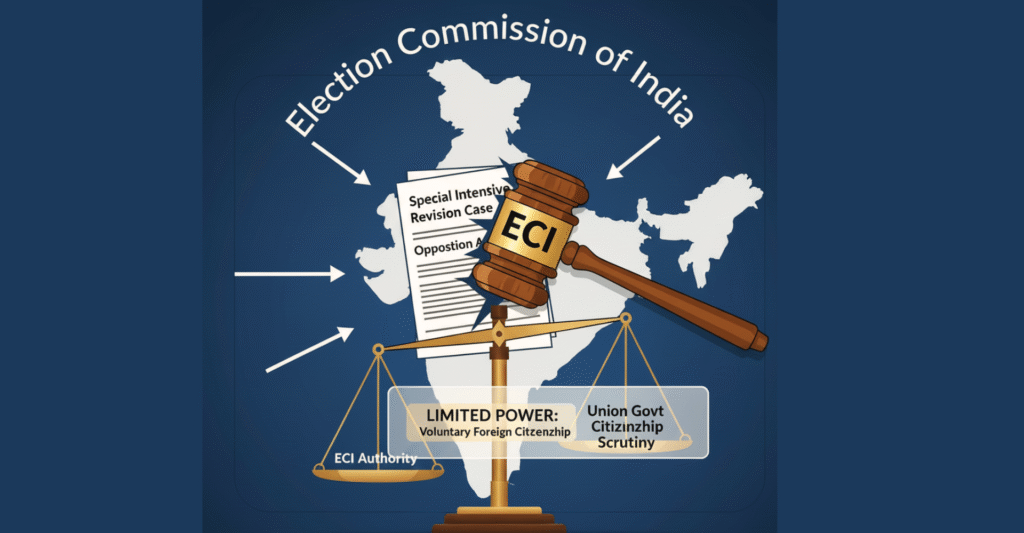
In a significant clarification before the Supreme Court, the Election Commission of India (ECI) countered Opposition claims that only the Union government can scrutinise citizenship. The Commission argued that the Centre’s authority is narrowly limited to examining cases where individuals may have voluntarily acquired foreign citizenship, while electoral verification remains its constitutional mandate.
ECI Says Centre’s Citizenship Scrutiny Power Is Limited
During the hearing on the Special Intensive Revision (SIR) case, the Election Commission emphasised that the Citizenship Act, 1955 does not give the Centre exclusive control over determining citizenship during electoral roll verification. Referring specifically to Section 9, the ECI noted that the Union government’s role is confined to assessing how and when a citizen might have taken foreign citizenship, not to broadly validating voter eligibility.
The Commission argued that SIR is a constitutional exercise intended to maintain accurate, lawful electoral rolls and prevent non-citizens from being enrolled as voters. It also stressed that the process neither exceeds legal boundaries nor interferes with the Centre’s statutory functions.
How the ECI justified the SIR Process?
- Section 9 of the Citizenship Act deals only with termination of citizenship after voluntary foreign citizenship acquisition.
- The Centre’s authority applies specifically to determining the circumstances of such foreign citizenship cases.
- Electoral roll verification remains under the ECI’s constitutional supervision.Opposition claims of “exclusive central authority” were termed incorrect and legally unsound.
- SIR, according to ECI, ensures “clean and credible” voter lists essential for free and fair elections.
- The Commission reiterated that SIR does not declare anyone foreign; it only flags inconsistencies for further legal scrutiny.
- ECI defended the process as neutral, non-political, and fully compliant with constitutional provisions