India Drug-Free by 2029: Amit Shah Sets Out Government Roadmap
India drug-free by 2029 is now a stated target of the Narendra Modi government, with Union Home Minister Amit Shah outlining a three-year roadmap focused on strengthening the country’s fight against narcotics.
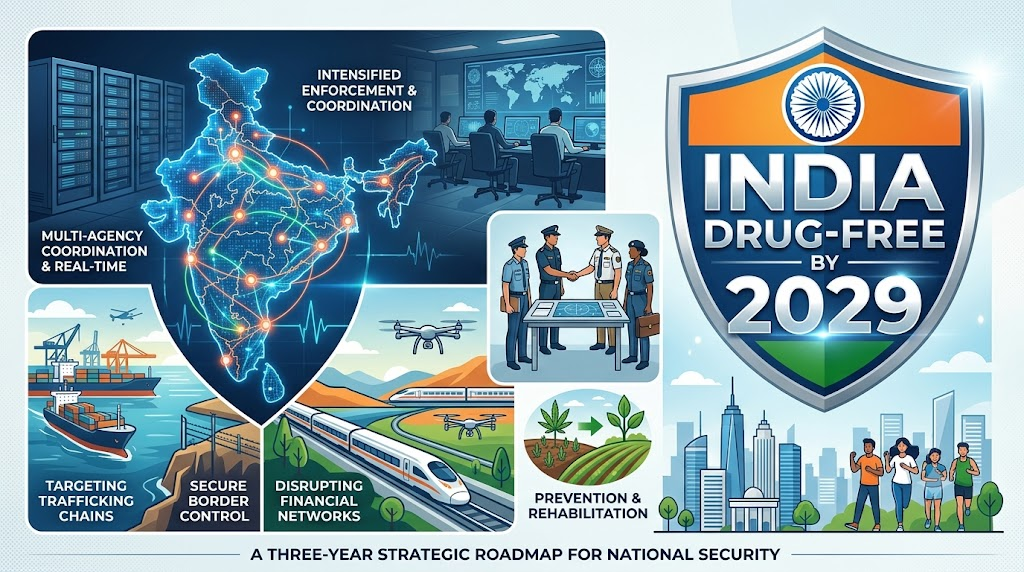
Speaking in Goa, Shah said the government has prepared a roadmap aimed at achieving the target by 2029. The plan puts greater emphasis on disrupting drug trafficking networks, increasing enforcement and improving coordination among agencies involved in the anti-narcotics campaign.
The announcement comes as the government continues to treat drug trafficking as both a law-and-order challenge and a national security concern.
Also Read :- Delhi Satya Niketan Building Collapse: Death Toll Rises to 6 as Rescue Teams Search Rubble
What is the India drug-free by 2029 roadmap?
The India drug-free by 2029 roadmap covers the next three years and is intended to intensify action against the illegal drug trade.
Key points highlighted in the government’s approach include:
- Stronger narcotics enforcement across the country.
- Action against drug trafficking networks, rather than focusing only on individual seizures.
- Greater coordination between central and State agencies.
- Continued efforts to identify and dismantle the financial and logistical networks supporting illegal drugs.
- Increased focus on preventing the movement of narcotics through India’s borders and other trafficking routes.
- A continued push against the cultivation and production of illegal narcotic substances.

Narcotics seizures remain a major focus
The India drug-free by 2029 strategy comes against the backdrop of increased government action and narcotics seizures in recent years.
Amit Shah has repeatedly stressed that agencies must move beyond simply recovering drugs and instead target the complete trafficking chain. This includes identifying suppliers, financiers, transporters and organised networks involved in the illegal trade.
The approach is designed to make enforcement more comprehensive, with intelligence-sharing and coordinated investigations playing an important role.
Why is 2029 significant for India’s anti-drug campaign?
The 2029 deadline gives the government a defined timeframe for implementing the new three-year strategy.
The objective is not limited to increasing the quantity of drugs seized. The broader approach involves drug trafficking prevention, narcotics enforcement, illegal cultivation control, inter-agency coordination and action against organised networks.
Shah’s announcement therefore signals a shift towards measuring the anti-drug campaign through wider disruption of the narcotics ecosystem.
Government intensifies action against drug networks
The India drug-free by 2029 target also places attention on the networks that enable narcotics to reach consumers.
Government agencies are expected to strengthen intelligence-based operations and coordinate investigations to identify connections between different parts of the supply chain.
The strategy also links narcotics control with wider national security efforts because organised drug trafficking can intersect with other forms of criminal activity.
Three-year action plan at the centre of the campaign
- 2026–2029: The government has outlined a three-year period for intensified action.
- Enforcement: Agencies will continue targeting illegal narcotics trafficking and supply networks.
- Coordination: Central and State agencies are expected to work more closely.
- Seizures: Recovering illegal drugs remains a key enforcement measure.
- Network disruption: Greater attention is being placed on the people and organisations behind trafficking operations.
- Prevention: The campaign also seeks to reduce the availability and movement of narcotic substances.
What happens next?
The India drug-free by 2029 target now moves the focus towards implementation of the three-year roadmap. The effectiveness of the strategy will depend on how consistently enforcement agencies coordinate operations, disrupt trafficking networks and prevent the illegal movement and production of narcotics.
Amit Shah’s announcement in Goa puts the 2029 deadline at the centre of India’s latest anti-drug campaign, with the government seeking stronger action against the country’s narcotics trade over the coming three years.