
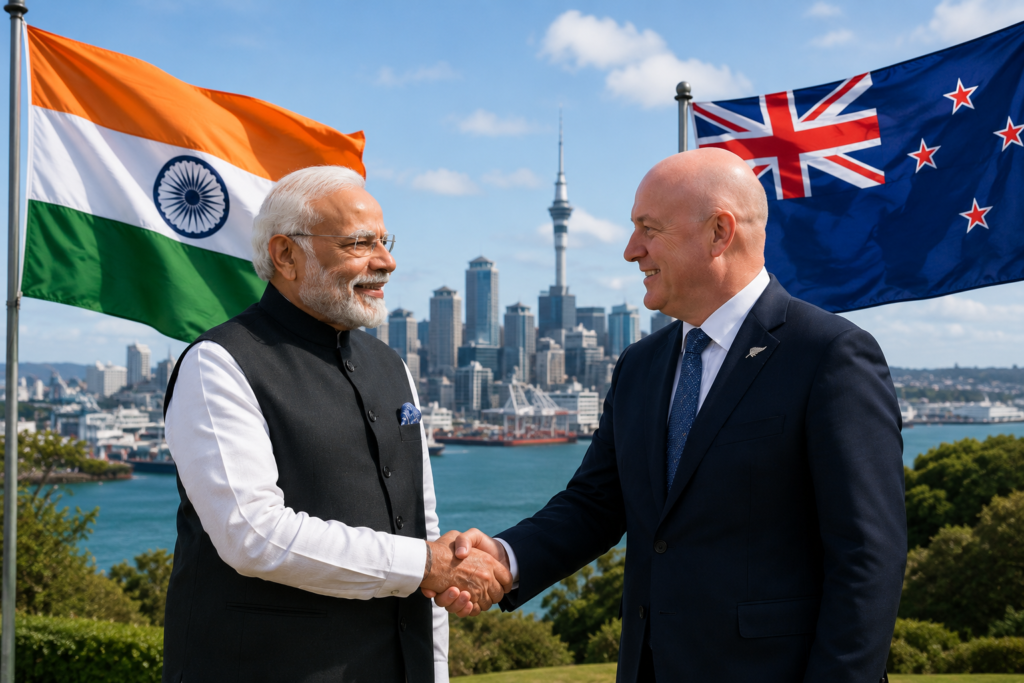
India and New Zealand have taken a major step in their bilateral relationship by elevating ties to a strategic partnership and setting an ambitious target of ₹35,000 crore in trade by 2030.
The development signals that the two countries now want to move beyond traditional diplomatic engagement and build stronger cooperation in trade, investment and the Indo-Pacific region.
Prime Minister Narendra Modi and New Zealand Prime Minister Christopher Luxon also exchanged views on regional and global developments, according to a joint statement.
India and New Zealand Focus on Stronger Trade Ties
Economic cooperation is expected to be a major part of the new India New Zealand Strategic Partnership.
Both countries aim to expand bilateral trade and create new opportunities for businesses. The ₹35,000 crore trade target by 2030 reflects a push to strengthen commercial links and encourage greater participation from companies in both nations.
India’s large consumer market and growing economy offer opportunities for New Zealand businesses. At the same time, Indian companies are increasingly looking at international markets for investment and expansion.
Closer economic cooperation could benefit sectors such as agriculture, food processing, education, technology and other emerging industries.

Modi and Luxon Discuss Indo-Pacific Region
The Indo-Pacific was another important part of the talks between Narendra Modi and Christopher Luxon.
The two leaders reaffirmed their shared commitment to a free, open and prosperous Indo-Pacific region.
The Indo-Pacific has become strategically important because of its major sea routes, growing economies and role in global trade. India has repeatedly supported an open and inclusive regional order.
New Zealand also plays an important role in the wider Pacific region, making closer dialogue between the two countries increasingly significant.
What Does Strategic Partnership Mean?
A strategic partnership indicates a broader and deeper relationship between two countries.
For India and New Zealand, the upgraded partnership is expected to support more regular political engagement and closer cooperation in areas of mutual interest.
It also shows that both governments see greater long-term value in working together at a time when global trade and regional security are rapidly changing.
Education and People-to-People Links Remain Important
New Zealand has long been a popular destination for Indian students. The Indian community also contributes to the country’s social and economic life.
Stronger bilateral relations could further support cooperation in education, skills and professional exchanges.
These people-to-people connections have become an important foundation of India-New Zealand ties and may play a bigger role as the strategic partnership develops.
Also Read: US-Iran Conflict Escalates as Both Sides Exchange Strikes for Second Consecutive Day
A New Phase in India-New Zealand Relations
The decision to elevate bilateral ties comes as India continues to deepen its engagement with countries across the Indo-Pacific.
For New Zealand, stronger relations with India provide an opportunity to engage more closely with one of the world’s major economies.
The India New Zealand Strategic Partnership, combined with the ₹35,000 crore trade goal for 2030, marks a new phase in relations between the two countries. The real focus now will be on how quickly both sides turn these diplomatic commitments into stronger trade, investment and practical cooperation.