Some people become famous because they seek power. Others are remembered because they ask questions that powerful people do not want answered.
Jaswant Singh Khalra belonged to the second group.
A human rights activist from Punjab, Khalra became known for investigating alleged enforced disappearances and secret cremations during the years of militancy and counter-insurgency in the state. His work brought international attention to families who had spent years searching for missing relatives.
His story is not simply about one activist. It is about records, names and the difficult question of what happens when people disappear without explanation.
Who Was Jaswant Singh Khalra?
Jaswant Singh Khalra was born in Punjab and came from a Sikh family with a history of social and political awareness. He later became involved in human rights work and was associated with organisations documenting alleged abuses during Punjab’s violent years.
The 1980s and early 1990s were a deeply troubled period in Punjab. Militancy, terrorist violence and security operations claimed thousands of lives. In the middle of this conflict, many families alleged that their relatives had been taken into custody and never returned.
Khalra began listening to these families.
But he did something more. He started looking for documentary evidence.

The Cremation Records That Changed Everything
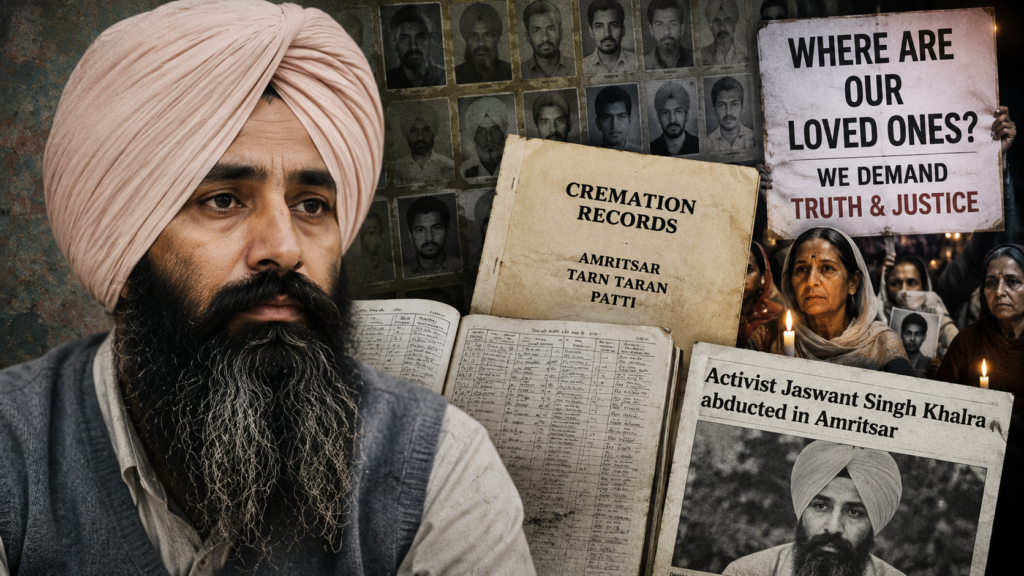
The turning point in Jaswant Singh Khalra’s work came when he and fellow activists examined records from cremation grounds in and around Amritsar district.
They found entries relating to bodies reportedly cremated as “unidentified” or “unclaimed.” Khalra argued that some of these people had previously been taken into police custody and that their families had never been officially told what happened to them.
His investigation focused on cremation records from places including Amritsar, Tarn Taran and Patti.
The findings raised serious questions about alleged extrajudicial killings and secret cremations.
The matter eventually reached India’s legal and investigative institutions. A Central Bureau of Investigation inquiry later examined more than 2,000 cremations at three cremation grounds in Amritsar district, giving significant weight to concerns raised by Khalra and other human rights campaigners.
Why Was His Work So Important?
Before Khalra’s investigation, many families had stories but little official documentation.
A mother could say her son had been taken away. A wife could say her husband never returned. But without records, proving what happened was extremely difficult.
Khalra understood the importance of paperwork.
Cremation registers, dates and official entries could create a trail. His approach turned individual stories of loss into a wider human rights investigation.
This is why he became known as “the man who counted the missing.”
He was not simply counting numbers. Behind every number, he believed, was a person and a family waiting for an answer.
Jaswant Singh Khalra’s International Advocacy
Khalra also spoke about his findings outside India. He travelled abroad and raised concerns about alleged disappearances and unidentified cremations in Punjab.
His public speeches attracted international attention to the issue.
One of the ideas closely associated with Khalra’s legacy is that even in periods of extreme darkness, people must continue searching for the truth. His speeches are still widely shared by human rights groups and members of the Sikh community.
The Abduction of Jaswant Singh Khalra
On September 6, 1995, Jaswant Singh Khalra was abducted from outside his home in Amritsar.
Witness testimony and later court proceedings linked Punjab Police personnel to his abduction and illegal detention.
He never returned home.
Investigations and court proceedings later established that Khalra had been illegally detained and killed. Several police officers were convicted in connection with his abduction and murder.
His disappearance became one of India’s most widely discussed human rights cases.
The Long Fight for Justice
After Khalra disappeared, his wife Paramjit Kaur Khalra and human rights campaigners continued the legal fight.
The case moved through investigations and courts for years. Police personnel were eventually convicted, and higher courts dealt with appeals and sentences in the case.
For Khalra’s family, the legal battle was long and difficult. However, the convictions formally recognised criminal responsibility for his abduction and killing.
The Legacy of Jaswant Singh Khalra
Today, Jaswant Singh Khalra is remembered as one of Punjab’s most prominent human rights activists.
His work helped bring the issue of alleged mass cremations and enforced disappearances into public and legal discussion. The National Human Rights Commission also became involved in proceedings related to unidentified cremations in Punjab.
His research continues to be discussed by journalists, lawyers, academics and human rights organisations.
For the families of the missing, Khalra represented something even more personal: someone who believed their questions deserved answers.
Also Read: Cristiano Ronaldo Biography: From Madeira to Football Greatness
Why Jaswant Singh Khalra’s Story Still Matters
Decades after his death, Khalra’s story continues to attract attention because it raises difficult questions about accountability, state power and the right of families to know what happened to their loved ones.
He worked with records when rumours were everywhere. He searched for names when people had been reduced to numbers.
That is why Jaswant Singh Khalra is still remembered as the man who counted the missing—a man whose search for answers ultimately cost him his life but ensured that thousands of unanswered questions could not simply be forgotten.