
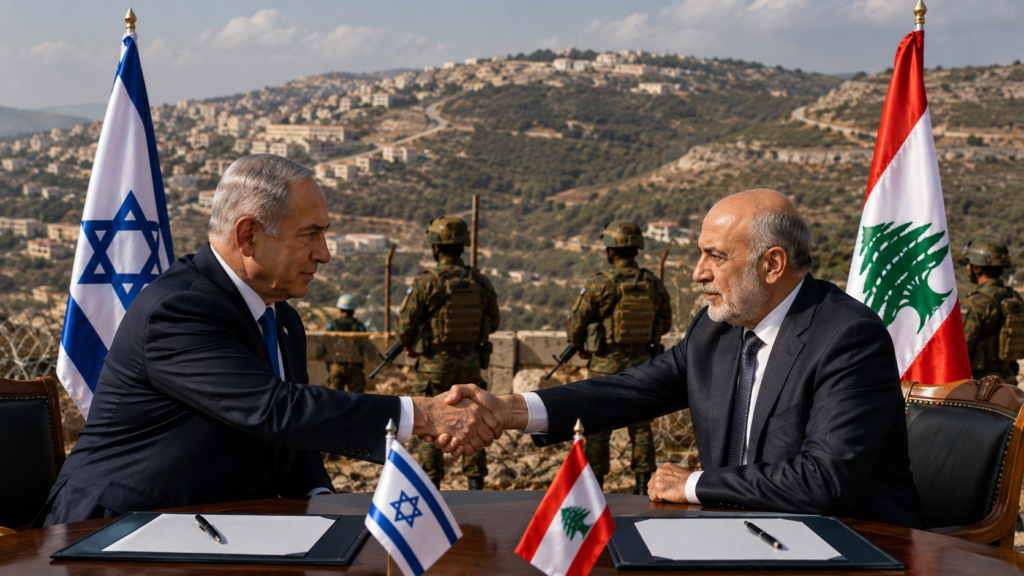
Israel Lebanon Framework Agreement has emerged as a significant diplomatic development after Israel and Lebanon accepted a United States-backed framework designed to reduce military tensions along their shared border. The agreement outlines security measures, a limited redeployment of Israeli forces, strengthened monitoring mechanisms, and continued negotiations aimed at maintaining regional stability.
The framework comes after months of cross-border hostilities and diplomatic efforts involving the United States. Officials from all sides have described the agreement as a step toward lowering tensions while addressing security concerns on both sides of the border.
Also Read :- Operation Amistad: India Launches Emergency Relief Mission for Earthquake-Hit Venezuela
Israel Lebanon Framework Agreement: Key Highlights
- Israel and Lebanon have accepted a United States-backed framework agreement.
- The agreement includes a limited Israeli military pullback from specific areas.
- Security arrangements will be strengthened along the Israel-Lebanon border.
- The United States will continue facilitating implementation and coordination.
- Monitoring mechanisms will be expanded to support compliance with the agreement.
- The framework is intended to reduce cross-border military escalation.
- Further negotiations are expected as implementation moves forward.

What Does the Israel Lebanon Framework Agreement Include?
The Israel Lebanon Framework Agreement establishes several measures intended to improve security conditions along the border.
According to the published framework, the agreement includes:
- A limited redeployment of Israeli forces from designated positions.
- Continued security coordination through internationally supported mechanisms.
- Measures to reduce military activity in sensitive border areas.
- Ongoing diplomatic engagement between the parties with US involvement.
- Support for monitoring implementation through existing international arrangements.
The agreement does not represent a final peace treaty but serves as a framework for managing security concerns and preventing further escalation.
Why Was the Agreement Reached?
The Israel Lebanon Framework Agreement follows months of armed exchanges and heightened instability along the Israel-Lebanon border.
The objective of the framework is to:
- Lower the risk of further military confrontation.
- Improve stability in border communities.
- Support continued diplomatic dialogue.
- Establish confidence-building measures between the two sides.
- Strengthen international monitoring of the situation.
The United States played a central role in facilitating discussions that led to the agreement.
Role of the United States
The United States acted as the principal mediator during negotiations leading to the Israel Lebanon Framework Agreement.
Its responsibilities include:
- Facilitating diplomatic communication.
- Supporting implementation of agreed measures.
- Coordinating with regional and international stakeholders.
- Encouraging continued negotiations.
- Assisting in efforts to maintain border stability.
US officials have stated that the agreement is intended to reduce immediate security risks while creating conditions for continued diplomatic engagement.
Does the Agreement End the Conflict?
No. The Israel Lebanon Framework Agreement is not a permanent peace agreement. It is a security and diplomatic framework designed to reduce tensions, implement limited military adjustments, and provide a structured process for further negotiations.
Expected Impact of the Agreement
The Israel Lebanon Framework Agreement is expected to:
- Reduce the likelihood of immediate cross-border clashes.
- Improve security coordination in sensitive areas.
- Support monitoring efforts by international partners.
- Create opportunities for continued diplomatic dialogue.
- Help stabilize conditions for civilians living near the border.
Implementation will depend on continued cooperation among the parties and adherence to the agreed security measures.
Current Official Status
The Israel Lebanon Framework Agreement has been accepted by both Israel and Lebanon with mediation from the United States. Initial implementation includes a limited Israeli troop redeployment, strengthened security arrangements, and expanded monitoring mechanisms.
Authorities from all sides have indicated that additional discussions will continue as the framework is implemented. The agreement remains focused on reducing border tensions, improving regional stability, and preventing further military escalation through ongoing diplomatic engagement.