
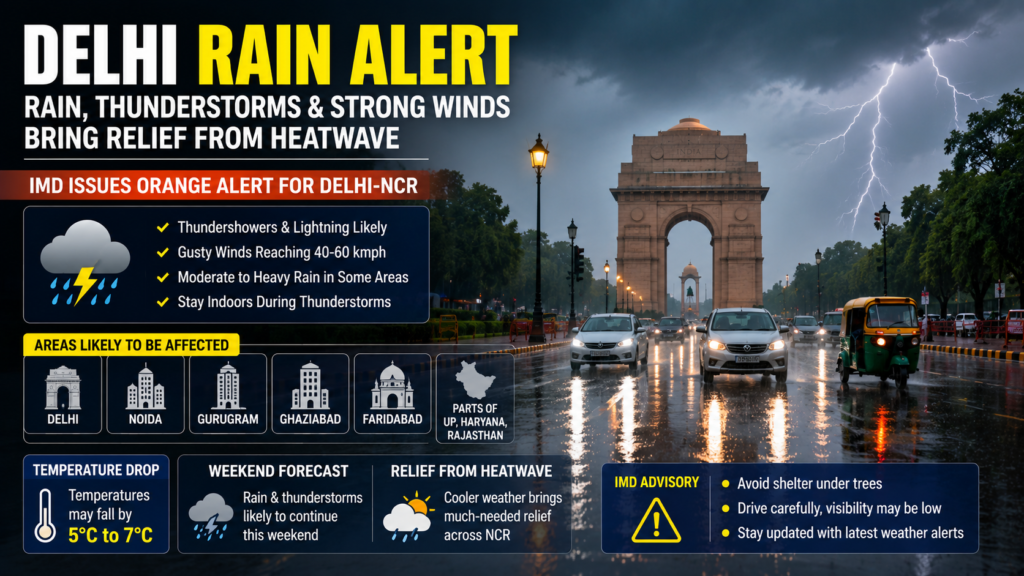
Delhi Rain Alert has become the most discussed weather update across North India as sudden showers, thunderstorms and powerful winds brought much-needed relief from the intense heatwave conditions that had gripped the national capital and surrounding regions.
Residents who were struggling with soaring temperatures and uncomfortable humidity witnessed a dramatic weather change as dark clouds covered the skies and strong winds swept across several parts of Delhi-NCR. The sudden shift not only reduced temperatures but also raised fresh questions about how long the pleasant weather conditions will continue.
According to the India Meteorological Department (IMD), more weather activity is expected over the coming days, keeping millions of residents on alert.
Advertisement

Also Read :- Tata Tiago Facelift 2026 Launched in India: More Premium, More Features and Bigger Value Than Before
Delhi Rain Alert: Why Has IMD Issued an Orange Alert?
The latest Delhi Rain Alert comes after the IMD issued an Orange Alert for Delhi and adjoining areas due to the possibility of thunderstorms, lightning, moderate rainfall and gusty winds.
Meteorologists have observed favorable atmospheric conditions that are supporting widespread weather activity across North India. Moisture-laden winds and changing pressure systems have combined to create conditions suitable for rainfall and thunderstorms.
The Orange Alert indicates that residents should remain cautious as weather conditions could change rapidly within a short period.
While rainfall is expected to bring relief, strong winds and lightning may also create temporary disruptions in some areas.
Advertisement

Delhi Rain Alert Brings Significant Temperature Drop
One of the biggest effects of the current Delhi Rain Alert has been the sharp decline in temperatures.
Just days ago, several parts of Delhi-NCR were witnessing extreme heat, with temperatures rising to uncomfortable levels. The combination of rainfall and cloud cover has now significantly reduced daytime temperatures.
According to weather officials, temperatures may fall by as much as 5 to 7 degrees Celsius compared to recent heatwave conditions.
This sudden cooling has offered relief to residents who were struggling with prolonged periods of intense heat.
The temperature drop has also improved outdoor conditions for commuters, office workers and students across the region.
Areas Likely to Receive Rainfall
The ongoing Delhi Rain Alert is not limited to the national capital alone.
Several surrounding regions are also expected to experience rainfall and thunderstorm activity.
Areas likely to be affected include:
- Delhi
- Noida
- Greater Noida
- Gurugram
- Ghaziabad
- Faridabad
- Parts of Haryana
- Western Uttar Pradesh
- Nearby regions of Rajasthan
Weather experts suggest that rainfall intensity may vary from one location to another, with some areas witnessing brief showers while others could experience more sustained rainfall.
Residents are advised to monitor local weather updates regularly.
Strong Winds Could Create Temporary Disruptions
While the Delhi Rain Alert has largely been welcomed by residents, strong winds accompanying the rainfall may cause localized disruptions.
The IMD has warned that gusty winds could reach significant speeds during thunderstorm activity.
Possible impacts include:
- Falling tree branches
- Traffic congestion
- Reduced visibility
- Temporary power disruptions
- Waterlogging in low-lying areas
- Delays in transportation services
Authorities have advised citizens to avoid standing under trees and unstable structures during thunderstorms.
Motorists are also being encouraged to drive carefully, especially during periods of reduced visibility.
Delhi Rain Alert Offers Relief from Heatwave Conditions
Perhaps the most positive outcome of the current Delhi Rain Alert is the relief from extreme heatwave conditions.
For several days, residents across Delhi-NCR had been dealing with rising temperatures and hot winds that made outdoor activities increasingly difficult.
The arrival of rain has improved air quality in some areas while reducing surface temperatures across the region.
Many residents have welcomed the cooler weather after enduring prolonged periods of scorching heat.
Weather experts note that such pre-monsoon rainfall events often play a crucial role in easing heatwave intensity before the full arrival of the southwest monsoon.
What IMD Forecasts for the Weekend
The latest Delhi Rain Alert suggests that weather activity may continue through the weekend.
According to forecasts, intermittent rainfall, cloud cover and thunderstorms are likely to persist in various parts of Delhi-NCR.
The possibility of scattered showers throughout the weekend means residents may continue to enjoy relatively cooler temperatures compared to recent weeks.
However, meteorologists caution that weather patterns remain dynamic, and rainfall distribution may vary significantly across different locations.
Some areas may receive heavier showers, while others could experience only brief rainfall spells.
Impact on Daily Life and Commuters
The ongoing Delhi Rain Alert is expected to influence daily routines across the region.
Morning and evening commuters may encounter traffic delays due to wet roads and reduced visibility.
At the same time, the cooler weather is likely to make outdoor travel considerably more comfortable than during recent heatwave conditions.
Schools, offices and businesses are expected to function normally, though residents are encouraged to plan their travel with weather conditions in mind.
Umbrellas and rain gear may once again become essential items for those spending time outdoors.
Is the Monsoon Arriving Early?
A common question being asked during the current Delhi Rain Alert is whether these showers indicate an early monsoon arrival.
Weather experts clarify that the present rainfall activity is primarily linked to pre-monsoon weather systems rather than the official onset of the southwest monsoon over Delhi.
However, these conditions often serve as an indication that seasonal weather transitions are underway.
Meteorologists continue to monitor atmospheric developments closely and will provide further updates regarding monsoon progression in the coming days.