Indian politics has always been dynamic, diverse, and deeply connected to regional identities. In 2026, the debate around Regional Parties vs National Parties has become more important than ever. While national parties continue to dominate parliamentary politics and national narratives, regional parties are strengthening their influence across states and playing a major role in shaping coalition politics, governance, and voter behavior.
The balance of power between regional and national parties is constantly changing. Some political experts believe national parties are becoming stronger due to centralized leadership and large-scale campaigns. Others argue that regional parties understand local issues better and maintain stronger emotional connections with voters. The reality is that both sides are influencing Indian Politics Today in different but powerful ways.

Why Regional Parties Are Becoming More Powerful in India
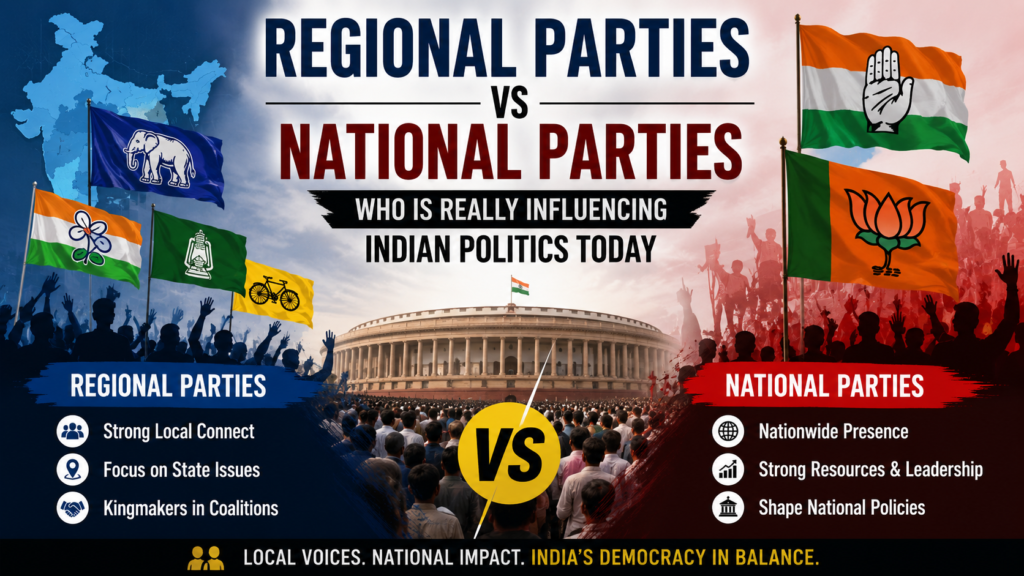
One of the biggest reasons regional parties are gaining influence is their strong connection with local communities. Unlike national parties, regional parties focus deeply on state-specific issues such as local development, language, employment, agriculture, caste equations, and regional identity. This local focus allows them to build loyal voter bases.
In many Indian states, regional leaders are seen as more accessible and relatable than national leaders. Parties like Dravida Munnetra Kazhagam in Tamil Nadu, Trinamool Congress in West Bengal, and Aam Aadmi Party in Delhi and Punjab have shown how regional parties can dominate state politics through targeted governance and welfare policies.
Another major reason behind the rise of regional parties is coalition politics. In several elections, no single national party has achieved complete dominance across all states. This creates opportunities for regional parties to become kingmakers in alliances and coalition governments. As a result, the debate around Regional Parties vs National Parties has become central to understanding modern Indian democracy.
Regional parties are also highly effective at protecting cultural and linguistic identities. In a country as diverse as India, many voters prefer parties that represent local traditions and regional aspirations. This emotional connection often gives regional parties a significant advantage in state elections.
Social media has also helped regional leaders expand their influence. Earlier, national parties had a communication advantage due to larger resources. Today, regional leaders can directly connect with voters through digital platforms and local campaigns. This has strengthened their visibility in Indian Politics Today.
How National Parties Still Control the Bigger Political Narrative
Despite the growth of regional parties, national parties continue to hold major influence in Indian politics. National parties operate on a much larger scale and focus on national security, economic growth, foreign policy, infrastructure, and nationwide welfare schemes. Their broader reach gives them significant visibility during general elections.
Bharatiya Janata Party and Indian National Congress remain the two most recognized national political forces in India. These parties possess strong organizational structures, larger financial resources, and extensive media coverage. This gives them an advantage in national-level campaigning.
National parties also benefit from leadership branding. Charismatic national leaders often influence voters beyond regional boundaries. In many cases, voters support national parties because they believe strong central leadership can ensure stability and economic progress.
Another key advantage is policy coordination. National parties can implement large-scale schemes across multiple states. Programs related to infrastructure, digital growth, healthcare, education, and welfare often create a strong national narrative that regional parties may struggle to match.
However, national parties sometimes face criticism for being disconnected from local issues. This is where regional parties gain ground. The conflict between centralized governance and regional representation continues to define the discussion around Regional Parties vs National Parties.
Indian Politics Today Is Shaped by Both Forces
The political reality of India in 2026 is not about one side completely defeating the other. Instead, Indian Politics Today is being shaped by a combination of national influence and regional power.
In parliamentary elections, national parties usually dominate media attention and leadership debates. But in state elections, regional parties often outperform national rivals because they understand local voter priorities better.
This dual structure reflects the complexity of Indian democracy. National parties provide broader policy direction, while regional parties ensure local representation and accountability. Together, they create a political system where both national unity and regional diversity continue to coexist.
Young voters are also changing political dynamics. Many younger Indians care about jobs, education, technology, and development more than traditional political loyalties. This shift may force both national and regional parties to adapt their strategies in the coming years.
Conclusion
The debate around Regional Parties vs National Parties is shaping the future of democracy in India. Regional parties are becoming more influential because of their local focus, cultural connections, and grassroots presence. At the same time, national parties continue to dominate broader political narratives through centralized leadership and nationwide campaigns.
In reality, both political forces are essential to understanding Indian Politics Today. National parties provide scale and stability, while regional parties protect local interests and strengthen democratic representation. The future of Indian politics will likely depend on how effectively these two forces compete, cooperate, and evolve in an increasingly diverse and politically aware nation.