Bangladesh witnessed a tense and violent night as protests erupted across major cities following the death of student leader Sharif Osman Hadi. What began as mourning quickly escalated into unrest, with anti-India slogans, arson attacks, and clashes with police, deepening political uncertainty in the country.
Protests Turn Violent After Hadi’s Death
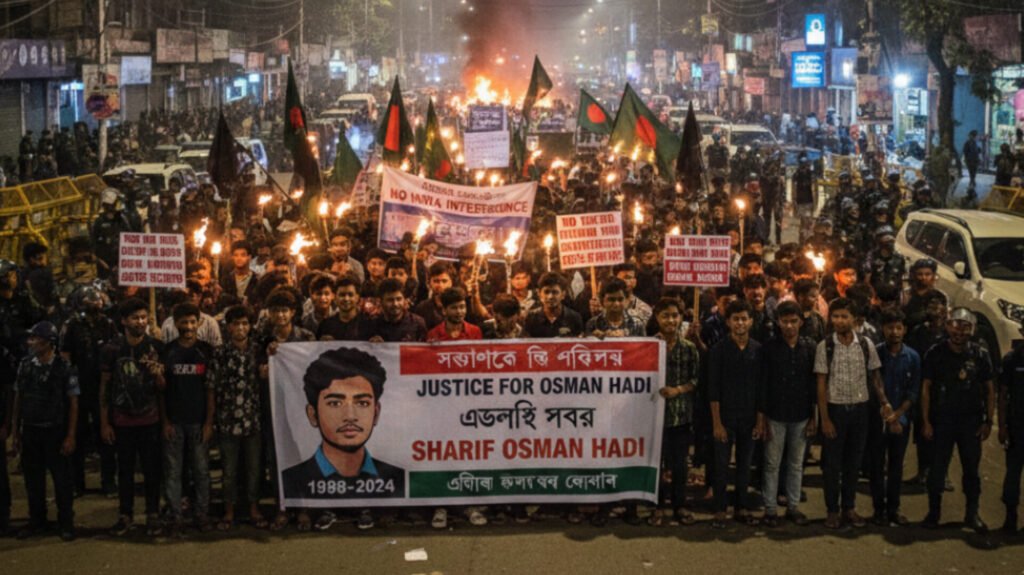
Bangladesh witnessed widespread unrest late Thursday into Friday after Sharif Osman Hadi, a prominent youth leader and spokesperson for the pro-democracy platform Inqilab Mancha, died in a Singapore hospital from injuries sustained in an assassination attempt last week.
- Thousands of protesters took to the streets in Dhaka, Chattogram and other cities, blocking highways and clashing with authorities.
- Anti-India slogans and sentiment surged as crowds attempted to march on Indian diplomatic premises, prompting police to use tear gas.
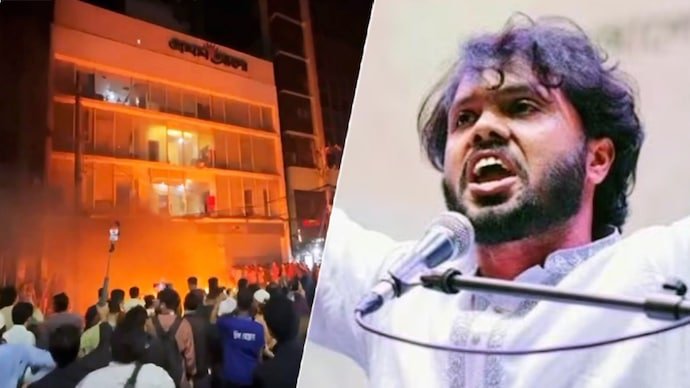
- Vandalism and arson erupted, with the offices of major newspapers Prothom Alo and The Daily Star set ablaze, trapping journalists who were later evacuated.
- Protesters also torched local political offices, including an Awami League office in Rajshahi, and attacked the residence of a former minister.
Interim government chief Muhammad Yunus declared a day of national mourning and vowed a transparent investigation, while security forces were deployed to contain violence.
Who was Sharif Osman Hadi?
Sharif Osman Hadi was a prominent Bangladeshi student leader and political activist who rose to national attention during the 2024 student-led uprising that reshaped Bangladesh’s political landscape. A key organiser and spokesperson of the youth platform Inqilab Mancha, he later emerged as an independent political voice ahead of the 2026 elections. Known for his strong anti-establishment and critical views on foreign influence, Hadi had a large youth following. He was shot in Dhaka in December 2025, later dying in a Singapore hospital. His death triggered nationwide protests and anti-India slogans, plunging Bangladesh into renewed unrest.
Key Developments in the Unrest
Hadi was a leading figure in the 2024 student uprising that ousted former Prime Minister Sheikh Hasina and was preparing to stand in the February 2026 election. He was shot by unknown assailants on Dec. 12 in Dhaka and later died in Singapore, igniting public outrage.
Spread of protests and violence
- Demonstrators blocked major intersections and highways across cities.
- Student groups staged rallies at Dhaka University and other hubs, demanding justice and accountability.
- Police intervened to disperse protesters near the Indian Assistant High Commission in Chattogram.
Anti-India sentiment and diplomatic strain
Protesters alleged Hadi’s attackers fled to India and demanded action, raising pressure on the interim government.
India suspended visa services at some diplomatic centres earlier amid security concerns.
The death of Sharif Osman Hadi has reignited deep political fault lines in Bangladesh, transforming grief into widespread unrest that combines demands for justice, anti-India rhetoric, and clashes with authorities. As the country heads toward elections, the situation remains highly volatile, with potential implications for domestic stability and regional diplomatic ties, particularly with India.