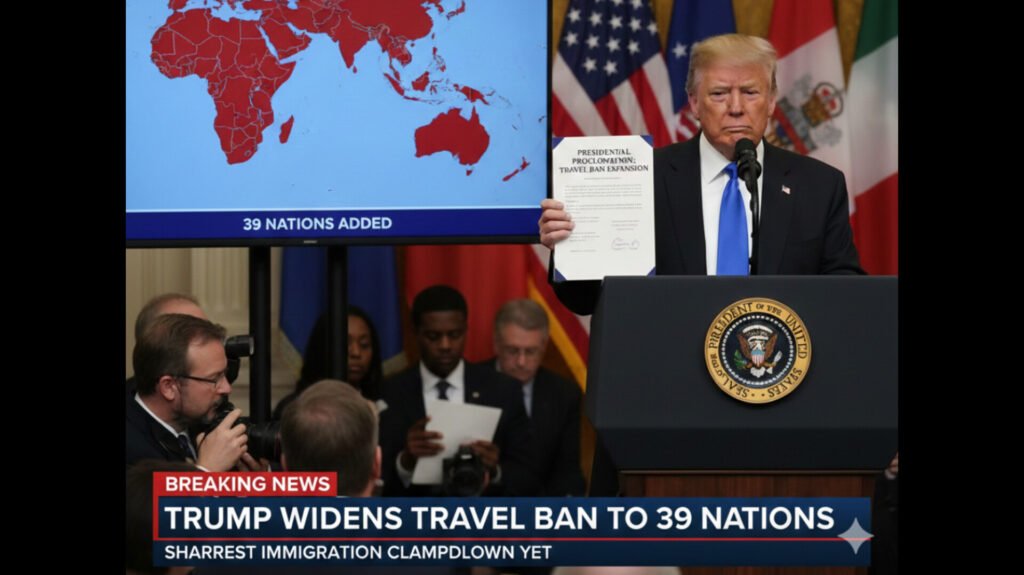
In a sweeping move that signals a tougher stance on immigration, US President Donald Trump has expanded America’s travel restrictions to 39 countries. The decision, announced through a presidential proclamation, dramatically widens the scope of full and partial bans, citing national security concerns.
Travel ban expanded: What the New Proclamation means
President Donald Trump on Tuesday signed a proclamation increasing the number of countries facing US travel restrictions from 19 to 39. According to the White House, the move is aimed at countries that show “severe deficiencies in screening, vetting, and information-sharing.”
Seven nations—Laos, Sierra Leone, Burkina Faso, Mali, Niger, South Sudan and Syria—have been added to the full travel ban list. Laos and Sierra Leone were earlier under partial restrictions but now face a complete suspension of entry. The proclamation also places limits on individuals holding Palestinian Authority-issued travel documents.
At the same time, the administration lifted a ban on nonimmigrant visas for citizens of Turkmenistan, while still keeping entry suspensions for Turkmen nationals. Exceptions remain in place for lawful permanent residents, existing visa holders, select visa categories and individuals whose entry is deemed to serve US national interests.
Countries Under Partial Restrictions and Policy Context
- Newly added partial restriction countries: Angola, Antigua and Barbuda, Benin, Cote d’Ivoire, Dominica, Gabon, The Gambia, Malawi, Mauritania, Nigeria, Senegal, Tanzania, Tonga, Zambia and Zimbabwe.
- Reason cited: Inadequate vetting systems and weak information-sharing mechanisms
- Policy backdrop: Comes amid a broader immigration crackdown, including pauses on asylum decisions and reviews of cases approved under the Biden administration.
- Security trigger: The move follows a Washington, DC shooting involving an Afghan national who had previously resettled in the US
- The expansion aligns with recommendations reportedly made earlier this month by Homeland Security Secretary Kristi Noem to significantly widen the list of restricted countries.
Trump’s latest proclamation revives and expands a policy approach first seen during his initial term, when travel bans on several countries sparked global controversy and legal battles. With immigration once again at the center of US politics, the expanded ban underscores the administration’s hardline stance—one likely to face renewed scrutiny both domestically and internationally.