
Short Summary
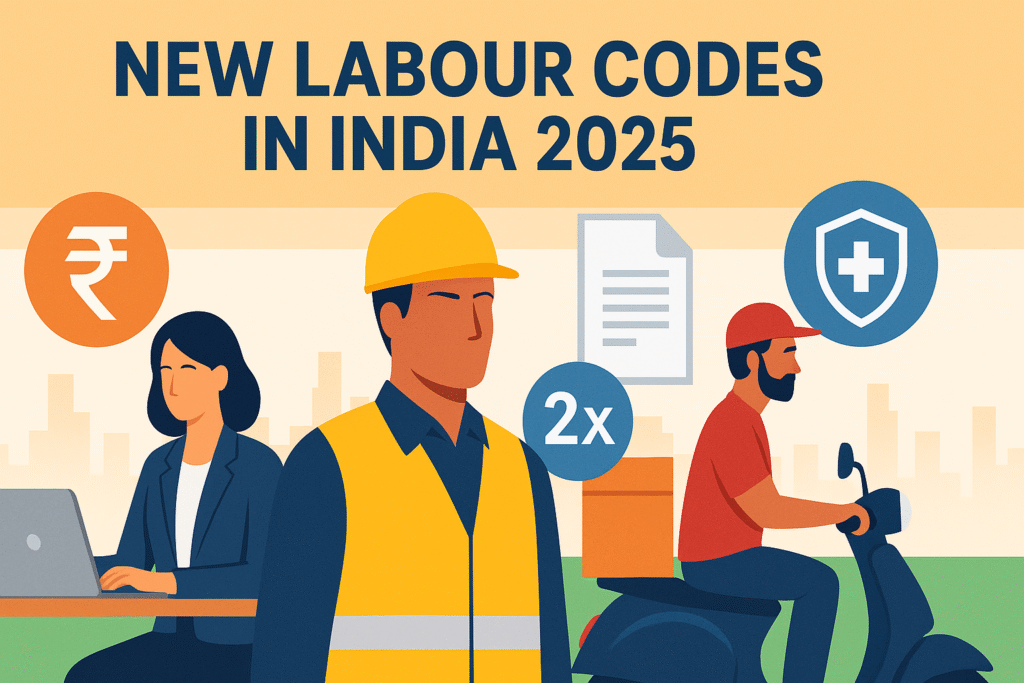
India has implemented four new Labour Codes that modernize the country’s workforce rules. Key changes include a universal minimum wage, early gratuity for fixed-term employees, formal recognition of work-from-home, double overtime pay, and expanded social security for gig and platform workers. The new rules also improve workplace safety, mandate appointment letters, and introduce a national migrant-worker database. Overall, the reforms aim to simplify 29 older laws into a clearer system that protects workers while supporting business efficiency.
Read In Detail
New Delhi, 22 November 2025 — India’s long-awaited labour reform has moved forward as the government begins implementing the four new Labour Codes. These codes consolidate 29 previous labour laws into a modern, simplified system designed to protect workers while reducing compliance burden for businesses.
Minimum Wage for All Workers
The Code on Wages introduces a universal minimum wage applicable to all sectors — organised and unorganised. The new structure also creates a National Floor Wage, below which no state may set its wage rate.
Highlights:
- Universal minimum wage
- Standard definition of “wages”
- Double overtime pay
- Stronger income protection
Early Gratuity for Fixed-Term Employees
For the first time, fixed-term employees are eligible for gratuity after just one year of service, replacing the earlier five-year requirement.
What changes:
- Gratuity eligibility reduced to 1 year for fixed-term roles
- A Re-skilling Fund will offer financial support to retrenched workers
Work-From-Home (WFH) Legally Recognised
WFH has now been formally included in labour regulations, especially benefiting employees in the IT and service sectors.
Key points:
- WFH allowed under employer-employee agreement
- Clear framework for flexible working
Overtime Pay at Double Rate
Employees working beyond regular hours must receive twice the daily wage.
Provisions:
- 8-hour standard workday
- 48-hour weekly limit
- Mandatory employee consent for overtime
Social Security for Gig & Platform Workers
Gig workers like delivery riders, drivers, and freelancers are now included under social security protection.
Coverage includes:
- Health benefits
- Old-age security
- Maternity support
- Disability assistance
A new Social Security Fund will be created for these workers.
Safety Rules & Night Shifts for Women
The OSHWC Code introduces improved safety norms and allows women to work night shifts with mandatory employer safeguards.
Included:
- Safe transport for women working night shifts
- Free annual health check-ups
- Workplace safety committees
Better Protection for Migrant & Unorganised Workers
The new laws require:
- A national migrant-worker database
- Mandatory appointment letters
- Compensation for workplace injuries
Why This Reform Matters
The four labour codes — Wages, Industrial Relations, Social Security, and Occupational Safety — mark India’s biggest labour overhaul in decades. They aim to boost worker welfare, increase transparency, and improve ease of doing business.